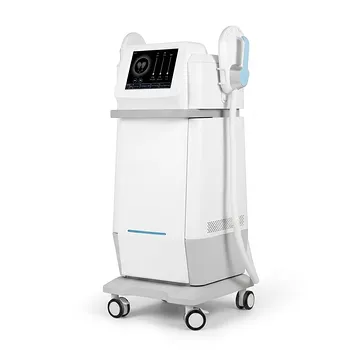
RF body contouring is considered suitable for all skin phototypes because it heats tissue through electrical impedance, not melanin absorption. Unlike many light-based systems, RF energy does not depend on a chromophore that varies with pigmentation, so darker skin does not inherently absorb more energy at the epidermis. This substantially reduces the risk of pigment-related complications, although incorrect settings, poor coupling, excessive heating, or inadequate cooling can still cause burns or post-inflammatory hyperpigmentation.
RF is broadly phototype-independent, but it is not risk-free. Lower frequencies generally support deeper energy deposition, while higher frequencies tend to concentrate heating more superficially; however, electrode design, tissue properties, power, treatment time, and cooling determine the actual treatment depth.
Why RF Is Suitable for Different Skin Phototypes
RF Does Not Target Melanin
RF body contouring uses alternating electrical current to move charged particles and interact with water-containing tissue. The resulting resistance, or impedance, converts electrical energy into heat.
This differs from lasers and intense pulsed light, which rely substantially on optical absorption by chromophores such as melanin and hemoglobin. Because melanin is not the primary target of RF, skin pigmentation does not inherently increase epidermal RF absorption.
Lower Pigment-Related Risk
In darker skin, excessive optical absorption by melanin can increase the risk of epidermal injury and post-inflammatory hyperpigmentation. RF avoids that specific chromophore-dependent mechanism.
This makes RF a useful option across Fitzpatrick skin types and ethnicities, provided the device is clinically appropriate and operated within validated parameters.
Phototype Independence Does Not Mean Universal Safety
RF can still produce excessive thermal injury. The main risks relate to temperature, energy density, treatment duration, electrode contact, movement, and cooling, rather than to melanin concentration.
Professional systems may use contact cooling, temperature controls, and real-time impedance monitoring to help limit superficial overheating and maintain consistent energy delivery.
How RF Reaches Subcutaneous Tissue
Tissue Impedance Creates Heat
As RF current passes through tissue, resistance to that current produces thermal energy. Tissue composition matters because skin, fat, connective tissue, and muscle have different electrical properties.
The treatment effect is therefore shaped by the distribution of current and the location of the highest energy dissipation, rather than by optical color.
Lower Frequencies Generally Penetrate Deeper
Within comparable RF delivery systems, lower operating frequencies generally allow current to propagate farther into tissue before dissipating, supporting deeper heating of subcutaneous fat and connective structures.
Higher frequencies tend to produce more localized, superficial heating. This is why frequency selection is commonly aligned with the intended target: deeper settings for body contouring and more superficial settings for dermal tightening.
Frequency Is Not a Depth Dial by Itself
The statement that penetration depth is simply inversely proportional to frequency is a useful general rule, but it is incomplete. Actual energy deposition depends on frequency together with electrode configuration, geometry, coupling, tissue hydration, conductivity, dielectric properties, power, and exposure time.
For this reason, two devices operating at different frequencies cannot be compared by frequency alone. Their delivery architecture may produce different thermal profiles even when their nominal frequencies appear similar.
How Device Configuration Changes Treatment Depth
Monopolar and Unipolar Delivery
Monopolar systems typically use an active treatment electrode and a return electrode, allowing current to travel through a larger tissue volume. Depending on the device design and operating frequency, this can support deeper volumetric heating.
Some systems described as unipolar use a single active electrode and a return path through the body or device architecture. Their clinical depth depends heavily on the specific electrical design, not merely on the label.
Bipolar Delivery
Bipolar systems position two electrodes near one another. Current travels between them over a more limited path, which generally creates a more controlled and localized heating zone.
This configuration is often used when the intended target is relatively superficial, such as the dermis or subdermal interface. It may be less suitable for reaching deeper adipose tissue unless the system is specifically engineered for that purpose.
Cooling Protects the Epidermis
Contact cooling helps keep the skin surface below the temperature reached by deeper target tissues. This creates a thermal gradient that allows the operator to pursue subdermal heating while reducing superficial injury.
Cooling does not eliminate risk. It must work together with appropriate energy settings, continuous movement where required, adequate coupling, and temperature monitoring.
Matching Frequency to the Clinical Target
Deeper Body Contouring
Body contouring protocols generally require energy to reach subcutaneous adipose tissue and associated connective structures. Lower-frequency configurations and suitable electrode geometries are commonly selected when a deeper thermal zone is needed.
The intended depth is usually in the subcutaneous treatment range rather than deep muscle or visceral tissue. Device-specific engineering and treatment protocols determine whether that target is actually reached.
Superficial Skin Tightening
Higher-frequency or more localized configurations can concentrate heat in the dermis and superficial subdermal layers. These applications are directed toward collagen contraction and remodeling rather than substantial adipose-tissue disruption.
Controlled heating can produce immediate collagen contraction followed by longer-term remodeling and neocollagenesis over subsequent weeks.
Controlled Thermal Targets
Professional RF systems are designed to deliver a controlled thermal response rather than indiscriminate heating. Treatment protocols may target subdermal temperatures around 40°C to 42°C for collagen-related effects, although the appropriate range depends on the device, indication, and manufacturer protocol.
Temperature limits and feedback systems help prevent the superficial skin from exceeding safe levels.
Understanding the Trade-offs
RF Reduces One Risk, Not Every Risk
RF does not carry the same chromophore-related pigmentation risk as many light-based treatments, but it can still cause pain, erythema, burns, altered sensation, or pigmentary changes if excessive heat is delivered.
The correct conclusion is that RF is generally phototype-independent, not that every RF treatment is automatically safe for every person or body area.
Frequency Alone Cannot Guarantee Depth
A lower frequency may favor deeper propagation, but tissue properties and applicator design can dominate the final thermal pattern. Power, exposure time, electrode pressure, treatment motion, and the presence of cooling also affect the depth and size of the heated zone.
Claims such as a fixed penetration depth should therefore be treated cautiously unless they are supported by device-specific testing.
Clinical Controls Are Essential
Real-time impedance monitoring can detect changes in tissue contact or electrical resistance and may reduce power when preset conditions are reached. Automatic temperature limiting, surface cooling, and appropriate applicator movement provide additional safeguards.
These features support safety, but they do not replace trained operation, contraindication screening, skin inspection, and adherence to the manufacturer’s protocol.
Making the Right Choice for Your Goal
The appropriate RF system should be selected by its complete energy-delivery design, not by frequency alone.
- If your primary focus is treating all skin phototypes: Choose an RF platform whose heating mechanism is independent of melanin and whose protocol includes temperature control, epidermal cooling, and trained clinical operation.
- If your primary focus is deeper body contouring: Select a system engineered for subcutaneous heating, with an appropriate lower-frequency or deep-delivery configuration and validated treatment-depth data.
- If your primary focus is superficial skin tightening: Use a configuration designed to concentrate controlled heat in the dermal and superficial subdermal layers rather than assuming a deep-fat treatment will provide the same effect.
- If your primary focus is minimizing thermal injury: Prioritize real-time temperature or impedance feedback, reliable electrode coupling, cooling, and protocols that control power, exposure time, and applicator movement.
RF is broadly suitable across skin phototypes because it is electrically driven rather than melanin-driven, while safe and effective penetration depends on the interaction of frequency, device design, tissue properties, and clinical control.
Summary Table:
| Factor | Safety | Depth |
|---|---|---|
| Mechanism | Electrical impedance (not melanin) | Frequency & electrode design |
| Risk | Minimal pigment-related; still thermal risk | Lower frequency = deeper; higher = superficial |
| Skin types | Suitable for all Fitzpatrick types | Not a fixed depth; dependent on device |
Elevate your clinic with professional RF body contouring equipment. At BELIS, we provide advanced systems (like RF Cavitation) used by top clinics and salons. Our portfolio includes laser, IPL, and more. Contact us today at #ContactForm to explore how BELIS can help you expand services and increase revenue.
Related Products
- EMSlim Neo Nova Body Sculpting EMS Sculpting Machine
- Cryolipolysis Fat Freezing Machine and Ultrasonic Cavitation Device
- Ultrasonic Cavitation Radiofrecuency Machine for Body Slimming
- EMS Body Sculpting Slimming Machine EMSlim Body Slimming Machine
- EMSlim RG Laser Body Sculpting and Slimming Machine
People Also Ask
- How do RF body sculpting devices target subcutaneous fat & tighten skin?
- What is the biological mechanism of action by which radiofrequency (RF) energy achieves body sculpting and cellulite reduction? Discover how controlled heating remodels collagen, influences fat, and smooths skin.
- What anatomical mechanisms cause lower face and submental contour loss, and how do body sculpting and RF technologies address jowls and neck laxity? Discover the key causes and non-surgical solutions.
- How can aesthetic practitioners accurately differentiate between muscular hypertrophy and subcutaneous fat accumulation when evaluating patients for calf or lower face contouring using body sculpting equipment?
- How does the cellular differentiation process of subcutaneous fat inform the mechanism of action behind non-invasive body sculpting equipment such as cryolipolysis and RF cavitation devices? Key insights for clinical practice