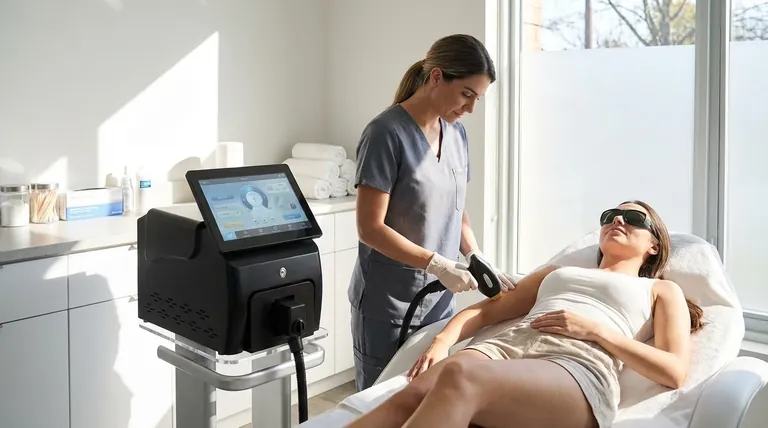
The Patient's Paradox
A client has just completed their first laser hair removal session. They go home, wait a few days, and look in the mirror. The hair is still there. In some cases, it even looks like it's growing.
Doubt creeps in. "Did it work? Was it worth the money?"
This is the central paradox of laser hair removal. The most potent signs of success are not immediate or intuitive. They unfold quietly, beneath the skin, and reveal themselves on a biological timeline, not a human one. Understanding this process is the key to recognizing victory, even when it looks like nothing is happening.
The First Data Points: Signals During Treatment
The earliest evidence that the technology is working is sensory. It’s a confirmation that a precise physical reaction has occurred.
The Scent of Progress
During a session, a faint smell of singed hair is not a side effect; it is the first data point. It confirms that the laser's energy has found its target—the melanin in the hair shaft—and converted light into the precise thermal energy needed to damage the follicle.
The Skin's Confirmation
Immediately after, slight redness or small bumps around the follicles (perifollicular edema) may appear. This is not just irritation. It's a visible confirmation from the skin itself, an inflammatory response that says, "A significant thermal event has occurred here." It's a sign the follicle has been successfully treated.
The Deceptive Interlude: What Happens Between Sessions
The most definitive proof of efficacy appears in the weeks following treatment. This is where expectations and reality often diverge.
The Great Shedding: Regrowth in Reverse
For one to three weeks post-treatment, the targeted hairs will often appear to "grow." This is an illusion. The laser has damaged the follicle, and the "dead" hair shaft is now being pushed out by the skin's natural regenerative cycle.
This is not regrowth. It is an expulsion. This shedding phase is the single most important sign that the treatment was a success.
The Slowing Clock: A New Growth Rhythm
After the first couple of sessions, a new pattern emerges. The time it takes for new hair to appear becomes noticeably longer.
This isn't just about having less hair; it's a fundamental shift in the biological clock of the follicles. Damaged follicles that weren't completely destroyed struggle to produce hair, significantly slowing down their growth cycle. The client finds themselves reaching for the razor far less often.
The Emerging Patches: A Map of Victory
Effective laser treatment creates patches of complete smoothness. These are not random spots the laser "missed." They are a map of successfully disabled follicles that can no longer produce hair.
With each subsequent session, these patches grow larger and begin to connect, charting the steady, methodical progress toward the final goal.
The Unseen System: Redefining "Success"
To accurately measure results, we must align our expectations with the underlying physics and biology of the treatment.
It's a Game of Phases
Hair grows in three phases: anagen (growth), catagen (transition), and telogen (rest). A laser can only destroy a follicle when the hair is in the active anagen phase. Since only a fraction of hairs are in this phase at any given time, multiple sessions are not an upsell—they are a biological necessity.
Reduction, Not Absolute Erasure
The FDA's term is "permanent hair reduction." The goal is to destroy the vast majority of follicles for long-lasting smoothness. It is not about achieving 100% elimination forever. Honesty about this builds trust and manages client expectations for the long term.
| Key Indicator | What to Look For | When to Expect It |
|---|---|---|
| Shedding Phase | Treated hairs fall out; may resemble slow regrowth. | 1-3 weeks post-treatment |
| Slower Regrowth | Longer intervals between needing to shave or wax. | After 2-3 sessions |
| Patchy Reduction | Smooth patches appear where hair no longer grows. | Progresses with each session |
| Finer, Lighter Hair | Any regrown hairs are softer and less noticeable. | With subsequent treatments |
The Clinician's Role: Turning Patience into Trust
For medical aesthetic clinics, guiding a client through this journey requires more than just performing a procedure. It requires building trust through education and, most importantly, delivering consistent, undeniable results.
This consistency is born from the quality of the equipment. A device that delivers fluctuating energy levels will produce inconsistent shedding, patchy results, and slower-than-expected progress. It erodes client confidence and undermines the clinician's expertise.
BELIS specializes in professional medical aesthetic equipment engineered for precision and reliability. Our systems are designed to deliver consistent, optimal energy with every pulse, ensuring each treatment effectively targets anagen-phase follicles. This predictable performance produces the clear, reassuring signs of progress that turn a client's patience into unshakeable trust.
Understanding these signs is half the battle; the other half is having technology you can count on to produce them. To ensure your clients see the progress they deserve and build the reputation your clinic warrants, the right equipment is non-negotiable. Contact Our Experts
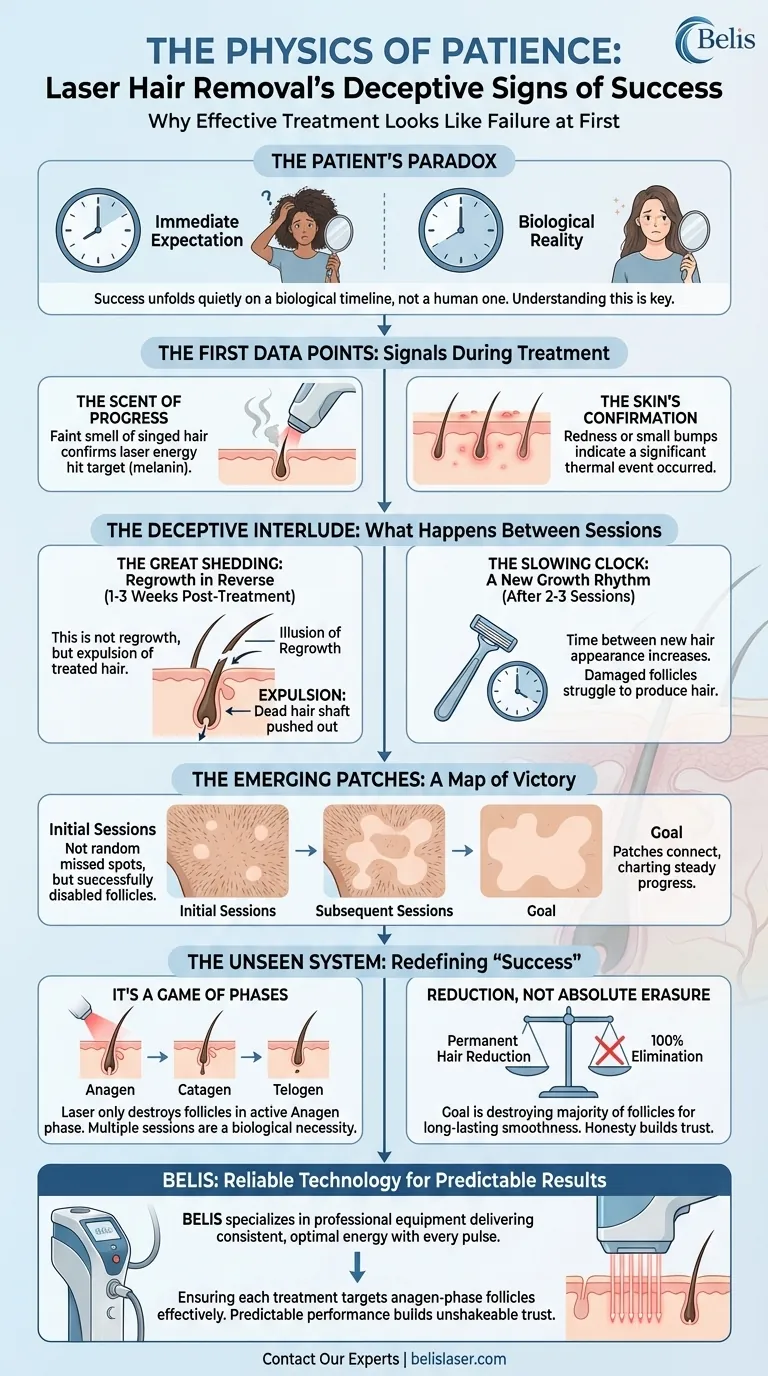
Visual Guide
Related Products
- Diode Tri Laser Hair Removal Machine for Clinic Use
- Diode Laser SHR Trilaser Hair Removal Machine for Clinic Use
- Clinic Diode Laser Hair Removal Machine with SHR and Trilaser Technology
- Clinic Use IPL SHR ND YAG Laser Hair Removal RF Skin Tightening Machine
- Trilaser Diode Hair Removal Machine for Beauty Clinic Use
Related Articles
- The Specialist's Blade: The Unseen Advantage of Diode Lasers in Hair Removal
- Diode Laser vs. TRILASER-LED Hair Removal: Which Technology Delivers Better Results?
- A Dialogue of Light and Pigment: The Precise Science of Diode Laser Hair Removal
- Diode Laser vs. TRILASER-LED: Which Hair Removal Technology Fits Your Skin Type?
- Diode vs. IPL: How to Choose the Right Technology for Your Clinic’s Skin Diversity and Goals

















