
The Allure of a Final Solution
We are psychologically drawn to finality. The appeal of a "permanent solution" is powerful because it promises an end to recurring effort. In aesthetics, few promises are as compelling as permanent hair removal—the dream of a future free from razors, wax, and routine maintenance.
But in the consultation room, when a client asks, "Will it be gone forever?" the most honest answer isn't a simple yes. It’s the beginning of a crucial conversation about biology, physics, and the definition of success. The gap between the expectation of a single event and the reality of a biological process is where client satisfaction is either won or lost.
The Elegant Physics of Selective Destruction
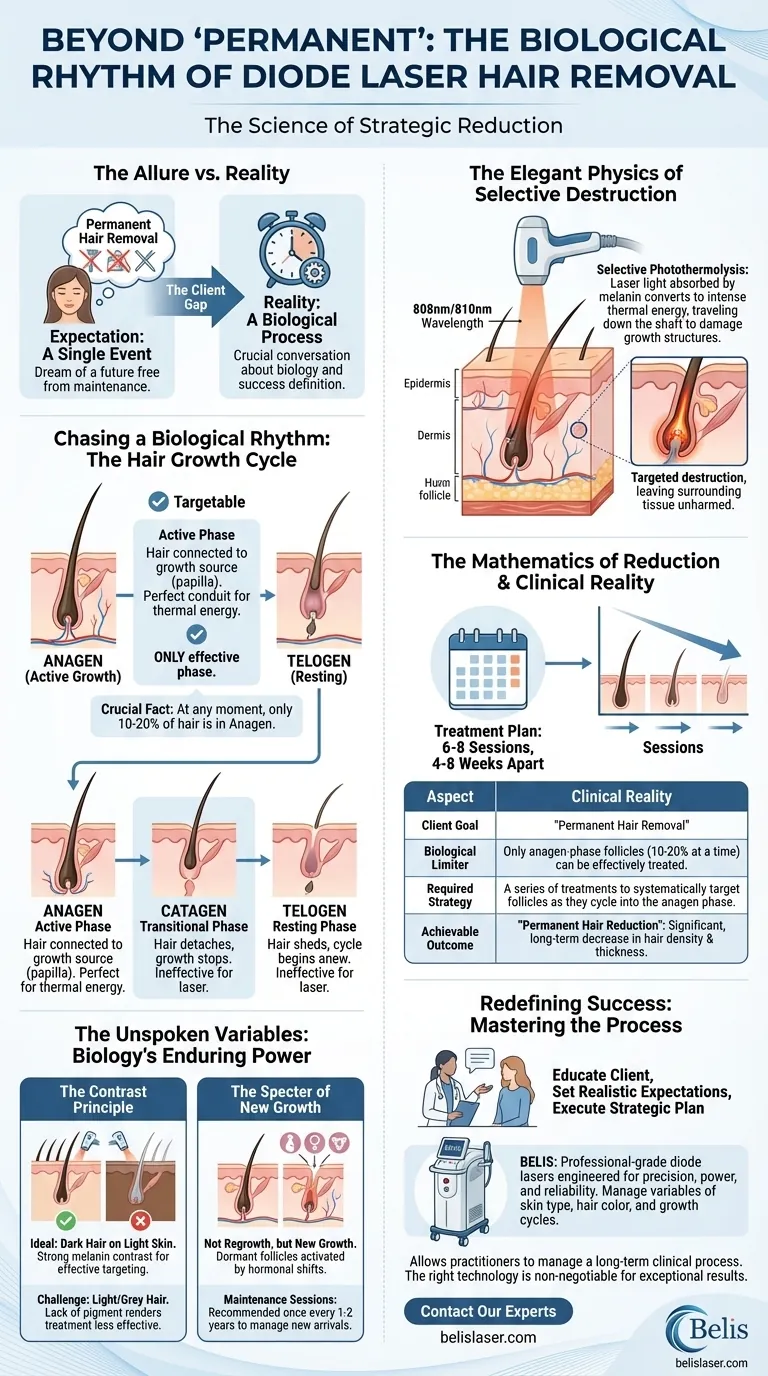
A diode laser doesn't brute-force its way to a solution. It engages in a precise dialogue with pigment, a principle known as selective photothermolysis.
It works like this: a highly concentrated beam of light, at a specific wavelength (typically 808nm or 810nm), is emitted. This light is largely ignored by the skin but eagerly absorbed by the dark melanin concentrated in the hair follicle. That light energy instantly converts to intense thermal energy, traveling down the hair shaft to damage the structures responsible for growth.
It’s an act of targeted destruction, elegant in its precision, leaving the surrounding tissue unharmed. This is the foundational "how" of the treatment. But the "when" is even more critical.
Chasing a Biological Rhythm
A laser can only destroy a follicle that is ready to be destroyed. Hair growth is not a constant state; it's a cyclical process with three distinct phases:
- Anagen: The active growth phase. The hair is physically connected to the follicle's base (the papilla), providing a perfect conduit for the laser's thermal energy.
- Catagen: The transitional phase. The hair detaches from the papilla and growth stops.
- Telogen: The resting phase. The old hair sits in the follicle until it sheds, before the cycle begins anew.
A diode laser is only effective during the anagen phase. If the hair isn't connected to its growth source, the thermal energy cannot reach its target. The treatment will be ineffective.
The Mathematics of Reduction
At any given moment, only about 10-20% of the hair on your body is in the anagen phase. This single biological fact is why one session is never enough.
A treatment plan is essentially a strategy to intercept more and more follicles as they enter their brief anagen window. Each session, spaced 4-8 weeks apart, catches a new cohort of active follicles. This methodical process is what leads to "permanent hair reduction"—an FDA-approved term signifying a stable, significant decrease in hair count.
| Aspect | Clinical Reality |
|---|---|
| Client Goal | "Permanent Hair Removal" |
| Biological Limiter | Only anagen-phase follicles (10-20% at a time) can be effectively treated. |
| Required Strategy | A series of 6-8 treatments to systematically target follicles as they cycle into the anagen phase. |
| Achievable Outcome | "Permanent Hair Reduction": A significant, long-term decrease in hair density and thickness. |
The Unspoken Variables: Biology's Enduring Power
Even the most perfect treatment plan must contend with the body's dynamic nature. Two key factors influence the final outcome.
1. The Contrast Principle
The laser's targeting system relies on contrast. It seeks dark melanin. The ideal scenario is dark, coarse hair on lighter skin, which provides a clear and distinct target. For hair that lacks sufficient pigment (very light, red, or grey), the laser has nothing to lock onto, rendering the treatment less effective.
2. The Specter of New Growth
A common source of client frustration is the appearance of hair months or years after a completed treatment course. This is rarely regrowth from a successfully treated follicle. Instead, it's typically new growth.
Our bodies hold millions of dormant follicles that can be activated by hormonal shifts, such as pregnancy, menopause, or conditions like PCOS. The laser can't prevent the body from creating new hair; it can only treat the follicles that are active during the treatment period. This is why occasional maintenance sessions (e.g., once every 1-2 years) are often recommended to manage these new arrivals.
Redefining Success: From a Single Event to a Strategic Process
True success in laser hair removal isn't achieved by promising a magic wand. It's achieved by mastering a process. It requires educating the client, setting realistic expectations, and executing a treatment plan that respects the rhythms of the body.
This biological reality places an immense responsibility on the technology. A treatment plan is only as effective as the device executing it. The system must deliver consistent energy, reliable pulse durations, and effective cooling to safely damage the follicle while protecting the skin, session after session.
Professional-grade diode lasers from BELIS are engineered for this very challenge. They provide the precision, power, and reliability that clinics need to manage the variables of skin type, hair color, and growth cycles. This allows practitioners to move beyond simply operating a machine and toward truly managing a long-term clinical process for their clients.
For clinics dedicated to mastering this process and delivering exceptional, long-term results, the right technology is non-negotiable. Contact Our Experts
Visual Guide
Related Products
- Clinic Diode Laser Hair Removal Machine with SHR and Trilaser Technology
- Diode Tri Laser Hair Removal Machine for Clinic Use
- Diode Laser SHR Trilaser Hair Removal Machine for Clinic Use
- Trilaser Diode Hair Removal Machine for Beauty Clinic Use
- Clinic Use IPL and SHR Hair Removal Machine with Nd Yag Laser Tattoo Removal
Related Articles
- Diode Laser Hair Removal: A Personalized Guide for Your Skin & Hair Type
- Diode Laser vs. TRILASER-LED: Which Hair Removal Technology Fits Your Skin Type?
- Diode Laser vs. TRILASER-LED Hair Removal: Which Technology Delivers Better Results?
- The Specialist's Blade: The Unseen Advantage of Diode Lasers in Hair Removal
- The Paradox of Patience: Why What You Do *After* Diode Laser Hair Removal Defines Its Success












