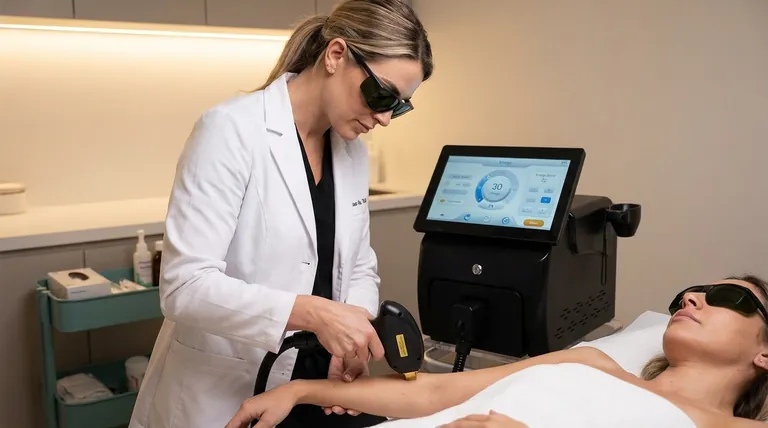
The Allure of the Machine
When a client walks into a medical aesthetics clinic, they often ask about the technology. "What brand of laser do you use? Is it the latest model?"
This is a logical question, born from a psychological bias. We tend to place our faith in tangible, branded hardware. We assume a newer, more expensive machine inherently delivers a better, safer result.
But in the world of diode laser hair removal, this is a dangerous oversimplification. The single most critical factor for a safe and effective outcome is not the machine, but the mind and hands of the person operating it. The real risk lies in the gap between the technology's potential and the technician's proficiency.
A Principle of Elegant Limitation
The science behind diode laser hair removal is a beautiful piece of physics called selective photothermolysis. It's not a brute-force attack on hair; it's a targeted strike.
How it Works: Light into Heat
A diode laser emits a single, concentrated wavelength of light (typically around 810nm). This light is specifically chosen because it is readily absorbed by melanin—the pigment that gives hair its dark color.
When the melanin in a hair shaft absorbs this light, it converts the light energy into intense heat. This heat travels down the hair to the follicle, damaging the structures responsible for hair growth.
The Inherent Boundary
This mechanism is precise, but its precision creates its primary limitation. The laser needs a target. If there is no pigment, there is no absorption, no heat, and no effect.
This is why diode lasers are fundamentally ineffective on:
- Blonde hair
- Red hair
- Gray or white hair
This isn't a defect in the technology. It's a law of its physics. The laser is working perfectly; it simply has nothing to "see."
The Human Factor: The Critical Calculation
A laser device is an instrument. Like a scalpel, its capacity for precision and its potential for harm are both governed by its user. Every treatment is a high-stakes calculation performed by the technician.
The Technician's True Role
An expert technician isn't just aiming and firing. They are constantly assessing the unique canvas of the client's skin and hair, calculating the precise energy level (fluence) needed to destroy the follicle without damaging the surrounding tissue.
They are managing a delicate trade-off: enough energy to be effective, but not so much as to be dangerous.
When the Calculation Fails
Nearly all serious adverse effects—burns, blisters, and permanent scarring—are the result of operator error. A power setting too high for a specific skin type turns a precision tool into a blunt instrument.
Common side effects can include temporary redness and mild swelling. But more significant risks, often tied to operator misjudgment, include:
- Hyperpigmentation: A darkening of the skin.
- Hypopigmentation: A lightening of the skin.
These occur when the laser's energy is inadvertently absorbed by the melanin in the skin, not just the hair.
The High-Contrast Problem: Navigating Darker Skin Tones
The ideal scenario for a diode laser is a high-contrast pairing: dark hair on light skin. This gives the laser a clear and distinct target.
As skin tone darkens, the contrast between hair and skin melanin decreases. The laser's task becomes exponentially more difficult. It struggles to differentiate the target (hair) from the background (skin).
This dramatically shrinks the margin for error. Treating darker skin tones requires not only a higher level of technician expertise but also superior technology. Advanced systems incorporate features like sophisticated cooling mechanisms and longer pulse durations to protect the epidermis. But even these are merely tools to empower a skilled operator, not replace them.
A Framework for Excellence
For clinic owners, the goal is not just to acquire a machine, but to build a system of safety and efficacy. This means shifting the focus from the brand of the box to the quality of the service.
| Patient Profile | Key Challenge | The Right Approach |
|---|---|---|
| Dark Hair, Light Skin | Operator Skill | Diode laser is highly effective. The priority is vetting the technician's training, certification, and experience. |
| Light Hair (Any Skin) | Lack of Target (Melanin) | Diode laser is ineffective. Alternative modalities like electrolysis should be recommended. |
| Dark Hair, Dark Skin | Low Contrast & High Risk of Burns/Pigmentation | Requires a highly experienced provider and advanced equipment specifically designed for darker skin tones. |
Understanding these limitations is not about finding fault with the technology. It is about respecting its power and acknowledging that its ultimate potential is unlocked by human expertise. The most advanced laser in the world is only as good as the professional who wields it.
For clinics committed to mastering both the science and the art of laser hair removal, equipping your team with professional-grade systems and comprehensive training is the foundation of success and client safety. Contact Our Experts
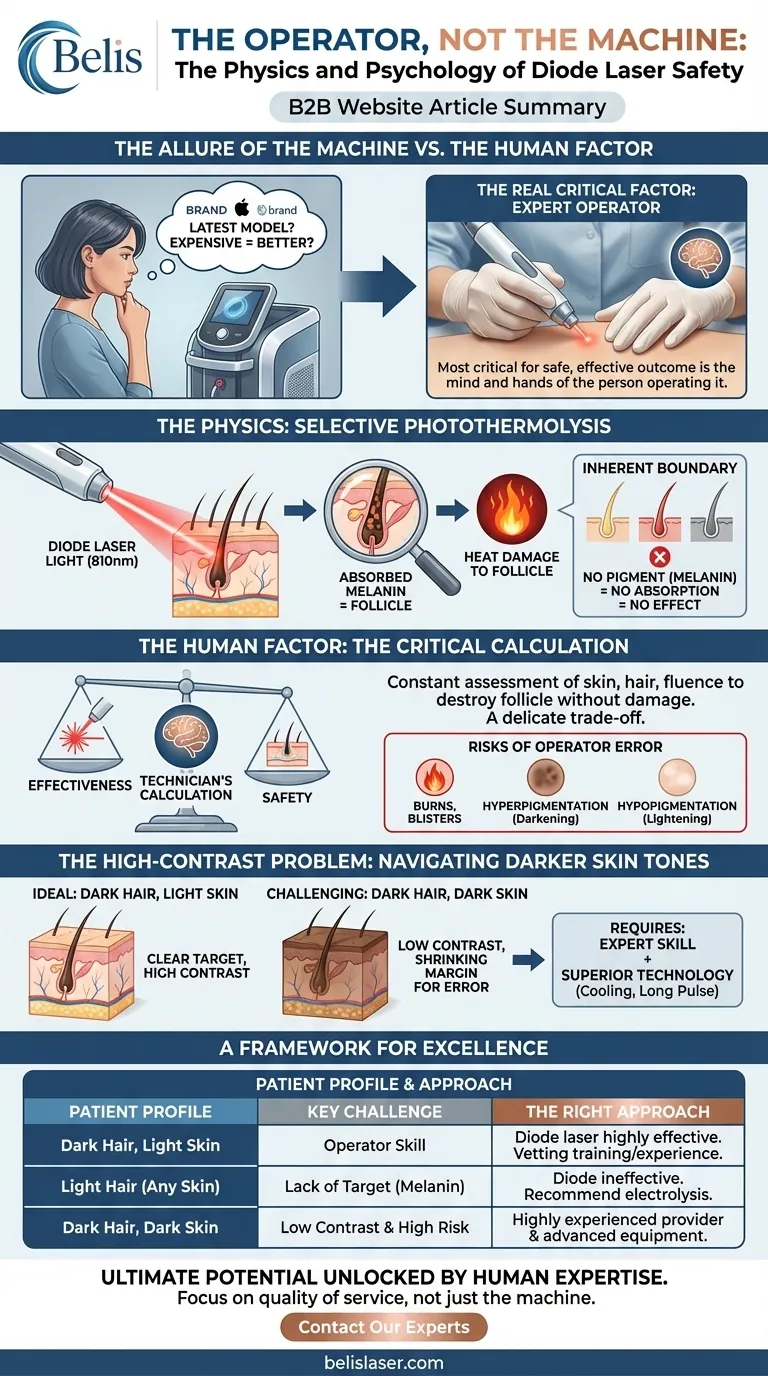
Visual Guide
Related Products
- Diode Laser SHR Trilaser Hair Removal Machine for Clinic Use
- Clinic Diode Laser Hair Removal Machine with SHR and Trilaser Technology
- Trilaser Diode Hair Removal Machine for Beauty Clinic Use
- Diode Tri Laser Hair Removal Machine for Clinic Use
- Fractional CO2 Laser Machine for Skin Treatment
Related Articles
- The Physics of Trust: Why a Single Wavelength Changes Everything in Hair Removal
- The Elegant Battle: Why Permanent Hair Removal Is a War of Attrition, Not a Single Strike
- The Specialist's Blade: The Unseen Advantage of Diode Lasers in Hair Removal
- Diode vs. IPL: How to Choose the Right Technology for Your Clinic’s Skin Diversity and Goals
- Diode Laser vs. TRILASER-LED: Which Hair Removal Technology Fits Your Skin Type?








