The Misleading Silence After Treatment
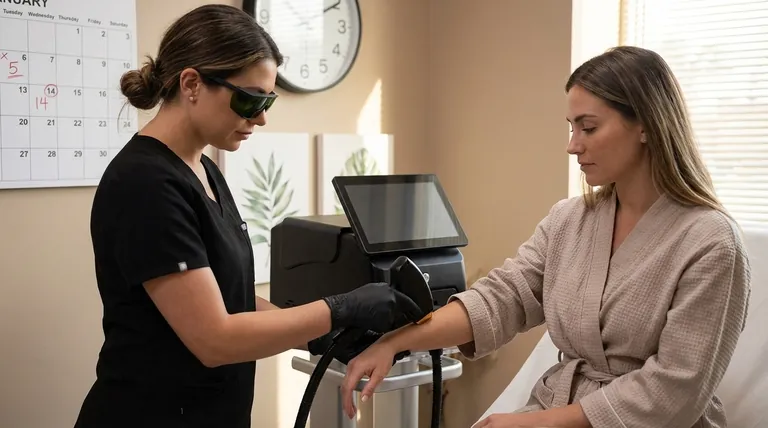
A client leaves your clinic after their first diode laser session. They felt the quick, warm snap of the laser and saw the precise work of the practitioner. Yet, for the next few days, nothing seems to happen. The hair is still there.
This initial silence is one of the most misunderstood parts of the laser hair removal journey. It creates a psychological gap between a decisive technological action and its delayed biological result. The truth is, the most critical work is already done, happening invisibly, deep beneath the skin.
The Target Isn't the Hair, It's the Factory
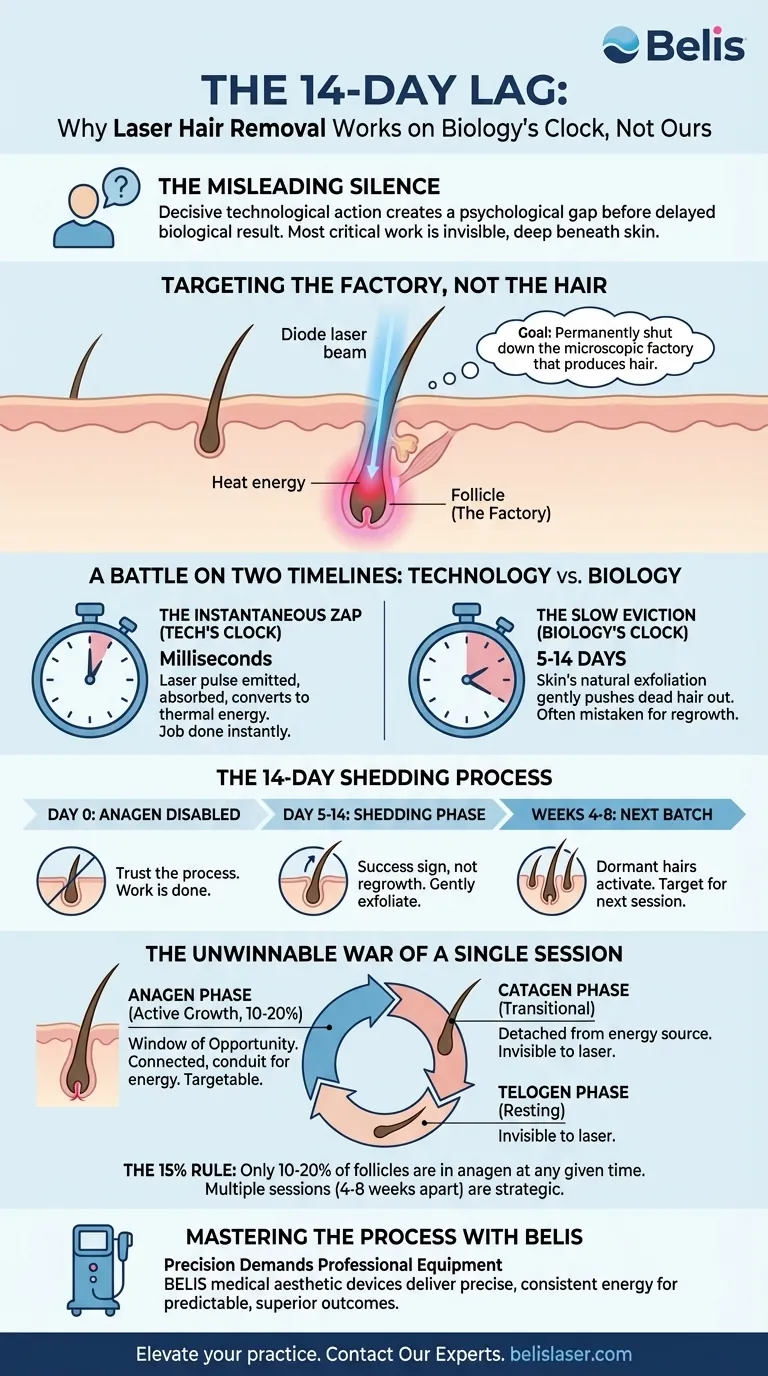
We tend to think of laser hair removal as a process of eliminating hair. But that’s a misconception. The real goal is to permanently shut down the microscopic "factory" that produces it: the hair follicle.
The hair shaft you see is merely the product. The follicle is the engine.
A diode laser is an incredibly precise energy delivery system. It sends a concentrated beam of light down the hair shaft, which acts like a wire. The light energy converts to heat, targeting the follicle's growth structures. Professional systems, like those from BELIS, are engineered for this exact task—delivering a controlled thermal insult sufficient to disable the follicle without damaging surrounding skin.
The result isn't immediate vaporisation; it's a quiet, permanent shutdown of the production line.
A Battle on Two Timelines: Technology vs. Biology
The process unfolds on two vastly different clocks. Understanding this is key to managing expectations and appreciating the elegance of the treatment.
The Instantaneous Zap (Technology's Clock)
The physics of the laser are nearly instantaneous. The pulse of light is emitted, absorbed by the melanin in the hair, and converted to thermal energy in a matter of milliseconds. From a technological standpoint, the job is done the moment the button is pressed.
The Slow Eviction (Biology's Clock)
Once the follicle is disabled, the hair shaft inside it is essentially an inert object. It’s no longer growing, but it’s still anchored in the skin.
Now, biology takes over. Over the next 5 to 14 days, the skin’s natural exfoliation and renewal process gently pushes this dead hair out. This "shedding" can often be mistaken for new growth, causing confusion and anxiety. In reality, it is the final, visible proof of a successful treatment.
Our brains are wired for immediate cause-and-effect. The laser provides the immediate cause, but we must wait for biology to provide the effect.
The Unwinnable War of a Single Session
Another common source of frustration is seeing hair remain—or seem to "grow back"—after the initial shedding period. This isn't a failure of the technology. It's a fundamental reality of hair biology.
The Anagen Phase: Your Window of Opportunity
A laser can only destroy a follicle when the hair is in its active growth stage, the anagen phase.
During this phase, the hair is physically connected to the follicle's base, providing a perfect conduit for the laser's energy. Hairs in their transitional (catagen) or resting (telogen) phases are detached from this energy source and are essentially invisible to the laser.
The 15% Rule: Why Patience is Non-Negotiable
At any given moment, only about 10-20% of the hair follicles in a given area are in the anagen phase.
This means a single laser session, no matter how perfect, can only ever address a small fraction of the total follicles. Subsequent sessions, scheduled 4-8 weeks apart, are a strategic campaign designed to catch the next "batch" of follicles as they cycle into the anagen phase.
Mastering the Process: Aligning Expectations with Reality
Success in laser hair removal is as much about psychological readiness as it is about technological efficacy. A well-informed client is a satisfied client.
| Timeline | What's Actually Happening | How to Manage It |
|---|---|---|
| Day 0 | Follicles in the anagen phase are disabled. | Trust the process. The work is done. |
| Day 5-14 | The "shedding" phase begins. | Recognize this is a sign of success, not regrowth. Gently exfoliate. |
| Weeks 4-8 | Dormant hairs enter the anagen phase. | This is expected. This is the hair your next session will target. |
| Between Sessions | Managing new growth. | Do not pluck or wax. This removes the target for the next session. Shaving is the only approved method. |
The Clinician's Role: Precision Demands Professional Equipment
This elegant interplay between physics and biology hinges on one crucial factor: the quality of the tool. To reliably disable a follicle without harming the skin requires a device that delivers a precise, consistent, and safe dose of energy, every single time.
This is where the distinction of professional-grade equipment becomes clear. BELIS medical aesthetic devices are engineered for clinics that value predictable, superior outcomes. They provide the power and control necessary to effectively treat each follicle as it enters its anagen growth phase, ensuring the entire strategic campaign of treatments is built on a foundation of success.
When a client trusts you with their skin, they are trusting your process and your tools. To provide treatments that are not only effective but also understood, equipping your clinic with technology that respects the body's natural rhythms is paramount. Contact Our Experts to learn how BELIS can elevate your practice.
Visual Guide
Related Products
- Clinic Diode Laser Hair Removal Machine with SHR and Trilaser Technology
- Diode Tri Laser Hair Removal Machine for Clinic Use
- Diode Laser SHR Trilaser Hair Removal Machine for Clinic Use
- Trilaser Diode Hair Removal Machine for Beauty Clinic Use
- Clinic Use IPL SHR ND YAG Laser Hair Removal RF Skin Tightening Machine
Related Articles
- Beyond 'Permanent': The Biological Rhythm of Diode Laser Hair Removal
- Diode Laser Hair Removal: A Personalized Guide for Your Skin & Hair Type
- Diode Laser vs. TRILASER-LED: Which Hair Removal Technology Fits Your Skin Type?
- Diode Laser vs. TRILASER-LED Hair Removal: Which Technology Delivers Better Results?
- The Specialist's Blade: The Unseen Advantage of Diode Lasers in Hair Removal












