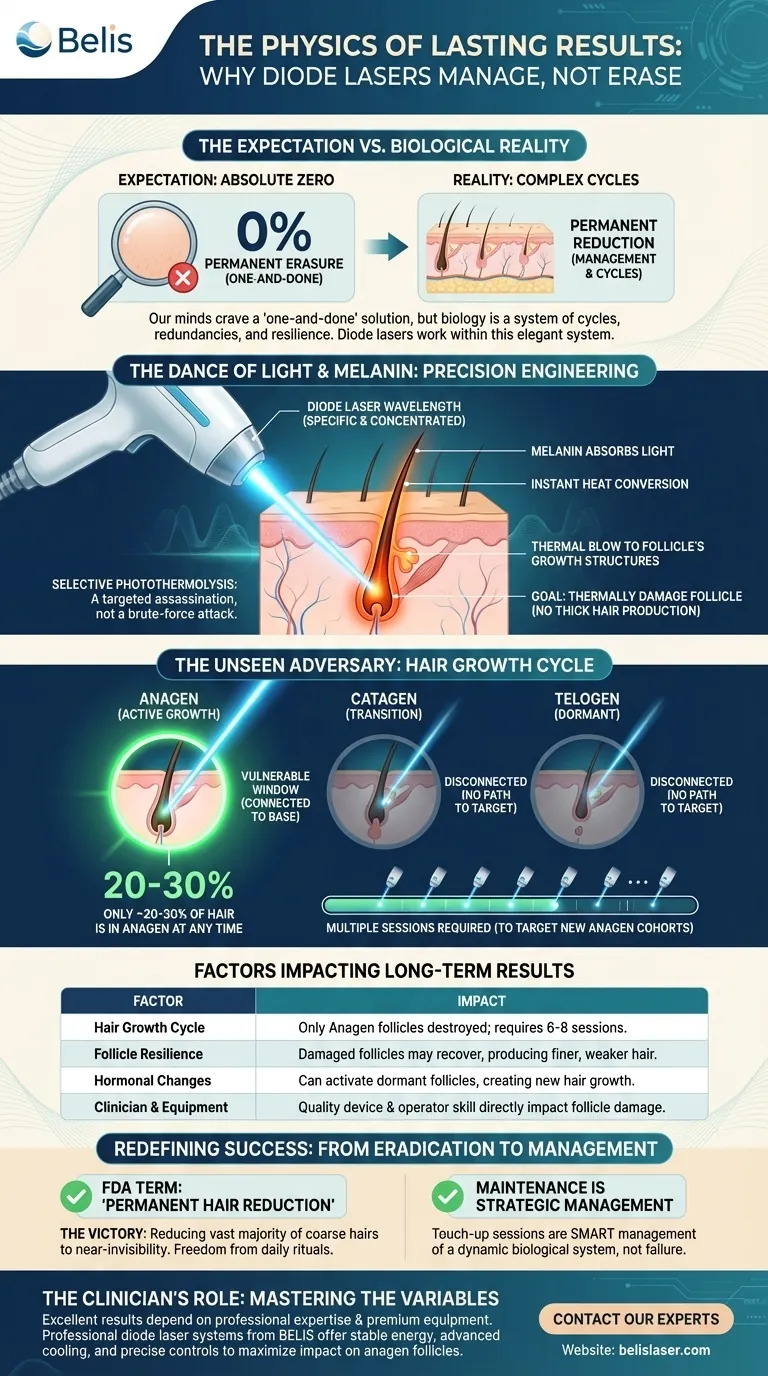
The Expectation of Absolute Zero
A client returns a year after their final laser session. They've enjoyed months of smooth, carefree skin. But one morning, they notice it: a few, fine hairs in the treated area.
Their first thought is often a quiet sense of failure. "It didn't work. The hair is back."
This moment of disappointment doesn't stem from a failure of the technology. It stems from a psychological gap—the chasm between our desire for absolute, permanent erasure and the complex biological reality of hair growth.
Our minds crave certainty. We want a "one-and-done" solution. But biology is a system of cycles, redundancies, and resilience. To truly appreciate the power of diode laser technology, we must first appreciate the elegant system it works within.
The Dance of Light and Melanin
Diode laser hair removal is not a brute-force attack. It's a feat of precision engineering rooted in a principle called selective photothermolysis.
It’s less of a battle and more of a targeted assassination.
A Precise Attack Vector
The laser emits a single, concentrated wavelength of light. This light has a specific mission: to find melanin, the pigment that gives hair its color.
When the beam hits the hair shaft, the melanin absorbs the light energy, instantly converting it into intense heat. This heat travels down the shaft, delivering a thermal blow directly to the follicle’s growth structures.
The goal isn't just to remove the hair. It's to thermally damage the follicle so severely that it can no longer produce a thick, coarse hair.
The Unseen Adversary: The Hair Growth Cycle
If the process is so precise, why isn't it absolute? Because the laser can only succeed when the target is perfectly aligned. And that alignment is fleeting.
The Anagen Phase: A Brief Window of Opportunity
A hair follicle is only vulnerable during its active growth phase, known as the anagen phase.
During this window, the hair is physically connected to the follicle's base, creating a perfect conduit for the laser's heat to reach and destroy its target.
The problem? At any given time, only about 20-30% of your body's hair is in this phase. The rest are in a transitional or dormant state, disconnected from the follicle's base. Treating them is like attacking a castle after the drawbridge is up. The laser's energy simply has no path to the target.
This is the non-negotiable reason for multiple sessions. Each treatment, spaced weeks apart, targets a new cohort of follicles that has just entered the anagen phase.
The Ghosts in the Machine
Even after a full course of treatments, other biological factors come into play:
- Damaged, Not Destroyed: Some follicles aren't obliterated, merely damaged. Over months or years, these resilient structures can partially repair themselves, eventually producing a new hair—though it's almost always weaker and finer than the original.
- Dormant Follicles: The body holds countless hair follicles in reserve, lying dormant for years. Hormonal shifts—triggered by pregnancy, menopause, or medical conditions—can awaken these sleeping follicles, leading to what appears to be regrowth, but is actually new growth.
Redefining Success: From Eradication to Management
This is why regulatory bodies like the FDA use the term "permanent hair reduction," not removal. It's a scientifically honest and accurate description of the outcome.
The victory isn't achieving a sterile, hairless void for all time. The victory is reducing the vast majority of coarse, dark hairs to a state of near-invisibility, freeing someone from the daily or weekly rituals of shaving, waxing, or plucking.
Maintenance, in the form of a touch-up session every year or two, isn't a sign of failure. It's the smart, strategic management of a dynamic biological system.
| Factor | Impact on Long-Term Results |
|---|---|
| Hair Growth Cycle | Only anagen-phase follicles can be destroyed, requiring 6-8 sessions for full coverage. |
| Follicle Resilience | Damaged follicles may recover, producing finer, weaker hair over time. |
| Hormonal Changes | Can activate previously dormant follicles, creating entirely new hair growth. |
| Clinician & Equipment | The quality of the device and skill of the operator directly impact follicle damage efficacy. |
The Clinician's Role: Mastering the Variables
Understanding this complex interplay of physics and biology reveals the immense value of professional expertise and equipment. An excellent result depends on a clinician's ability to manage these variables.
This is where the quality of the instrument becomes paramount. For medical aesthetic clinics and premium salons, delivering consistent, safe, and effective hair reduction is a cornerstone of client trust. Professional diode laser systems from BELIS are engineered to provide just that. They offer the stable energy, advanced cooling, and precise controls that professionals need to target follicles effectively across a full treatment course.
Great equipment doesn't defy biology, but it gives an expert the best possible tool to master it. It ensures that every session maximizes its impact on anagen-phase follicles, leading to a more profound and lasting state of hair reduction for the client.
By shifting the conversation from impossible perfection to powerful, long-term management, clinics can set realistic expectations and deliver results that create lasting client satisfaction.
Ready to provide your clients with truly effective, long-term hair reduction? Contact Our Experts
Visual Guide
Related Products
- Diode Laser SHR Trilaser Hair Removal Machine for Clinic Use
- Clinic Diode Laser Hair Removal Machine with SHR and Trilaser Technology
- Trilaser Diode Hair Removal Machine for Beauty Clinic Use
- Diode Tri Laser Hair Removal Machine for Clinic Use
- Fractional CO2 Laser Machine for Skin Treatment
Related Articles
- The Physics of Trust: Why a Single Wavelength Changes Everything in Hair Removal
- The Elegant Battle: Why Permanent Hair Removal Is a War of Attrition, Not a Single Strike
- The Specialist's Blade: The Unseen Advantage of Diode Lasers in Hair Removal
- Diode vs. IPL: How to Choose the Right Technology for Your Clinic’s Skin Diversity and Goals
- Diode Laser vs. TRILASER-LED: Which Hair Removal Technology Fits Your Skin Type?








