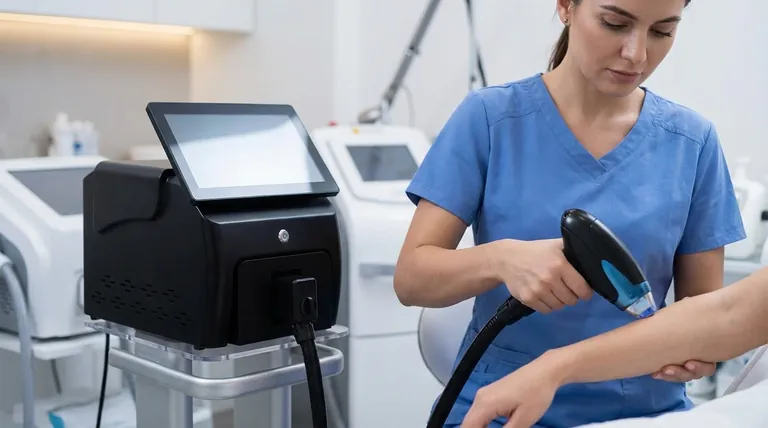
The Allure of the Generalist
In any field, there's a temptation to invest in the "jack of all trades"—the tool that promises to do everything. In medical aesthetics, Intense Pulsed Light (IPL) often plays this role. It seems like a sound business decision: one machine to treat sun spots, broken capillaries, and, yes, unwanted hair.
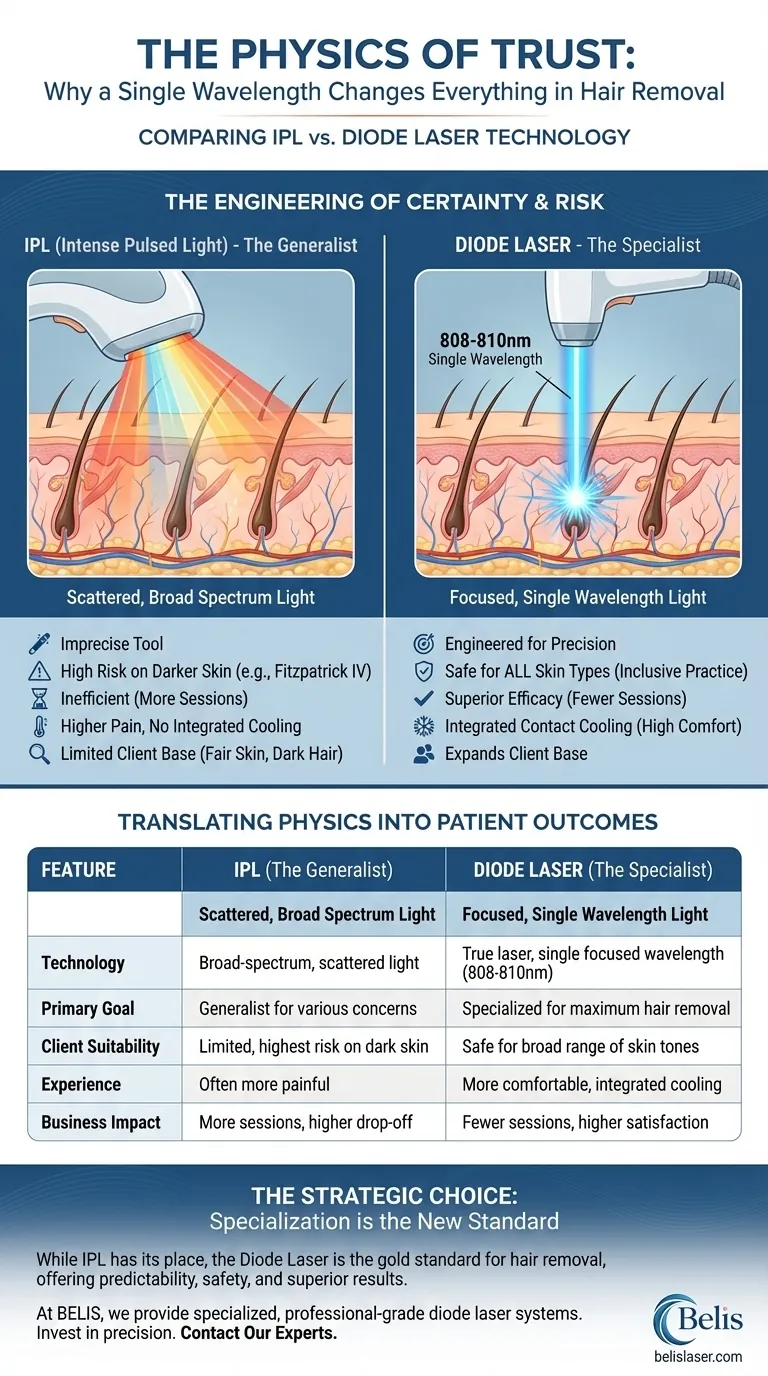
This versatility, however, comes from its nature. IPL is not a laser. It's more like a powerful, filtered camera flash, casting a broad spectrum of scattered light. For hair removal, this is a profound compromise. It’s an attempt to solve a precise problem with an imprecise tool.
The Engineering of Certainty
A diode laser is the antithesis of this. It is an instrument of specialization, born from a deeper understanding of physics and biology. It doesn't try to do everything. It is engineered to do one thing perfectly: destroy the hair follicle.
It achieves this through an elegant principle: a single, coherent wavelength of light (typically 808-810nm). This isn't a scattered blast; it's a focused column of energy, optimized for one specific target—the melanin pigment within the hair shaft.
The light travels directly to the follicle, bypassing the surrounding tissue with minimal collateral absorption. This is more than a technical detail; it’s the foundation of a predictable, repeatable, and safe outcome.
A Question of Risk and Trust
Consider the daily challenge in a professional clinic: a client with a darker skin tone (e.g., Fitzpatrick Type IV) seeking hair removal. This is where the physics become critically important.
With IPL, the broad spectrum of light struggles to differentiate between the melanin in the client's hair and the melanin in their skin. The energy scatters. This isn't just inefficient; it dramatically increases the risk of burns, hyperpigmentation, and patient discomfort. The margin for error is high because the tool is imprecise.
A diode laser, by contrast, turns this scenario from a high-risk gamble into a controlled procedure. Its specific wavelength is more readily absorbed by the concentrated melanin in the hair follicle than the diffused melanin in the epidermis. It is the physics of trust. It provides the clinician with certainty and the client with a safe pathway to their desired results.
Translating Physics into Patient Outcomes
When clinics choose a technology, they are ultimately choosing the results and experience they can offer their clients. The difference between a focused laser and scattered light translates into clear, measurable advantages.
Efficacy and The Value of Time
Because its energy is so precisely targeted, a diode laser is more efficient at destroying the follicle.
- Diode Laser: Achieves superior results in fewer sessions.
- IPL: Often requires more treatments to reach a similar endpoint, testing client patience and increasing the total cost in time.
Safety and an Inclusive Practice
The diode laser's precision makes it safe for a much wider range of skin types.
- Diode Laser: Safely and effectively treats clients across the Fitzpatrick scale. This isn't just a technical feature; it's a passport to serving a larger, more diverse community.
- IPL: Best suited for the narrow combination of fair skin and dark hair, limiting a clinic's potential client base.
The Psychology of Comfort
Modern professional diode laser systems almost universally integrate advanced contact cooling. A chilled sapphire tip on the handpiece pre-cools the skin, keeping it comfortable as the laser pulse is delivered. This dramatically reduces pain, which is a primary reason clients abandon treatment plans.
The Strategic Choice: Specialization is the New Standard
The choice is not merely between two machines. It is a choice between two philosophies of care.
| Feature | Diode Laser | IPL (Intense Pulsed Light) |
|---|---|---|
| Technology | A true laser with a single, focused wavelength. | Broad-spectrum, scattered light. |
| Primary Goal | Specialized for maximum hair removal efficacy. | A generalist tool for various skin concerns. |
| Client Suitability | Safe for a broad range of skin tones. | Limited, highest risk on darker skin. |
| Experience | More comfortable due to integrated cooling. | Often more painful. |
| Business Impact | Fewer sessions, higher client satisfaction. | More sessions needed, higher drop-off rate. |
While IPL has a place for treating general pigmentation, it is a master of none. For the clinic dedicated to providing the gold standard in hair removal, the specialist tool is the only logical investment. This commitment to excellence is what builds a reputation and a loyal clientele.
At BELIS, we provide the specialized, professional-grade diode laser systems that empower clinics to deliver these superior results. Investing in precision technology is an investment in your clients' trust and your practice's future. To learn more about implementing the gold standard in hair removal, Contact Our Experts.
Visual Guide
Related Products
- Diode Laser SHR Trilaser Hair Removal Machine for Clinic Use
- Clinic Diode Laser Hair Removal Machine with SHR and Trilaser Technology
- Diode Tri Laser Hair Removal Machine for Clinic Use
- Trilaser Diode Hair Removal Machine for Beauty Clinic Use
- Clinic Use IPL SHR ND YAG Laser Hair Removal RF Skin Tightening Machine
Related Articles
- The Elegant Battle: Why Permanent Hair Removal Is a War of Attrition, Not a Single Strike
- The Specialist's Blade: The Unseen Advantage of Diode Lasers in Hair Removal
- Diode vs. IPL: How to Choose the Right Technology for Your Clinic’s Skin Diversity and Goals
- Diode Laser vs. TRILASER-LED: Which Hair Removal Technology Fits Your Skin Type?
- The Paradox of Patience: Why What You Do *After* Diode Laser Hair Removal Defines Its Success













