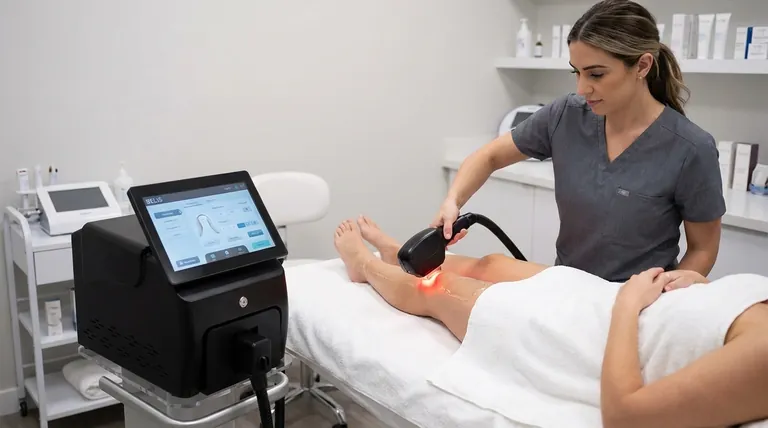
The Unseen Dialogue
To the client, laser hair removal looks simple. A flash of light, a faint warmth, and the promise of smooth skin. It feels like a surface-level act.
But beneath the skin, a complex dialogue is taking place. It's a conversation between physics and biology, spoken in a language of specific wavelengths and targeted energy. The process isn't about zapping; it's about selective communication. The laser sends a message, and only one structure is meant to receive it: the melanin within the hair follicle.
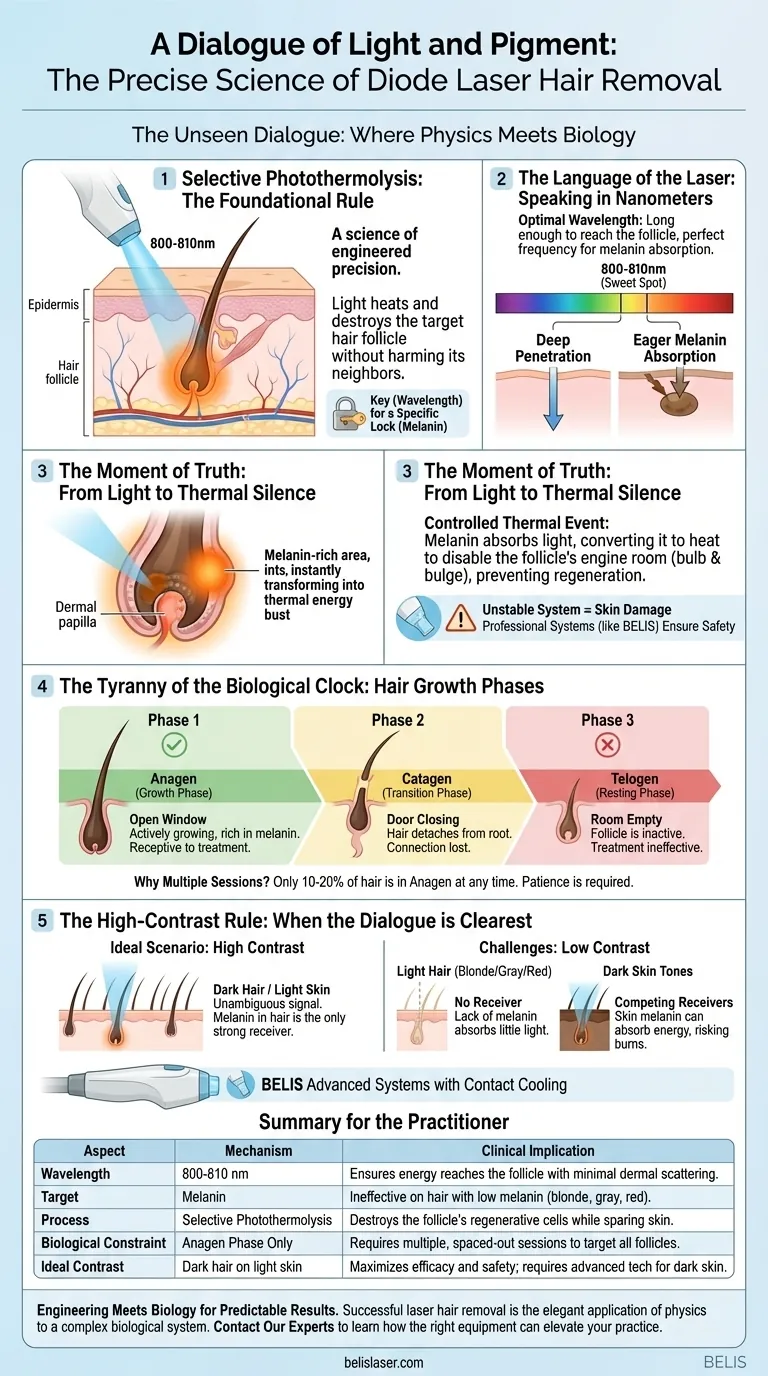
This principle, selective photothermolysis, is less a piece of jargon and more the foundational rule of this dialogue. It dictates that light can be used to heat and destroy a precise target without harming its neighbors. It is a science of engineered precision.
The Language of the Laser: Speaking in Nanometers
Every effective communication requires a clear medium. For a diode laser, that medium is its wavelength, typically 800-810 nanometers (nm).
This isn't an arbitrary number. It’s a carefully chosen "sweet spot." This wavelength is long enough to penetrate deep into the dermis to reach the hair follicle, yet it's also the specific frequency that melanin eagerly absorbs. Think of it as a key cut for a very specific lock.
Melanin, the pigment that gives hair its color, acts as the antenna. It is the designated receiver for the laser’s message. This focus is what we crave from technology—a tool that performs its single function with unwavering accuracy.
The Moment of Truth: From Light to Thermal Silence
When melanin absorbs the laser's light, that energy instantaneously converts to heat.
This isn't a brute-force burn. It's a controlled thermal event designed to disable the follicle's engine room—the hair bulb and bulge, which are responsible for regeneration. The heat disrupts the follicle's blood supply and silences its ability to produce a new hair.
This critical moment of energy conversion is where the quality of the equipment becomes non-negotiable. A professional system, like those developed by BELIS for medical aesthetic clinics, ensures this dialogue is spoken clearly and safely. An unstable wavelength or an inadequate cooling system turns this precise conversation into a sloppy, dangerous shout, risking damage to the skin.
The Tyranny of the Biological Clock
The most common source of client frustration is the need for multiple sessions. This isn't a flaw in the technology; it's a fundamental constraint imposed by biology. The laser can only speak to follicles that are actively listening.
Hair growth occurs in three phases, creating a narrow window of opportunity.
- Anagen (The Growth Phase): This is the open window. The hair is physically connected to its root, actively growing, and rich in melanin. It is the only time the laser’s thermal energy can be effectively transferred to the follicle's regenerative structures.
- Catagen (The Transition Phase): The door is closing. The hair detaches from its root and prepares to shed. The connection is lost, and the laser’s message cannot be delivered to its intended target.
- Telogen (The Resting Phase): The room is empty. The hair is dormant, and the follicle is inactive. Treating a follicle in this phase is like speaking into a disconnected phone.
Since only about 10-20% of your hair is in the anagen phase at any given time, treatments must be timed to catch the next wave of follicles as they enter their receptive state. Patience isn't just a virtue; it's a physical requirement.
The High-Contrast Rule: When the Dialogue is Clearest
The ideal scenario for this technology is one of high contrast: dark, coarse hair on light skin. Here, the signal is unambiguous. The laser's message is sent, and the follicle's melanin is the only strong receiver in the vicinity.
When contrast is low, the conversation gets noisy.
- Light Hair (Blonde, Gray, Red): There is no receiver. These hairs lack sufficient melanin to absorb the light. The message is sent, but it is never heard.
- Dark Skin Tones: There are too many receivers. The melanin in the skin competes with the melanin in the hair, creating a risk that the skin will absorb the energy, potentially leading to burns or pigmentation changes.
This is where engineering must accommodate biology. Advanced diode laser systems from BELIS incorporate sophisticated contact cooling and adjustable pulse durations. These features act as a "noise-canceling" system, protecting the epidermis so the technician can deliver the laser’s message safely and effectively, even in more complex scenarios.
Summary for the Practitioner
| Aspect | Mechanism | Clinical Implication |
|---|---|---|
| Wavelength | 800-810 nm for optimal depth & melanin absorption | Ensures energy reaches the follicle with minimal dermal scattering. |
| Target | Melanin in the hair shaft and follicle | Ineffective on hair with low melanin (blonde, gray, red). |
| Process | Selective Photothermolysis | Destroys the follicle's regenerative cells while sparing skin. |
| Biological Constraint | Effective only during the Anagen (growth) phase | Requires multiple, spaced-out sessions to target all follicles. |
| Ideal Contrast | Dark hair on light skin | Maximizes efficacy and safety; requires advanced tech for dark skin. |
Engineering Meets Biology for Predictable Results
Successful laser hair removal is not magic; it is the elegant application of physics to a complex biological system. Its success hinges on understanding the "why" behind the technology, respecting the body's natural cycles, and wielding equipment engineered for unwavering precision and safety.
For clinics and salons committed to delivering superior outcomes, investing in the right technology is the first step to mastering this dialogue between light and skin. Contact Our Experts to learn how the right equipment can elevate your practice.
Visual Guide
Related Products
- Clinic Diode Laser Hair Removal Machine with SHR and Trilaser Technology
- Diode Tri Laser Hair Removal Machine for Clinic Use
- Diode Laser SHR Trilaser Hair Removal Machine for Clinic Use
- Trilaser Diode Hair Removal Machine for Beauty Clinic Use
- Clinic Use IPL SHR ND YAG Laser Hair Removal RF Skin Tightening Machine
Related Articles
- Beyond 'Permanent': The Biological Rhythm of Diode Laser Hair Removal
- Diode Laser Hair Removal: A Personalized Guide for Your Skin & Hair Type
- Diode Laser vs. TRILASER-LED: Which Hair Removal Technology Fits Your Skin Type?
- Diode Laser vs. TRILASER-LED Hair Removal: Which Technology Delivers Better Results?
- The Specialist's Blade: The Unseen Advantage of Diode Lasers in Hair Removal












