The One-Size-Fits-All Illusion
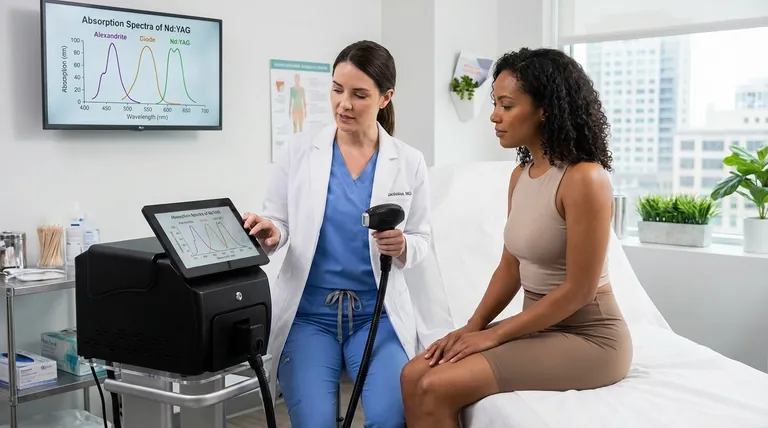
Imagine a client with a deep skin tone walks into a clinic, excited to begin their laser hair removal journey. The clinic has a state-of-the-art laser, known for its incredible power. But there's a problem hiding in the physics: the machine is an Alexandrite laser, optimized for fair skin.
Using it would be a gamble. The technician faces a dilemma: turn the client away, or lower the settings and hope for the best? This scenario isn't a failure of the technology itself. It's a failure of the a "one-tool-for-all-jobs" mindset.
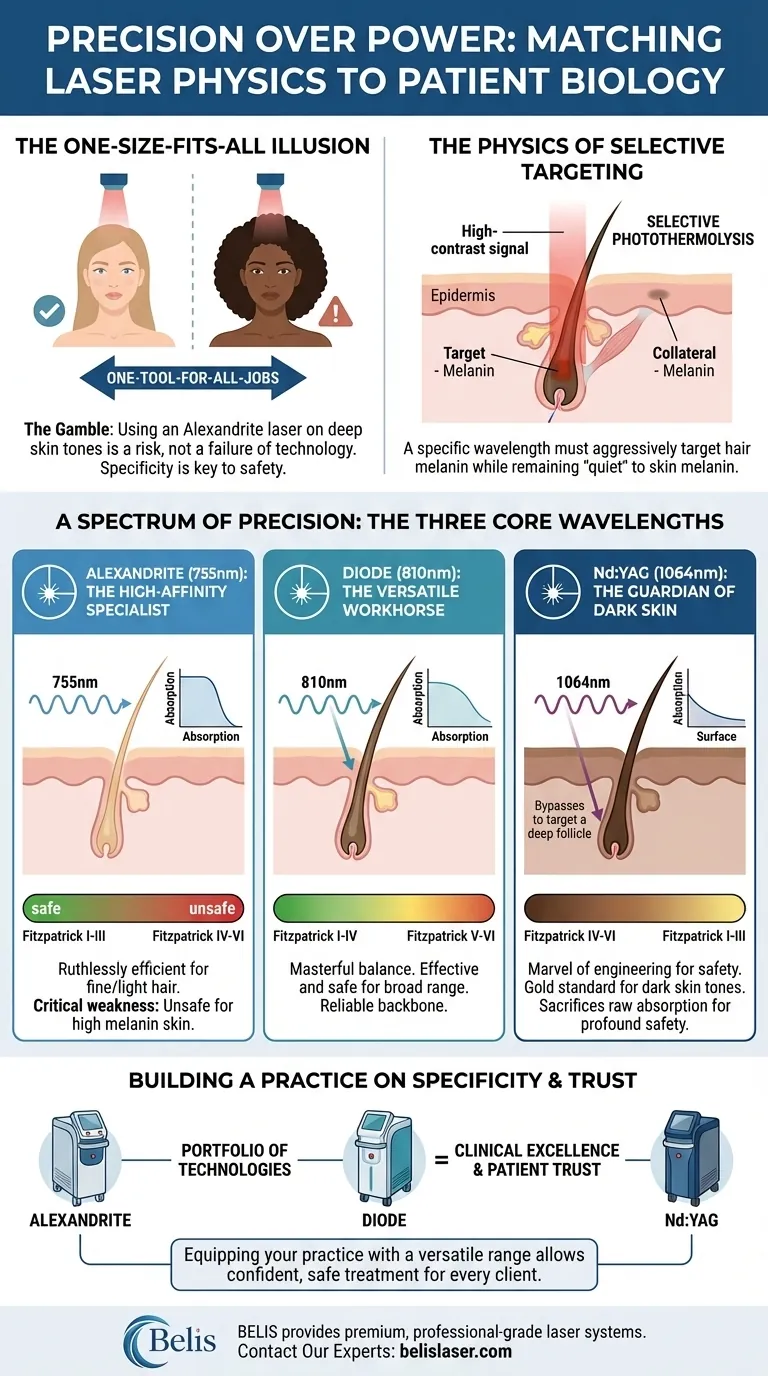
In medical aesthetics, effectiveness and safety are born from specificity. The most fundamental challenge in laser hair removal is differentiating between the melanin in the hair follicle (the target) and the melanin in the surrounding skin (the collateral).
The Physics of Selective Targeting
Laser hair removal operates on a simple, elegant principle: selective photothermolysis. A specific wavelength of light is absorbed by the melanin in the hair, converting to heat and disabling the follicle.
The challenge is that skin also contains melanin. The wrong wavelength can't tell the difference, leading to burns, blistering, or pigmentation changes.
The goal isn't just power; it's precision. The ideal treatment uses a wavelength that creates a high-contrast signal—aggressively targeting the hair's melanin while remaining "quiet" or "invisible" to the skin's melanin. This signal-to-noise ratio is the foundation of a safe and effective treatment.
A Spectrum of Precision: The Three Core Wavelengths
No single laser can master this task for every person. The physics demands a specialized approach, which is why the industry relies on three primary wavelengths.
H3: The High-Affinity Specialist: Alexandrite (755nm)
The Alexandrite laser has the highest absorption coefficient for melanin. This makes it ruthlessly efficient at targeting and destroying fine or light-colored hairs that other lasers might miss.
Its strength, however, is also its critical weakness. On skin with a high concentration of melanin (Fitzpatrick types IV-VI), its aggressive targeting becomes a liability. It cannot distinguish between the hair and the skin, making it an unsafe choice for darker skin tones.
H3: The Versatile Workhorse: Diode (810nm)
The Diode laser offers a masterful balance. Its 810nm wavelength penetrates deeper than the Alexandrite, and while its melanin absorption is strong, it's less aggressive.
This balanced profile makes it a highly effective and safe option for a broad range of patients—from fair to medium-tan skin (Fitzpatrick I-IV) with darker, coarser hair. It is the reliable backbone of many successful aesthetic practices.
H3: The Guardian of Dark Skin: Nd:YAG (1064nm)
The Nd:YAG laser is a marvel of engineering designed for safety. Its long 1064nm wavelength has a much lower affinity for melanin.
This seems counterintuitive, but it's a brilliant design choice. By largely bypassing the melanin in the epidermis, it directs its energy deep into the dermis to target the follicle. It sacrifices raw absorption for profound safety, making it the undisputed gold standard for treating dark skin tones (Fitzpatrick IV-VI) without damaging the surrounding tissue. It's not weaker; it's smarter.
The Cognitive Trap of a Single Machine
Why, then, do some clinics operate with only one type of laser? The answer often lies in a cognitive bias. The initial investment in a single high-end machine creates an economic and psychological pressure to make it work for every client who walks through the door.
This is the "instrument bias": when you own a hammer, every problem starts to look like a nail.
But clients are not nails. Treating them as such erodes trust and exposes a clinic to significant risk—both to the patient's health and the business's reputation. True professionalism lies in recognizing the limits of a tool and having the right alternative on hand.
Building a Practice on Specificity and Trust
The most successful and respected clinics build their reputation not on having the single "best" machine, but on curating a portfolio of the right technologies. Offering Alexandrite, Diode, and Nd:YAG systems isn't a cost; it's an investment in clinical excellence and patient trust.
It signals a commitment to bespoke care, acknowledging that every patient's biology is unique. This strategy transforms a clinic from a simple service provider into a trusted expert.
Equipping your practice with a versatile range of technologies allows you to confidently and safely treat a wider demographic, ensuring optimal outcomes for every single client. BELIS provides premium, professional-grade laser systems across all essential wavelengths, empowering clinics to deliver on the promise of precision.
To build a practice founded on this principle of safety and efficacy, you need a partner who understands the technology's nuances. Contact Our Experts
Visual Guide
Related Products
- Diode Tri Laser Hair Removal Machine for Clinic Use
- Diode Laser SHR Trilaser Hair Removal Machine for Clinic Use
- Clinic Diode Laser Hair Removal Machine with SHR and Trilaser Technology
- Clinic Use IPL SHR ND YAG Laser Hair Removal RF Skin Tightening Machine
- Trilaser Diode Hair Removal Machine for Beauty Clinic Use
Related Articles
- The Specialist's Blade: The Unseen Advantage of Diode Lasers in Hair Removal
- Diode Laser vs. TRILASER-LED Hair Removal: Which Technology Delivers Better Results?
- A Dialogue of Light and Pigment: The Precise Science of Diode Laser Hair Removal
- Diode Laser vs. TRILASER-LED: Which Hair Removal Technology Fits Your Skin Type?
- Diode vs. IPL: How to Choose the Right Technology for Your Clinic’s Skin Diversity and Goals

















