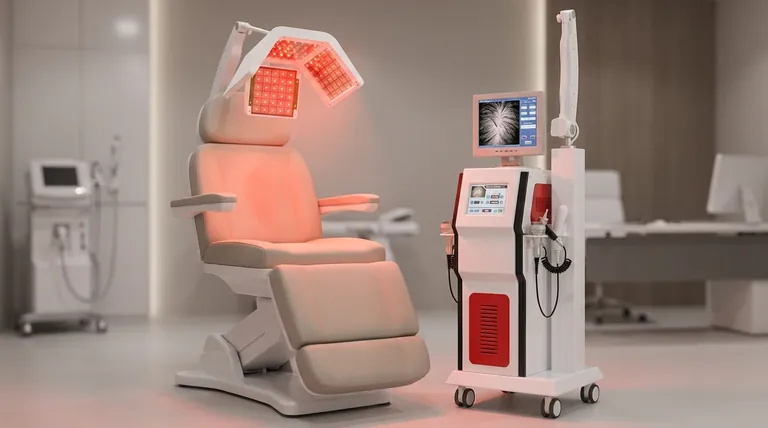
The Consultation Room Paradox
A client sits in your chair. They aren't bald, but they are losing something far more important: their sense of control. They bring a story of a widening part, a thinner ponytail, and a brush that collects more hair each morning.
They are caught in a paradox. They are deeply concerned about hair loss but hesitant to commit to pharmaceuticals or invasive procedures. This is not just a conversation about hair; it's a conversation about identity, anxiety, and the desire to stop a seemingly inevitable decline.
This is where the engineering elegance of Low-Level Laser Therapy (LLLT) finds its purpose.
Redefining Success: From Regrowth to Control
The industry often quotes an "over 80% success rate" for LLLT. While statistically encouraging, this number can be misleading if not framed correctly. The psychological victory for most clients isn't a miraculous return to a teenage hairline.
It's the cessation of loss. It's stabilization.
Success with LLLT is primarily about biological preservation. It empowers practitioners to offer a concrete, science-backed tool that shifts the client's narrative from one of passive loss to one of active management.
Halting the Cascade
The most immediate and profound impact of consistent LLLT is a reduction in shedding. For a client who lives with the daily anxiety of seeing hair on their pillow or in the shower drain, this change is monumental.
LLLT energizes follicular cells, making them more resilient to the miniaturization signals of androgenic alopecia. You are not just treating hair; you are interrupting a negative feedback loop of stress and shedding.
The Architectural Win of Thicker Strands
The therapy’s second major achievement is increasing the diameter of existing hair shafts. Weak, vellus-like hairs mature into stronger, thicker terminal hairs.
This doesn't necessarily mean a dramatic increase in the absolute hair count. Instead, it improves the architecture of the hair. Thicker strands create better scalp coverage and a tangible feeling of fullness. It’s an optical and tactile victory that restores a client's confidence.
Inside the Engine Room: The Biophysics of LLLT
LLLT is not magic; it is a precise application of photobiomodulation. It's a bio-engineering intervention at the cellular level, using specific wavelengths of red light to initiate a cascade of metabolic events.
Fueling the Follicle
The light energy is absorbed by mitochondria, the microscopic power plants inside every cell. This triggers an increase in the production of adenosine triphosphate (ATP), the universal energy currency of the body.
By providing more fuel, LLLT enables weakened follicular cells to perform their functions with renewed vigor—from synthesizing proteins to building a healthier, more robust hair shaft.
Improving the Infrastructure
The therapy also promotes vasodilation, gently widening blood vessels in the scalp. This enhanced circulation acts like a logistics upgrade, delivering more oxygen and vital nutrients to the follicles while efficiently removing metabolic waste.
A well-fueled and well-supplied follicle is a productive follicle.
An Engineer's Honesty: Defining the Operational Limits
Every powerful tool has a clear operational manual. To build trust and ensure client satisfaction, we must be transparent about LLLT's boundaries.
It Revitalizes, Not Resurrects
LLLT is most effective on follicles that are dormant or thinning. It cannot revive a follicle that is scarred over or has been inactive for years. The ideal candidate is someone in the early to moderate stages of hair thinning, where the cellular machinery is still present and capable of being reactivated.
Consistency is a Design Requirement
The cellular benefits of LLLT are cumulative and dependent on consistent application. A typical professional protocol involves sessions multiple times a week. This is not a flaw in the therapy; it is a fundamental requirement of the biological process it supports. Sporadic use will not yield meaningful results.
The Power of Synergy
While LLLT is a formidable standalone treatment for slowing loss and improving hair quality, its true potential is often unlocked as part of a combination strategy. It prepares the scalp environment, making it more receptive to other treatments like Minoxidil or serving as a crucial supportive tool for post-transplant care.
Strategic Implementation for Your Clinic
Integrating LLLT is more than adding a new device; it's about offering a new category of care. It fills the crucial gap for clients seeking a non-invasive, scientifically-backed solution with an extremely high safety profile.
| Parameter | Strategic Value for a Professional Practice |
|---|---|
| Ideal Client | Individuals with early-stage hair thinning (Norwood 2-4, Ludwig I-II). |
| Primary Outcome | Stabilization of hair loss, increased hair shaft thickness, and improved quality. |
| Clinical Value | Non-invasive, no systemic side effects, high client compliance and retention. |
| Best Role | A powerful first-line defense or a foundational supportive therapy. |
By offering professional-grade LLLT, you provide a tangible sense of hope and control for clients who need it most. BELIS equipment is engineered to deliver the precise, consistent energy required to achieve these clinical outcomes, ensuring your practice is built on a foundation of trust and results.
If you are ready to incorporate this elegant and effective technology into your services, Contact Our Experts.
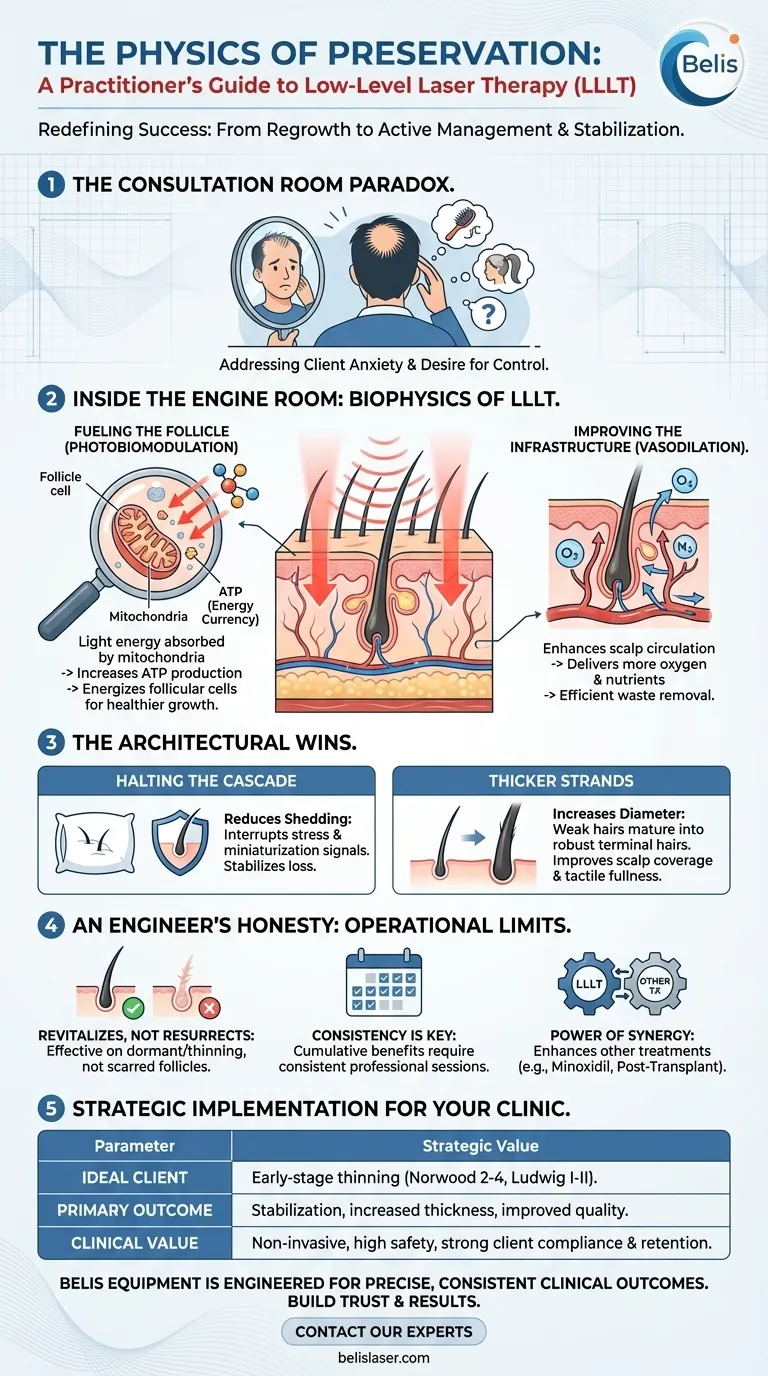
Visual Guide
Related Products
- Multifunctional Laser Hair Growth Machine Device for Hair Growth
- Multifunctional Laser Hair Growth Machine Device for Hair Growth
- Diode Tri Laser Hair Removal Machine for Clinic Use
- IPL SHR Hair Removal Machine for Permanent Hair Removal
- Clinic Diode Laser Hair Removal Machine with SHR and Trilaser Technology
Related Articles
- How to Optimize LLLT Hair Regrowth: A Science-Backed 3-Step Protocol
- How to Combine Hair Loss Treatments for Maximum Regrowth: A Science-Backed Guide
- The Two-Act Play of Hair Regrowth: Decoding the Cadence of Laser Therapy
- The Clinician's Guide to LLLT: From Cellular Mechanics to Client Confidence
- How IPL Treats Multiple Body Areas Safely: A Dermatologist-Approved Guide











