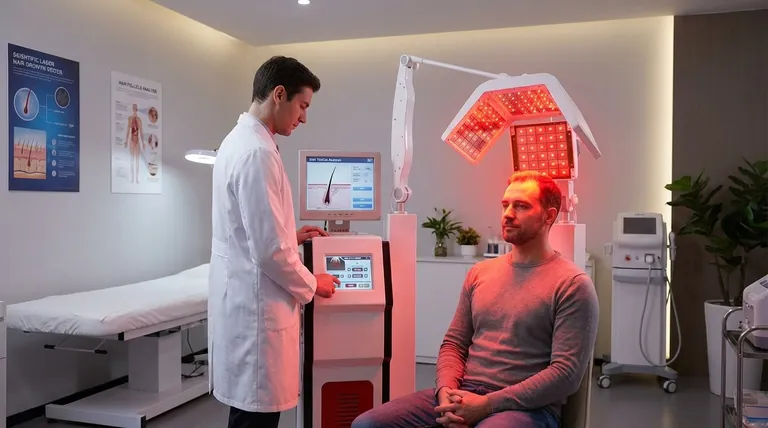
The Question Behind the Question
A client sits in your chair, pointing to their thinning hair. They’ve seen ads for at-home laser helmets and they ask a simple question: "Are they safe?"
For a clinical professional, this question is the tip of an iceberg. The client isn't just asking about physical safety. They are asking if the technology is real, if their hope for a solution is misplaced, and if they can trust you to guide them.
The fundamental safety of Low-Level Laser Therapy (LLLT) is well-established. The real challenge—and opportunity—for a professional lies in moving beyond that simple assurance to deliver genuine, predictable efficacy.
The Cellular Engine Room: Why LLLT is Fundamentally Safe
To build client trust, we must first master the mechanism. Unlike surgical or ablative lasers, LLLT devices don't operate on thermal energy. They don’t burn or cut.
Instead, they perform a delicate and elegant biological function.
The Principle: Photobiomodulation
The technology is formally known as photobiomodulation. It uses specific, low-energy wavelengths of red light that penetrate the scalp to the depth of the hair follicle.
This light energy is absorbed by mitochondria within the cells. It’s like providing a targeted energy source directly to the cellular powerhouses responsible for follicle health. The process is non-thermal and non-damaging.
From Dormant to Active
This energy absorption kicks off a cascade of metabolic events.
- ATP Production: It boosts the production of adenosine triphosphate (ATP), the universal energy currency of the cell.
- Follicular Shift: This surge of cellular energy can help awaken hair follicles from their dormant (telogen) phase and push them into the active growth (anagen) phase.
- Improved Circulation: It also enhances blood flow, delivering more vital oxygen and nutrients to the hair roots.
The result isn't magic. It's cellular engineering: creating the optimal conditions for existing follicles to produce thicker, stronger, and healthier hair.
Navigating the Real-World Risks: A Professional's Duty
While the technology is inherently safe, a professional's role is to manage the practical realities of treatment and set expectations. This is where clinical expertise separates a professional service from a consumer gadget.
Managing Minor, Transient Effects
The most common side effects are mild and temporary—a slight warmth, redness, or itchiness post-treatment. Some clients may also experience a brief period of increased shedding.
This is a critical moment for education. This shedding is not a sign of failure; it’s a positive indicator that follicles are clearing out old, weak hairs to make way for new, robust growth. Framing this correctly turns potential anxiety into a sign of progress.
The Critical Risk: Unmet Expectations
The greatest risk in LLLT is not physical harm; it's the erosion of client trust when a treatment proves ineffective.
This failure almost always stems from two sources:
- Incorrect Diagnosis: LLLT is most effective for androgenetic alopecia (pattern baldness). It is not a solution for hair loss from chemotherapy or autoimmune disorders like alopecia areata.
- Insufficient Technology: The device itself lacks the power or precision to deliver a therapeutic dose of light energy.
A professional diagnosis is the non-negotiable first step to protecting the client and the clinic's reputation.
From Consumer Gadgets to Clinical Instruments
The difference between a consumer device and professional equipment lies in a single engineering concept: dosimetry. The effectiveness of photobiomodulation is entirely dependent on delivering the right dose of energy.
| Parameter | Consumer-Grade Limitation | Professional-Grade Standard |
|---|---|---|
| Light Source | Often uses inexpensive LEDs, which diffuse light inconsistently. | Utilizes medical-grade laser diodes for coherent, focused energy delivery. |
| Wavelength | May vary or be outside the optimal therapeutic window. | Precisely calibrated to the 650-680 nm range for maximum mitochondrial absorption. |
| Energy & Coverage | Low diode count results in poor scalp coverage and insufficient energy fluence. | High number of diodes ensures total, uniform energy delivery across the treatment area. |
A device that fails on these parameters isn't just ineffective; it's a wasted investment in time and hope for the client.
Professional-grade systems, like those developed by BELIS, are engineered specifically to meet these clinical dosimetric standards. They are built not just to be safe, but to deliver the consistent, reproducible outcomes that form the foundation of a successful aesthetic practice.
Building a Hair Wellness Strategy
Integrating LLLT into your clinic is about more than just buying a machine. It's about building a comprehensive, trust-based program.
- Diagnose First, Treat Second: Always begin with a proper consultation to confirm the client is a suitable candidate for LLLT.
- Educate on the Process: Explain that results are gradual and require consistency. LLLT is a marathon, not a sprint. This manages expectations and encourages adherence.
- Equip for Efficacy: Investing in professional technology is an investment in your results. It gives you the confidence to stand behind your services because you know the engineering is sound.
Ultimately, the client's question about safety is an invitation to demonstrate your expertise. By explaining the science, managing expectations, and using clinically-proven equipment, you provide the answer they're truly seeking: a safe, effective, and trustworthy path forward.
To elevate your clinic's offerings with technology engineered for predictable results, Contact Our Experts.
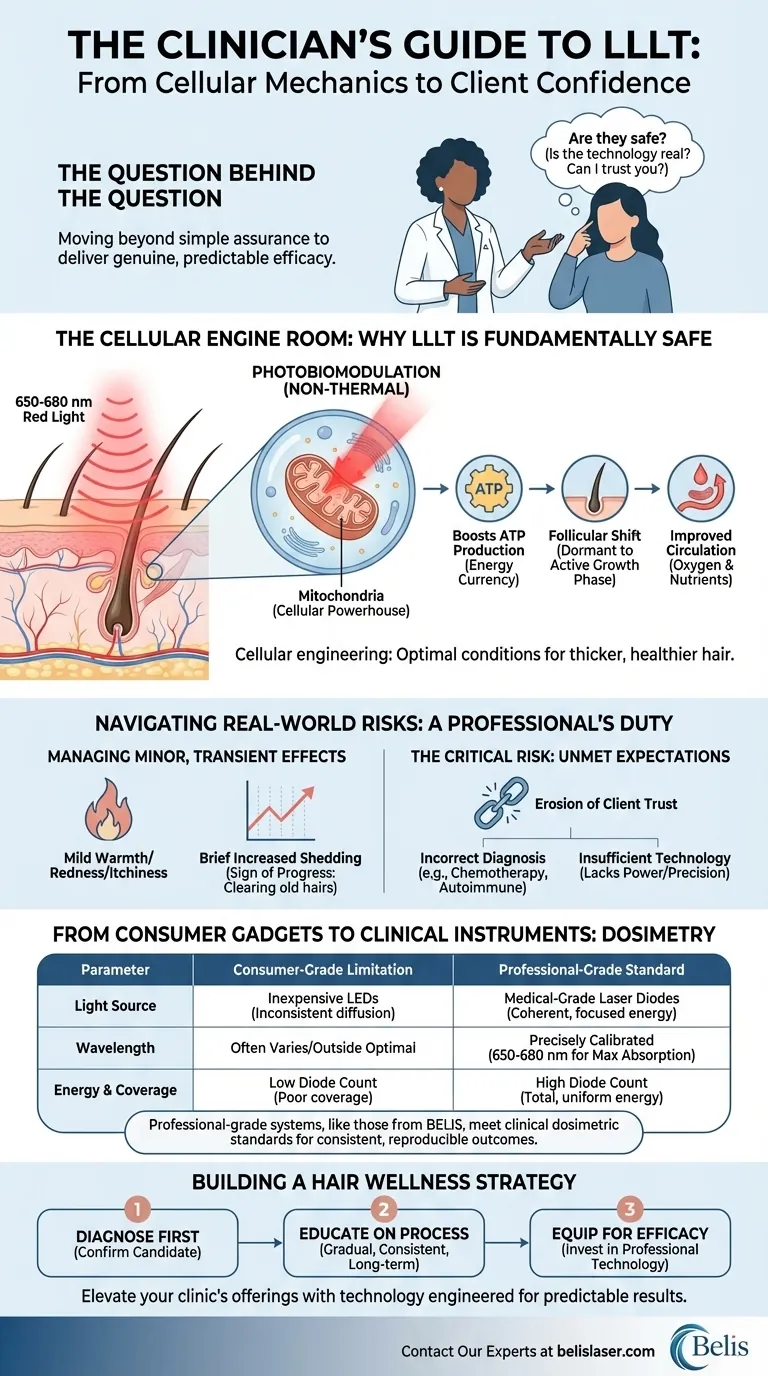
Visual Guide
Related Products
- Multifunctional Laser Hair Growth Machine Device for Hair Growth
- Multifunctional Laser Hair Growth Machine Device for Hair Growth
- Fractional CO2 Laser Machine for Skin Treatment
- Fractional CO2 Laser Machine for Skin Treatment
- Vaginal Tighten HIFU Gynecology HIFU Treatment
Related Articles
- How to Optimize LLLT Hair Regrowth: A Science-Backed 3-Step Protocol
- How to Combine Hair Loss Treatments for Maximum Regrowth: A Science-Backed Guide
- The Two-Act Play of Hair Regrowth: Decoding the Cadence of Laser Therapy
- How IPL Treats Multiple Body Areas Safely: A Dermatologist-Approved Guide
- Optimizing IPL for All Skin Types: Safety, Alternatives, and Expert Strategies










