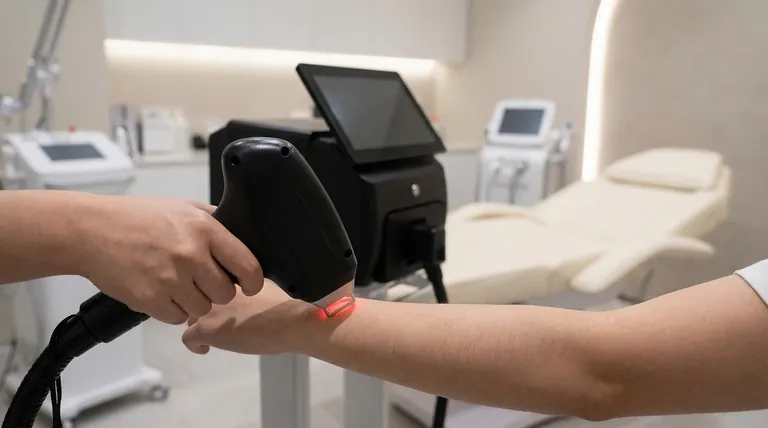
The Allure of "Permanent"
We are drawn to the idea of permanence. In a world of constant change, a one-time solution that lasts forever feels like the ultimate victory. This psychological pull is what makes "permanent hair removal" one of the most compelling promises in medical aesthetics.
But in biology, permanence is rarely an absolute. The body is a dynamic system, constantly regenerating. To achieve a lasting result, we can't just issue a single command; we must engage in a conversation with the body's own rules. This is the engineering truth at the heart of diode laser hair removal. It's not magic; it's a strategic battle waged against thousands of individual hair follicles, each on its own schedule.
A Conversation with Biology: Selective Photothermolysis
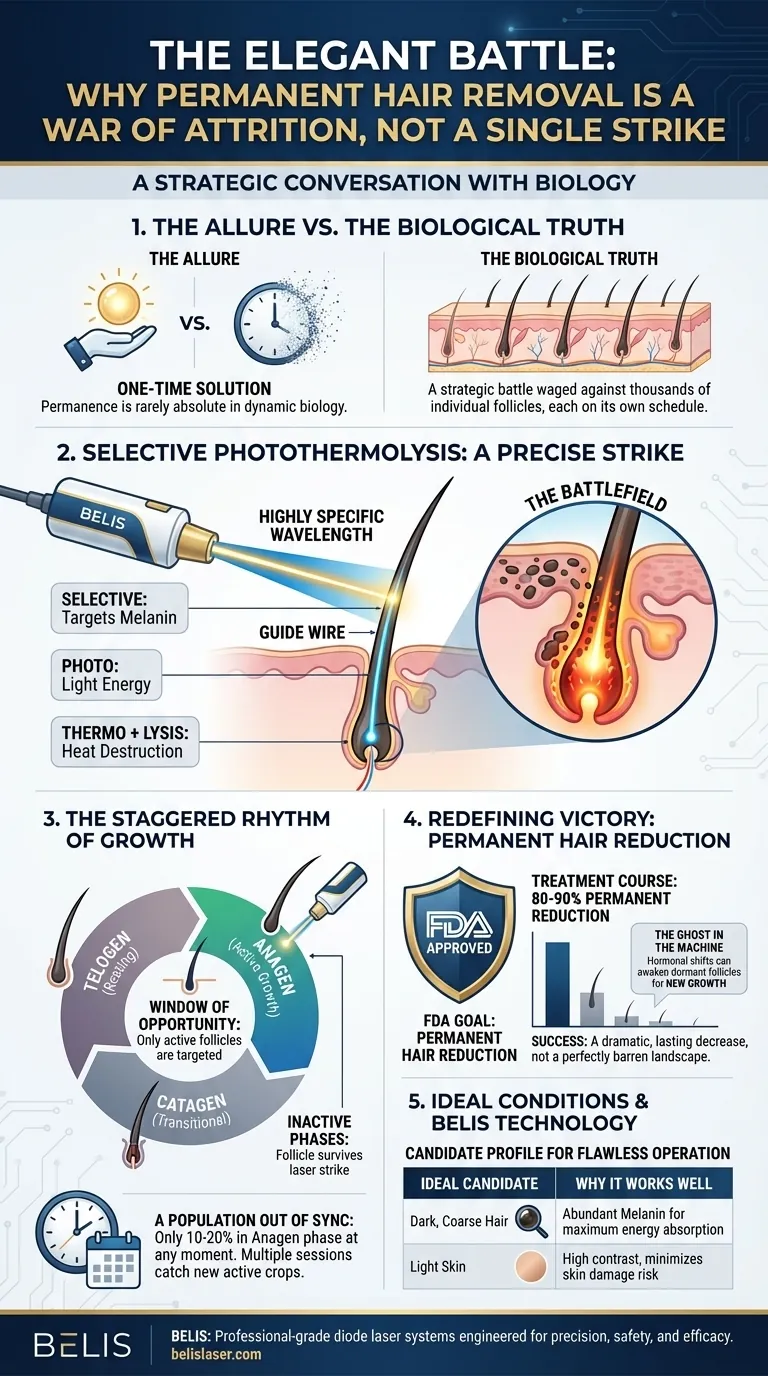
The core principle behind a diode laser is a beautiful piece of applied physics called "selective photothermolysis." It's an elegant solution to a complex problem.
- Selective: The laser emits a highly specific wavelength of light. This isn't a broad floodlight; it's a sniper's bullet calibrated for a single target: melanin, the pigment that gives hair its color.
- Photo (Light): The light energy travels down the hair shaft, which acts as a guide wire.
- Thermo (Heat) + Lysis (Destruction): As the melanin absorbs the light, the energy converts into intense, localized heat. This heat destroys the critical structures within the hair follicle responsible for growth, effectively disabling its ability to produce another hair.
The entire operation happens in milliseconds. It’s a clean, precise strike that leaves the surrounding skin tissue largely untouched. The quality of the laser system determines the precision of this strike, ensuring energy is delivered safely to the target and not the surrounding area.
The Staggered Rhythm of Growth
If the laser is so precise, why are multiple sessions necessary? Because the laser has a critical dependency: it can only destroy follicles that are in their active growth stage, known as the anagen phase.
The Anagen Phase: A Window of Opportunity
During the anagen phase, the hair is physically connected to the base of the follicle. This connection is the bridge that allows the thermal energy from the laser to travel from the hair shaft to the growth cells.
Hairs in other phases—the transitional (catagen) or resting (telogen) stages—have detached from this base. Firing a laser at them is like bombing an empty barracks. The hair itself may vaporize, but the factory—the follicle—remains unharmed, ready to produce a new hair when its cycle begins again.
A Population Out of Sync
At any given moment, only a fraction of your hair follicles (typically 10-20%) are in the anagen phase. The rest are dormant or transitioning.
This is the fundamental reason for a treatment course. Each session targets the current crop of active follicles. The next session, scheduled 4-8 weeks later, catches a new group that has since entered the anagen phase. The war is won through a series of planned, successive battles, not a single, all-out assault.
Redefining Victory: What Success Looks Like
Understanding the biological process allows us to set clear, realistic expectations. The goal defined by the FDA is not "total hair eradication" but "permanent hair reduction."
This isn't just semantics; it's an honest description of the outcome.
- The 80-90% Rule: A completed course of treatments typically results in a permanent reduction of 80-90% of hair. The remaining hairs are often finer, lighter, and far less noticeable. For most people, this outcome is life-changing.
- The Ghost in the Machine: Hormonal shifts, such as those during pregnancy or menopause, can sometimes awaken previously dormant follicles. This is new growth, not regrowth from a treated follicle. Occasional touch-up sessions, perhaps once a year, can easily manage this.
Success is not a perfectly barren landscape forever. Success is a dramatic, lasting, and predictable decrease in hair that frees a person from the endless cycle of temporary removal methods.
The Conditions for a Flawless Operation
The physics of the laser-melanin interaction dictates the ideal circumstances for treatment.
| Candidate Profile | Why It Works Well |
|---|---|
| Dark, Coarse Hair | Contains abundant melanin to absorb maximum laser energy. |
| Light Skin | Provides high contrast, minimizing the risk of the surrounding skin absorbing energy. |
This contrast is key. It allows the clinician to use an energy level that is potent enough to destroy the follicle while remaining completely safe for the skin. While modern, professional-grade systems have expanded the range of treatable skin types, the principle of contrast remains the guiding factor for efficacy.
For clinics committed to delivering these predictable and profound results, having equipment that performs with unwavering precision is paramount. BELIS provides professional-grade diode laser systems engineered for medical aesthetic clinics that demand safety, efficacy, and client satisfaction.
This isn't about simply offering a service; it's about mastering a technology to work in concert with human biology. When you understand the elegant battle being waged at the microscopic level, you can deliver results that aren't just permanent, but truly transformative. Contact Our Experts
Visual Guide
Related Products
- Diode Laser SHR Trilaser Hair Removal Machine for Clinic Use
- Clinic Diode Laser Hair Removal Machine with SHR and Trilaser Technology
- Diode Tri Laser Hair Removal Machine for Clinic Use
- Trilaser Diode Hair Removal Machine for Beauty Clinic Use
- Clinic Use IPL SHR ND YAG Laser Hair Removal RF Skin Tightening Machine
Related Articles
- The Physics of Trust: Why a Single Wavelength Changes Everything in Hair Removal
- The Specialist's Blade: The Unseen Advantage of Diode Lasers in Hair Removal
- Diode vs. IPL: How to Choose the Right Technology for Your Clinic’s Skin Diversity and Goals
- Diode Laser vs. TRILASER-LED: Which Hair Removal Technology Fits Your Skin Type?
- The Paradox of Patience: Why What You Do *After* Diode Laser Hair Removal Defines Its Success













