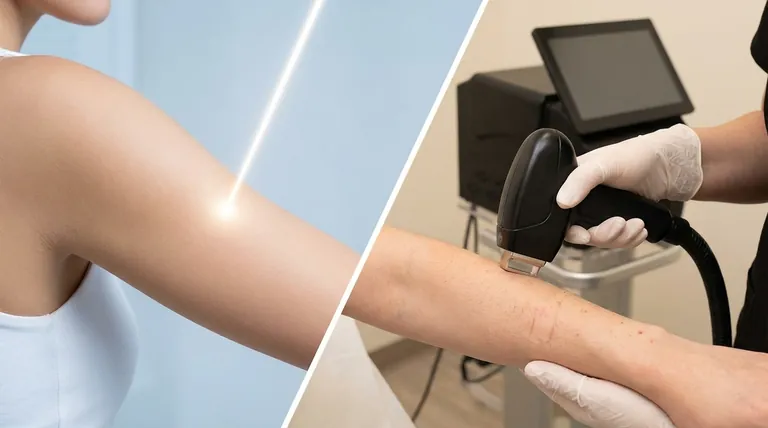
The Psychology of a Permanent Solution
We are psychologically wired to seek definitive solutions. We want the "one-and-done" fix, the silver bullet. This desire is especially strong when it comes to tedious, repetitive tasks like shaving or waxing.
The promise of "permanent hair removal" taps directly into this cognitive bias. But in the world of medical aesthetics, where biology meets physics, the word "permanent" has a more nuanced, and ultimately more honest, definition.
The gap between a patient's expectation of absolute hairlessness and the clinical reality of hair reduction is the single most important concept to grasp.
The Elegance of a Targeted System
To understand the results, you must first appreciate the engineering. Laser hair removal isn't a brute-force approach; it's a mission of remarkable precision.
A Controlled Collision of Light and Pigment
The technology works by firing a highly concentrated beam of light at a specific target: the melanin (pigment) within the hair shaft. This light energy is instantly converted into thermal energy.
This intense, localized heat travels down the hair shaft and damages the hair follicle—the tiny organ responsible for producing that hair. It's an elegant solution that attacks the source, not just the symptom. The goal isn't to remove the hair that exists today, but to disable the factory that will create the hair of tomorrow.
The Tyranny of the Biological Clock
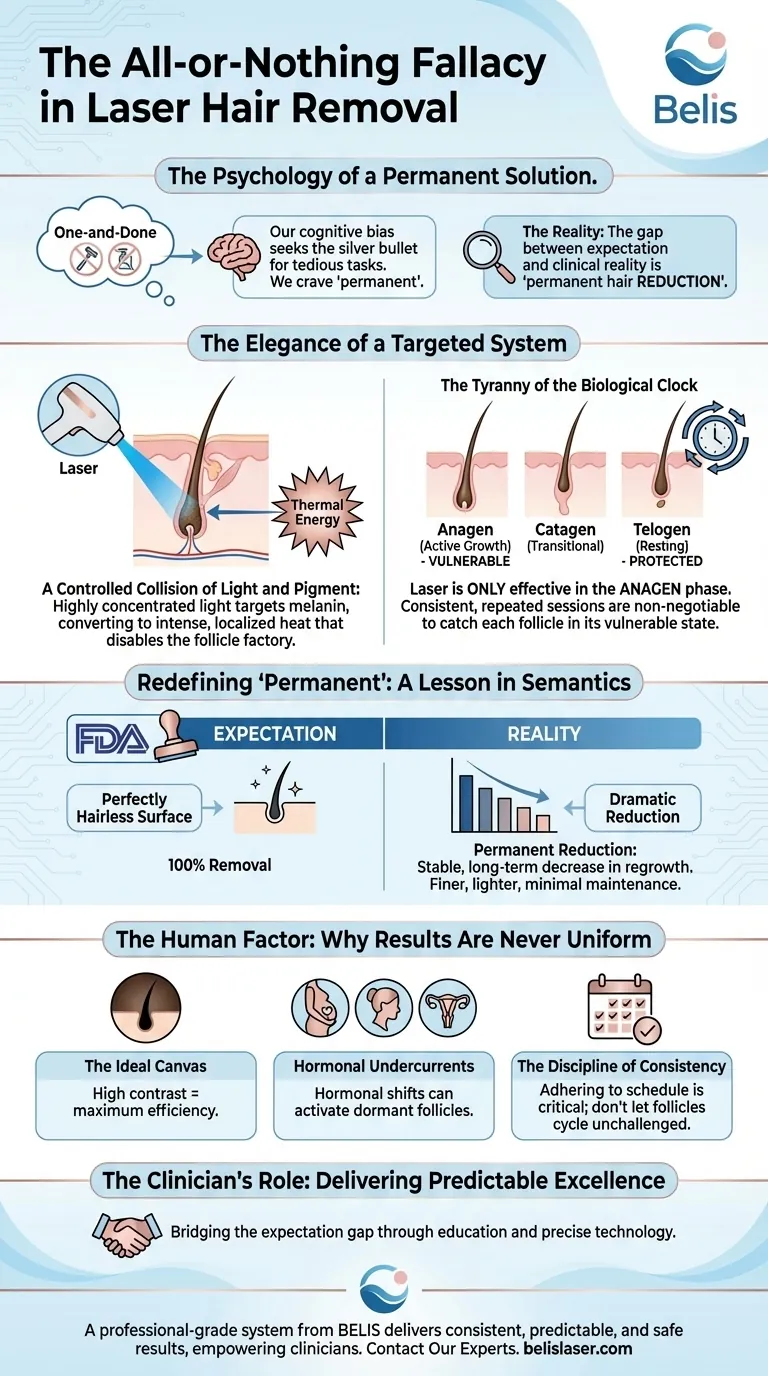
Here, the elegant physics collides with messy biology. The laser is only effective when the hair is in its active growth phase, known as the anagen phase. Only during this window is the hair firmly connected to the follicle, providing a perfect conduit for the laser's thermal energy.
But at any given moment, only a fraction of your hair is in this phase. The rest is in a transitional (catagen) or resting (telogen) state.
This is the non-negotiable biological constraint. It's why a single session can never be enough. Consistent, repeated treatments are required to systematically catch each follicle in its vulnerable anagen phase.
Redefining "Permanent": A Lesson in Semantics
The U.S. Food and Drug Administration (FDA) is famously precise with its language. Their classification of laser hair removal as "permanent hair reduction" is not a marketing loophole; it is a statement of scientific accuracy.
What Success Actually Looks Like
"Permanent reduction" means a stable, long-term decrease in the number of hairs re-growing after a full course of treatment.
In practice, this is what clients experience:
- A dramatic and life-changing reduction in hair density.
- Any hair that does regrow is typically finer, lighter, and far less noticeable.
- The need for shaving or waxing becomes minimal, sometimes reduced to a few times a year.
It's not about achieving a perfectly sterile, hairless surface for life. It's about trading a daily nuisance for occasional, simple maintenance.
The Human Factor: Why Results Are Never Uniform
The clinical outcome is a function of the technology, the treatment protocol, and the individual's unique physiology.
- The Ideal Canvas: The physics works best when there is high contrast. Dark, coarse hair on light skin allows the laser to find its target with maximum efficiency and minimal risk to the surrounding skin.
- Hormonal Undercurrents: The body is not a static system. Hormonal shifts due to pregnancy, menopause, or conditions like PCOS can activate dormant follicles, leading to new hair growth. This isn't a failure of the treatment, but a new chapter in the body's story.
- The Discipline of Consistency: Adhering to the recommended treatment schedule is critical. Spacing sessions too far apart gives follicles time to cycle through their anagen phase unchallenged, undermining the entire process.
Reality Check: Laser vs. Expectation
| Key Aspect | The Psychological Hope | The Clinical Reality |
|---|---|---|
| Outcome | 100% permanent removal | Significant, permanent reduction |
| Effort | One-time "fix" | A series of treatments + maintenance |
| Regrowth | None, ever | Finer, lighter, and far less |
| Universality | Works for everyone | Effectiveness varies with hair/skin type |
The Clinician's Role: Delivering Predictable Excellence
For medical aesthetic clinics and premium salons, success hinges on bridging this expectation gap. It requires educating the client on the biological realities and then using technology powerful and precise enough to deliver the best possible outcome within those realities.
This is where the quality of the equipment becomes paramount. A professional-grade system from BELIS is designed not just to perform a function, but to deliver consistent, predictable, and safe results. Our advanced medical aesthetic equipment empowers clinicians to provide the superior 'permanent reduction' their clients seek, building the trust that is the foundation of any successful practice.
To deliver this level of predictable, high-quality reduction, the right technology is non-negotiable. Contact Our Experts
Visual Guide
Related Products
- Diode Tri Laser Hair Removal Machine for Clinic Use
- Diode Laser SHR Trilaser Hair Removal Machine for Clinic Use
- Clinic Diode Laser Hair Removal Machine with SHR and Trilaser Technology
- Clinic Use IPL SHR ND YAG Laser Hair Removal RF Skin Tightening Machine
- Trilaser Diode Hair Removal Machine for Beauty Clinic Use
Related Articles
- The Specialist's Blade: The Unseen Advantage of Diode Lasers in Hair Removal
- Diode Laser vs. TRILASER-LED Hair Removal: Which Technology Delivers Better Results?
- A Dialogue of Light and Pigment: The Precise Science of Diode Laser Hair Removal
- Diode Laser vs. TRILASER-LED: Which Hair Removal Technology Fits Your Skin Type?
- Diode vs. IPL: How to Choose the Right Technology for Your Clinic’s Skin Diversity and Goals

















