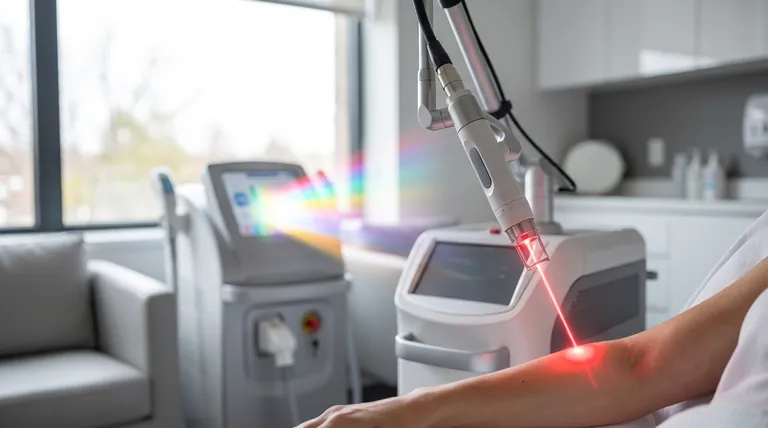
A Tale of Two Lights
In the world of medical aesthetics, practitioners face a fundamental choice when it comes to light-based treatments: Do you use a sniper rifle or a shotgun?
This isn't a frivolous question. It’s the single best analogy for understanding the profound difference between Laser and Intense Pulsed Light (IPL).
Both technologies use light to generate heat and achieve a clinical goal. But how they deliver that light changes everything—from the results you can promise your clients to the long-term reputation of your clinic. The choice reflects a philosophy: Are you aiming for a specific, decisive outcome, or are you casting a wide, less powerful net?
The Sniper and the Shotgun: A Mental Model
Imagine your target is a single hair follicle, deep within the skin.
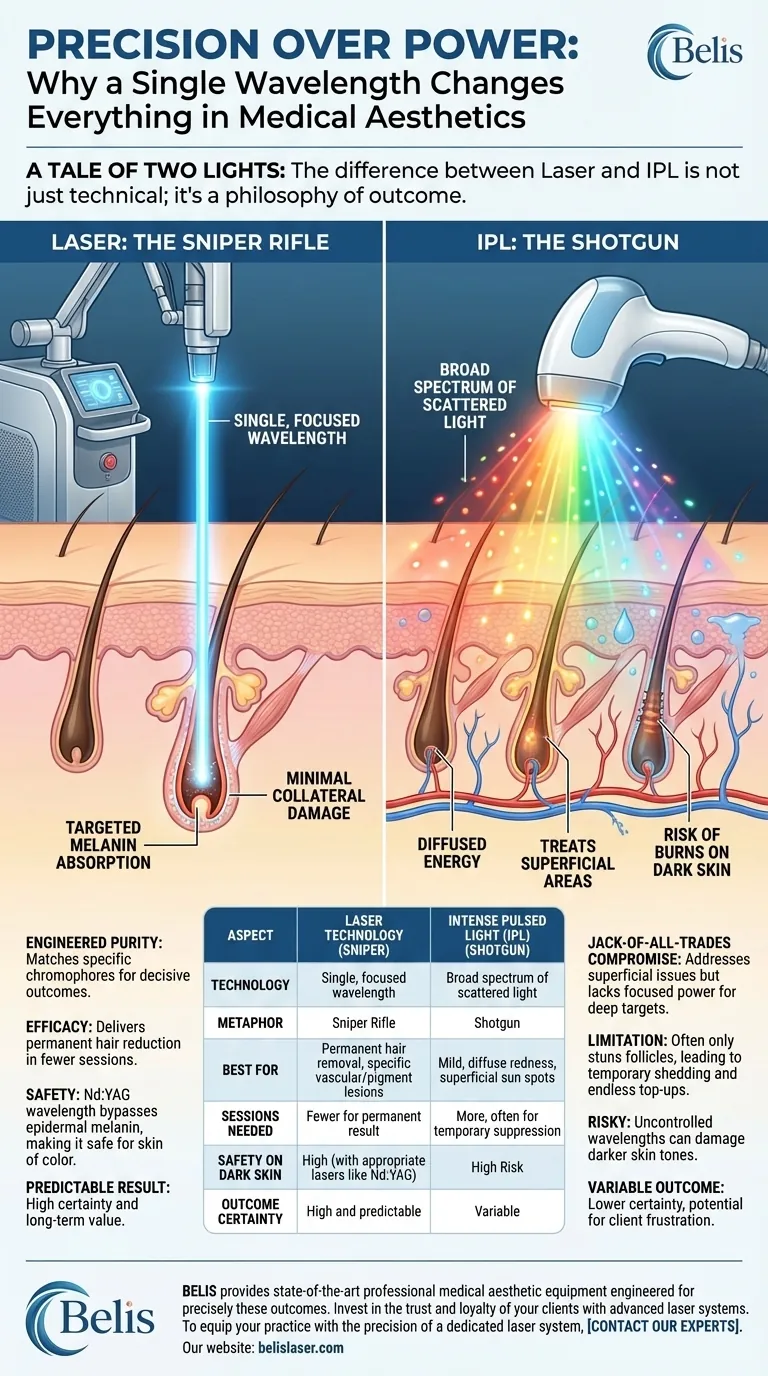
A laser is the sniper rifle. It emits a single, pure, and coherent wavelength of light. This beam is engineered to be absorbed by one specific target—the melanin in the hair follicle. All of its energy is focused on that one job, executing it with minimal collateral damage to the surrounding skin. It's precise, deep, and ruthlessly efficient.
IPL, by contrast, is the shotgun. It releases a broad spectrum of scattered, incoherent light wavelengths, like a powerful camera flash. This blast of light hits many things at once—melanin, blood vessels, water in the skin—but with diffused energy. It addresses a wide area superficially but lacks the focused power to neutralize a deep, stubborn target with finality.
This core difference isn't just technical jargon. It is the physical principle that dictates success or failure.
The Physics of a Predictable Result
The trust a client places in a clinic is built on predictable, repeatable outcomes. This predictability is born from the physics of the device you use.
The Laser’s Singular Mission
The elegance of a medical laser lies in its purity. By using a single wavelength, it can be perfectly matched to a specific chromophore (the light-absorbing molecule).
- For Hair Removal: An Alexandrite or Diode laser's wavelength is greedily absorbed by melanin, channeling thermal energy directly to the follicle's root and destroying its ability to regrow.
- For Darker Skin: An Nd:YAG laser uses a longer wavelength that bypasses the melanin in the epidermis, making it the gold standard for safely treating hair follicles in skin of color without risking burns or pigmentation changes.
This is the engineer's romance: designing a tool so perfectly attuned to its task that the outcome is not a matter of chance, but of physics.
IPL’s Jack-of-All-Trades Compromise
IPL's broad spectrum is both its defining feature and its greatest limitation. Because it can't focus its energy, it often fails where it matters most.
For a task like permanent hair removal, the scattered energy may only be enough to stun the hair follicle, not destroy it. This leads to temporary shedding, client frustration, and the need for endless "top-up" sessions. It treats the symptom without solving the problem.
Why This Matters in Your Clinic
The technical difference translates directly into business and clinical consequences. Choosing a laser is an investment in certainty.
1. Efficacy: Delivering on the Promise of Permanence
Because lasers deliver a more potent, concentrated dose of energy to the target, they achieve permanent hair reduction in significantly fewer sessions than IPL. This respects the client's time and money, building a reputation for delivering lasting value, not just temporary fixes.
2. Safety: The Mandate of Wavelength Control
The greatest risk with light-based treatments is causing unintended damage. IPL's uncontrolled, multi-wavelength approach makes it inherently riskier for darker skin tones, where the epidermal melanin can absorb too much energy, leading to burns or dyspigmentation.
A dedicated laser, like an Nd:YAG, is not just a better choice for Fitzpatrick IV-VI skin types; it is the only professionally responsible choice.
3. The Psychological Cost of "Good Enough"
Using a less effective tool can slowly erode client trust. When results from an IPL treatment are underwhelming, clients don't blame the physics of scattered light; they blame the clinic. The initial appeal of a "versatile" machine can quickly be outweighed by the long-term cost of a damaged reputation.
Choosing the Right Tool for the Job
While laser is the undisputed champion for specific, deep targets, IPL has a niche. Its strength lies in treating broad, superficial issues where precision is less critical.
| Aspect | Laser Technology | Intense Pulsed Light (IPL) |
|---|---|---|
| Technology | Single, focused wavelength | Broad spectrum of scattered light |
| Metaphor | Sniper Rifle | Shotgun |
| Best For | Permanent hair removal, specific vascular/pigment lesions | Mild, diffuse redness, superficial sun spots |
| Sessions Needed | Fewer for a permanent result | More, often for temporary suppression |
| Safety on Dark Skin | High (with appropriate lasers like Nd:YAG) | High Risk |
| Outcome Certainty | High and predictable | Variable |
For a professional clinic dedicated to providing the best possible outcomes, the choice is clear. Specialization and precision are not luxuries; they are the foundation of clinical excellence. Investing in advanced laser systems is an investment in the trust and loyalty of your clients.
BELIS provides state-of-the-art professional medical aesthetic equipment engineered for precisely these outcomes. Our laser systems are built to deliver the safety, efficiency, and permanent results that distinguish a leading clinic from the rest.
To equip your practice with the precision of a dedicated laser system, Contact Our Experts.
Visual Guide
Related Products
- Clinic Diode Laser Hair Removal Machine with SHR and Trilaser Technology
- Q Switch Nd Yag Laser Machine Tattoo Removal Nd Yag Machine
- 9D 7D HIFU Vaginal RF Lifting Treatment
- EMSlim RG Laser Body Sculpting and Slimming Machine
- Clinic Use IPL and SHR Hair Removal Machine with Nd Yag Laser Tattoo Removal
Related Articles
- Beyond 'Permanent': The Biological Rhythm of Diode Laser Hair Removal
- Diode Laser Hair Removal: A Personalized Guide for Your Skin & Hair Type
- Diode Laser vs. TRILASER-LED: Which Hair Removal Technology Fits Your Skin Type?
- Diode Laser vs. TRILASER-LED Hair Removal: Which Technology Delivers Better Results?
- The Specialist's Blade: The Unseen Advantage of Diode Lasers in Hair Removal


















