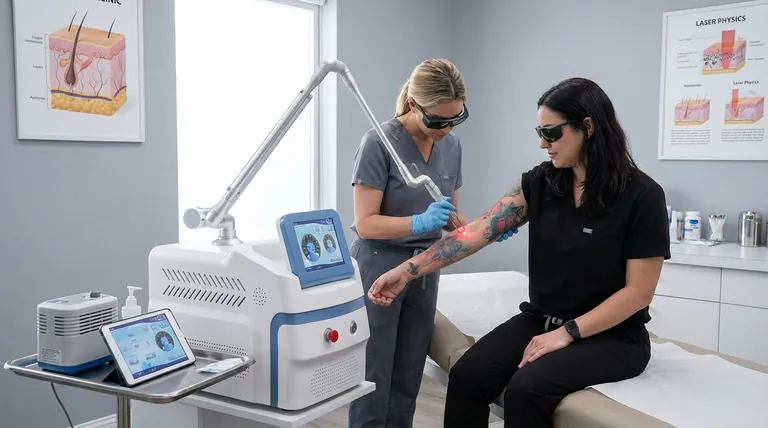
Tattoo removal has evolved beyond a one-size-fits-all approach. Clinics now face the challenge of safely eliminating diverse ink colors while protecting varying skin types—all while maximizing their equipment investment. This guide decodes laser-tattoo interactions, offers Fitzpatrick-scale-adapted protocols, and compares leading technologies with real-world case studies to help practitioners achieve consistent, skin-safe results.
Laser-Tattoo Pigment Interactions Decoded
Why Ink Colors Dictate Laser Choices
Tattoo inks absorb specific light wavelengths like sponges soaking up water. Black ink readily absorbs all wavelengths, making it the easiest to treat. But colored pigments? They’re picky.
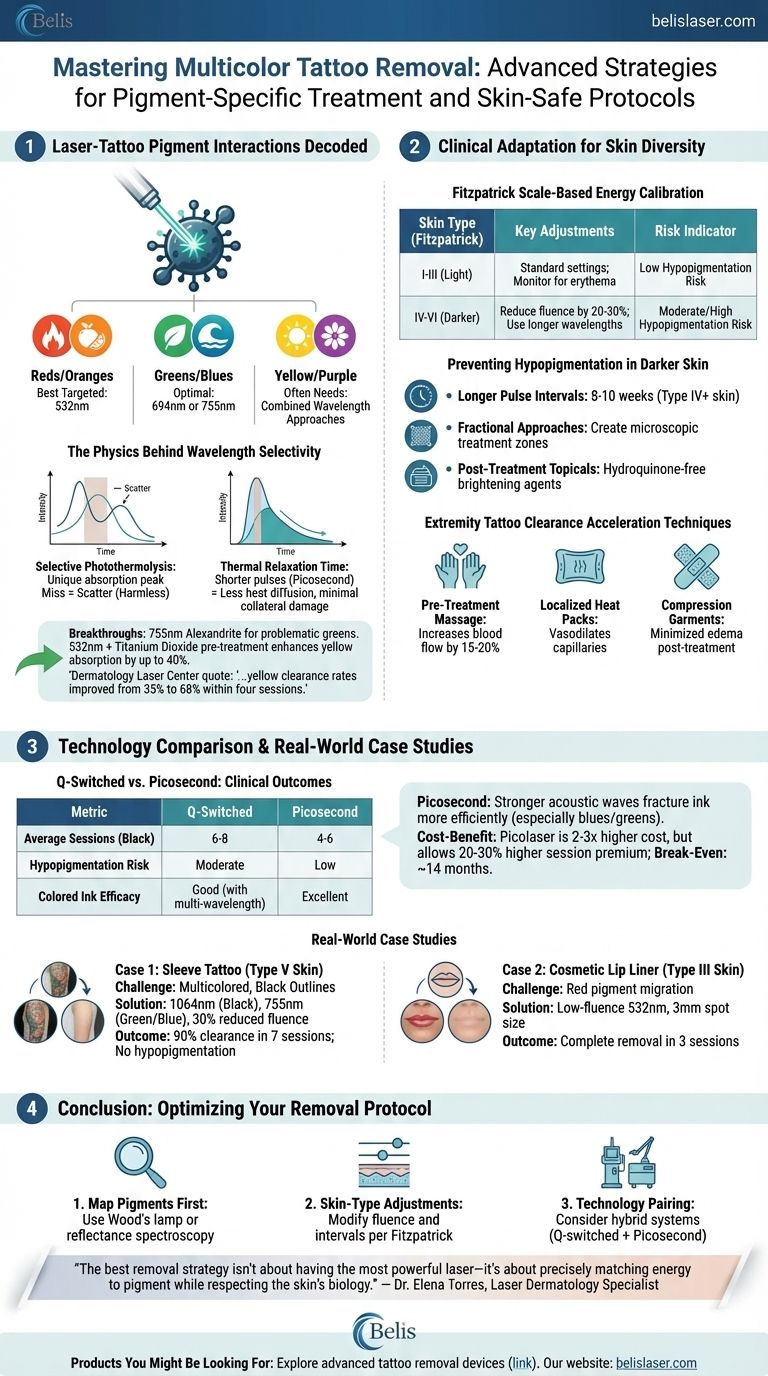
- Reds/Oranges: Best targeted by 532nm wavelengths
- Greens/Blues: Require 694nm or 755nm for optimal breakdown
- Yellow/Purple: Often need combined wavelength approaches
Ever wondered why some stubborn green inks persist after multiple sessions? The answer lies in their molecular structure.
The Physics Behind Wavelength Selectivity
Lasers work by delivering energy in billionth-of-a-second pulses (Q-switched) or trillionth-of-a-second bursts (picosecond). This energy gets absorbed by ink particles, causing them to shatter. But here’s the catch:
- Selective Photothermolysis: Each pigment has a unique "absorption peak"—the wavelength it most readily absorbs. Miss this peak, and energy scatters harmlessly into surrounding tissue.
- Thermal Relaxation Time: Shorter pulse durations (like picosecond lasers) reduce heat diffusion, minimizing collateral damage—especially crucial for delicate areas.
Green/Yellow Ink Removal Breakthroughs
Recent advancements in 755nm Alexandrite lasers show remarkable efficacy against problematic greens. For yellows, combining 532nm with topical titanium dioxide preparations can enhance absorption by up to 40%. Clinicians report:
"After adjusting our protocol to include pre-treatment pigment enhancers, yellow clearance rates improved from 35% to 68% within four sessions." — Dermatology Laser Center case log
Clinical Adaptation for Skin Diversity
Fitzpatrick Scale-Based Energy Calibration
Skin type isn’t just about color—it’s about melanin concentration and its potential to compete with ink for laser energy.
| Skin Type (Fitzpatrick) | Key Adjustments |
|---|---|
| I-III (Light) | Standard settings; monitor for erythema |
| IV-VI (Darker) | Reduce fluence by 20-30%; use longer wavelengths |
Preventing Hypopigmentation in Darker Skin
Hypopigmentation occurs when melanocytes absorb excessive energy. Prevention strategies include:
- Longer Pulse Intervals: 8-10 weeks between sessions for Type IV+ skin
- Fractional Approaches: Creating microscopic treatment zones to preserve melanocyte-rich areas
- Post-Treatment Topicals: Hydroquinone-free brightening agents to regulate melanin production
Extremity Tattoo Clearance Acceleration Techniques
Tattoos on limbs clear slower due to reduced circulation. Proven accelerators:
- Pre-Treatment Massage: Increases blood flow by 15-20%
- Localized Heat Packs: Applied pre-laser to vasodilate capillaries
- Compression Garments: Worn post-treatment to minimize edema
Technology Comparison in Practice
Q-Switched vs. Picosecond: Clinical Outcome Studies
| Metric | Q-Switched | Picosecond |
|---|---|---|
| Average Sessions Needed (Black Ink) | 6-8 | 4-6 |
| Hypopigmentation Risk | Moderate | Low |
| Colored Ink Efficacy | Good (with multi-wavelength) | Excellent |
Picosecond lasers’ ultra-short pulses create stronger acoustic waves, fracturing ink more efficiently—especially beneficial for blues and greens. However, their higher cost demands careful ROI analysis.
Cost-Benefit Analysis of Picolaser Adoption
A clinic performing 50 removals/month would see:
- Equipment Cost: 2-3x higher than Q-switched systems
- Session Premium: Ability to charge 20-30% more per treatment
- Break-Even Point: ~14 months with moderate caseload
Real-World Case Studies: From Neon to Blackwork
Case 1: Sleeve Tattoo (Type V Skin)
- Challenge: Multicolored design with black outlines
- Solution: 1064nm for black, 755nm for green/blue, 30% reduced fluence
- Outcome: 90% clearance in 7 sessions; no hypopigmentation
Case 2: Cosmetic Lip Liner (Type III Skin)
- Challenge: Red pigment migration
- Solution: Low-fluence 532nm with 3mm spot size
- Outcome: Complete removal in 3 sessions
Conclusion: Optimizing Your Removal Protocol
- Map Pigments First: Use Wood’s lamp or reflectance spectroscopy to identify dominant colors
- Skin-Type Adjustments: Modify fluence and intervals per Fitzpatrick guidelines
- Technology Pairing: Consider hybrid systems (Q-switched + picosecond) for clinics handling diverse cases
For clinics investing in Belis beauty equipment, selecting modular platforms that offer both nanosecond and picosecond capabilities future-proofs your practice against evolving pigment trends.
"The best removal strategy isn’t about having the most powerful laser—it’s about precisely matching energy to pigment while respecting the skin’s biology." — Dr. Elena Torres, Laser Dermatology Specialist
By adopting these pigment-specific, skin-adaptive approaches, clinics can transform challenging removals into predictable, profitable procedures.
Products You Might Be Looking For:
Explore advanced tattoo removal devices
Visual Guide
Related Products
- Pico Laser Tattoo Removal Machine Picosure Picosecond Laser Machine
- Clinic Use IPL and SHR Hair Removal Machine with Nd Yag Laser Tattoo Removal
- Q Switch Nd Yag Laser Machine Tattoo Removal Nd Yag Machine
- Diode Tri Laser Hair Removal Machine for Clinic Use
- Clinic Use IPL SHR ND YAG Laser Hair Removal RF Skin Tightening Machine
Related Articles
- How to Choose the Right Pico Laser Machine for Your Skin Type and Concerns
- How the Articulated Arm in Pico Laser Machines Delivers Unmatched Precision and Efficiency
- How Pico Laser Machines Revolutionize Skin Treatments: Evidence-Based Insights
- How to Choose Pico Laser Treatment Based on Skin Science (Not Brand Names)
- Pico Laser Explained: How Ultra-Fast Pulses Transform Skin Health







