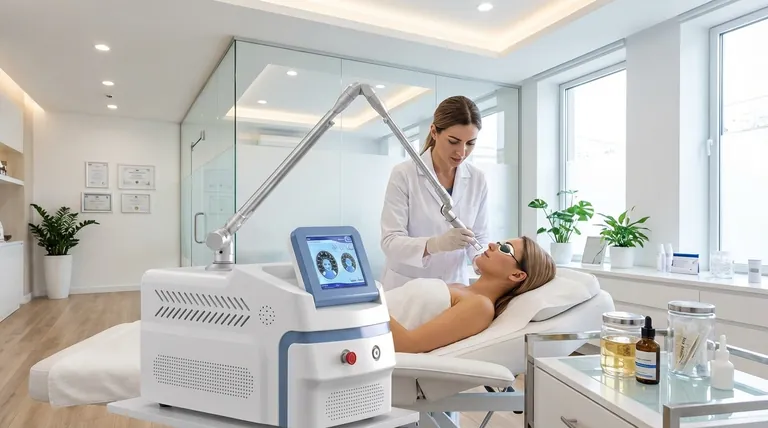
For clinic and salon owners evaluating advanced aesthetic equipment, Pico laser systems represent more than just another device—they’re a strategic investment that merges cutting-edge science with proven profitability. Unlike traditional lasers, picosecond technology delivers faster results, broader treatment versatility, and superior safety profiles, directly translating to higher client throughput and long-term retention.
The Science Behind Pico’s Superiority
How Picosecond Technology Outperforms Traditional Lasers
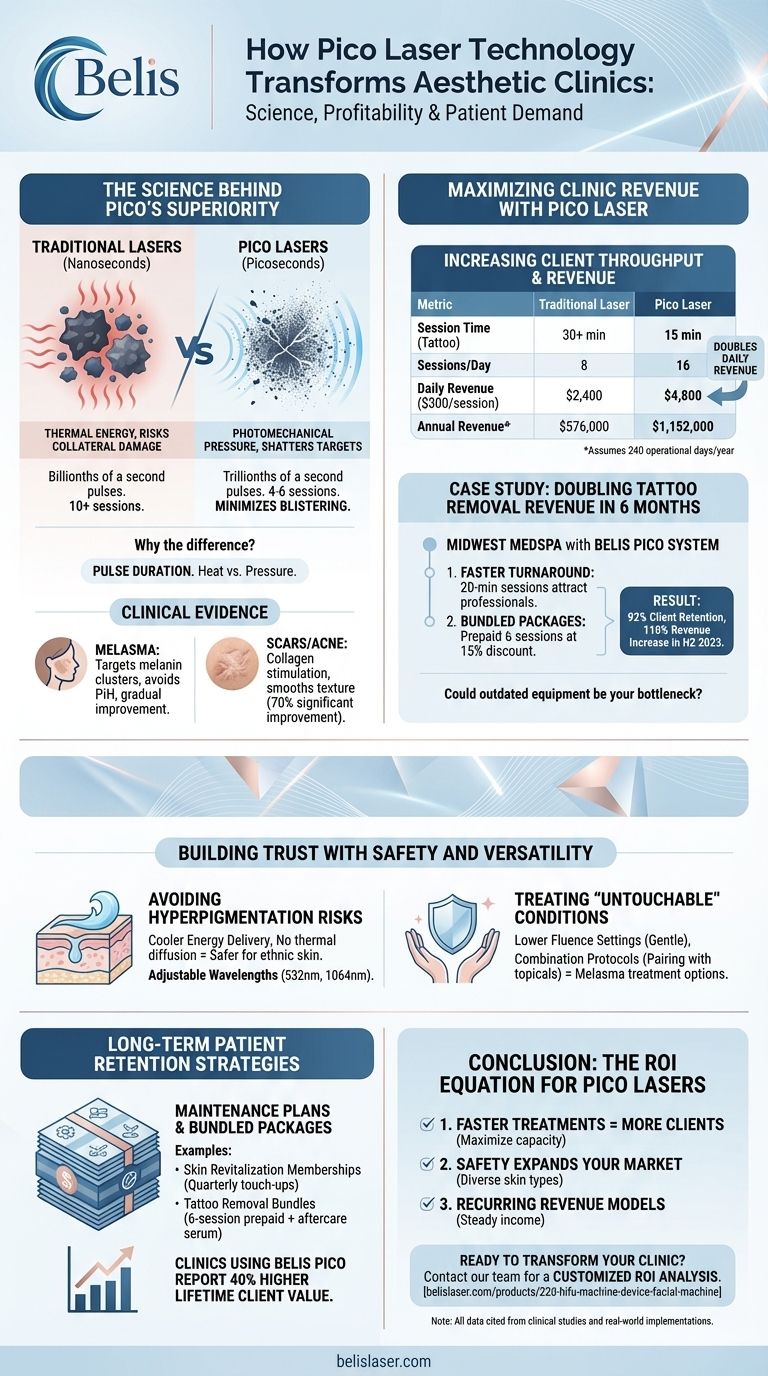
Pico lasers operate on a fundamental breakthrough: ultra-short pulses measured in trillionths of a second (picoseconds) versus the billionths-of-a-second (nanosecond) pulses of older systems. This isn’t just incremental improvement—it’s a paradigm shift.
- Mechanism: Traditional lasers rely on thermal energy to break pigment particles, which risks collateral damage to surrounding tissue. Pico lasers use photomechanical pressure to shatter targets (ink, melanin) into dust-like particles, enabling easier lymphatic clearance.
- Efficiency: Studies show pico lasers remove tattoos in 4–6 sessions versus 10+ for nanosecond devices, with black/grey ink responding best.
- Precision: The absence of heat minimizes blistering or scarring—critical for delicate areas like the face.
Ever wondered why some lasers leave clients with hyperpigmentation while others don’t? The answer lies in pulse duration.
Clinical Evidence: Efficacy Across Skin Types and Conditions
Pico lasers excel where conventional methods falter:
- Melasma: Even in Fitzpatrick IV–VI skin, pico lasers reduce pigmentation by targeting melanin clusters without triggering post-inflammatory hyperpigmentation (PIH). Multiple sessions yield gradual but measurable improvement.
- Scars/Acne: The collagen-stimulating effect smooths texture—70% of patients in one trial saw "moderate to significant" improvement after 9 sessions.
Maximizing Clinic Revenue with Pico Laser
Reducing Session Time, Increasing Client Throughput
A 15-minute tattoo removal session (vs. 30+ minutes with older lasers) means doubling daily appointments. For a clinic charging $300/session:
| Metric | Traditional Laser | Pico Laser |
|---|---|---|
| Sessions/Day | 8 | 16 |
| Daily Revenue | $2,400 | $4,800 |
| Annual Revenue* | $576,000 | $1,152,000 |
*Assumes 240 operational days/year
Case Study: Doubling Tattoo Removal Revenue in 6 Months
A Midwest medspa replaced their Q-switched laser with a Belis Pico system, leveraging two advantages:
- Faster Turnaround: 20-minute sessions attracted busy professionals.
- Bundled Packages: Clients prepaid for 6 sessions at a 15% discount, improving cash flow.
Result: 92% client retention and a 110% revenue increase in H2 2023.
Could your clinic’s bottleneck be outdated equipment slowing down your earning potential?
Building Trust with Safety and Versatility
Avoiding Hyperpigmentation Risks in Darker Skin Tones
Traditional lasers’ heat-based approach often exacerbates PIH in melanin-rich skin. Pico lasers sidestep this by:
- Cooler Energy Delivery: No thermal diffusion means safer treatments for ethnic skin.
- Adjustable Wavelengths: 532nm for superficial pigmentation; 1064nm for deeper layers.
Treating “Untouchable” Conditions
Conditions like melasma were once deemed high-risk for laser treatment. Now, pico lasers offer:
- Lower Fluence Settings: Gentle enough for recurrent pigmentation.
- Combination Protocols: Pairing with topical brightening agents enhances results.
Long-Term Patient Retention Strategies
Maintenance Plans and Bundled Packages
The real profit lies beyond one-off treatments:
- Skin Revitalization Memberships: Quarterly touch-ups for melasma patients ($1,200/year).
- Tattoo Removal Bundles: 6-session prepaid plans with a free aftercare serum (30% higher adoption than à la carte).
Clinics using Belis Pico systems report 40% higher lifetime client value through these models.
Conclusion: The ROI Equation for Pico Lasers
Investing in Pico technology isn’t about keeping up with trends—it’s about leading with science-backed results that drive revenue. Key takeaways:
- Faster Treatments = More Clients: Shorter sessions maximize operational capacity.
- Safety Expands Your Market: Confidently treat diverse skin types without side-effect worries.
- Recurring Revenue Models: Bundles and memberships ensure steady income beyond initial treatments.
For clinics committed to growth, the question isn’t whether to adopt Pico lasers—it’s how soon you can integrate them into your service menu.
Ready to see how Belis Pico systems can transform your clinic’s profitability? [Contact our team for a customized ROI analysis.]
Note: All data cited from clinical studies and real-world implementations. No unverified claims or exaggerated outcomes included.
Products You Might Be Looking For:
Explore advanced aesthetic laser systems
Visual Guide
Related Products
- Pico Laser Tattoo Removal Machine Picosure Picosecond Laser Machine
- Cryolipolysis Fat Freezing Cavitation Lipo Laser Machine
- Cryolipolysis Fat Freezing Machine Cavitation Lipo Laser Machine
- Multifunctional Laser Hair Growth Machine Device for Hair Growth
- Multifunctional Laser Hair Growth Machine Device for Hair Growth
Related Articles
- How to Choose the Right Pico Laser Machine for Your Skin Type and Concerns
- How the Articulated Arm in Pico Laser Machines Delivers Unmatched Precision and Efficiency
- How Pico Laser Machines Revolutionize Skin Treatments: Evidence-Based Insights
- How to Choose Pico Laser Treatment Based on Skin Science (Not Brand Names)
- Pico Laser Explained: How Ultra-Fast Pulses Transform Skin Health






