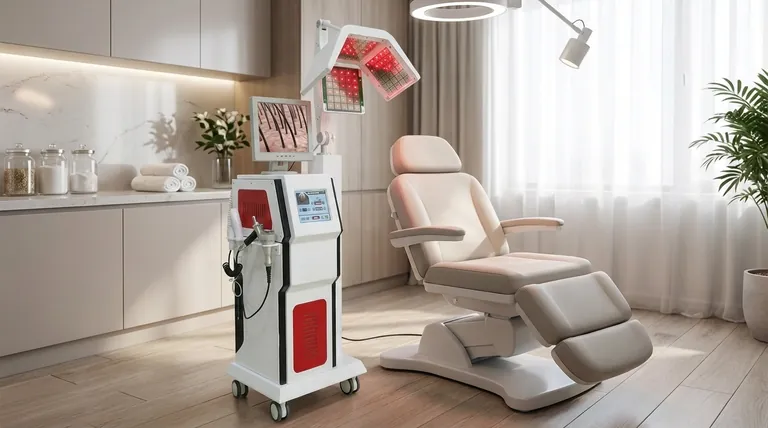
The Allure of "More" vs. The Reality of Biology
There is a deeply ingrained human bias: if a little of something is good, a lot must be better. We see it in the gym, in our diets, and in our work habits.
When it comes to biological stimulation like red light therapy, this intuition is not just wrong—it's counterproductive.
The most common question isn't about the light itself, but about frequency: "How often should I use it?" The answer reveals a core principle of cellular biology that defies our "more is better" impulse.
The Biphasic Dose Response: Finding the "Sweet Spot"
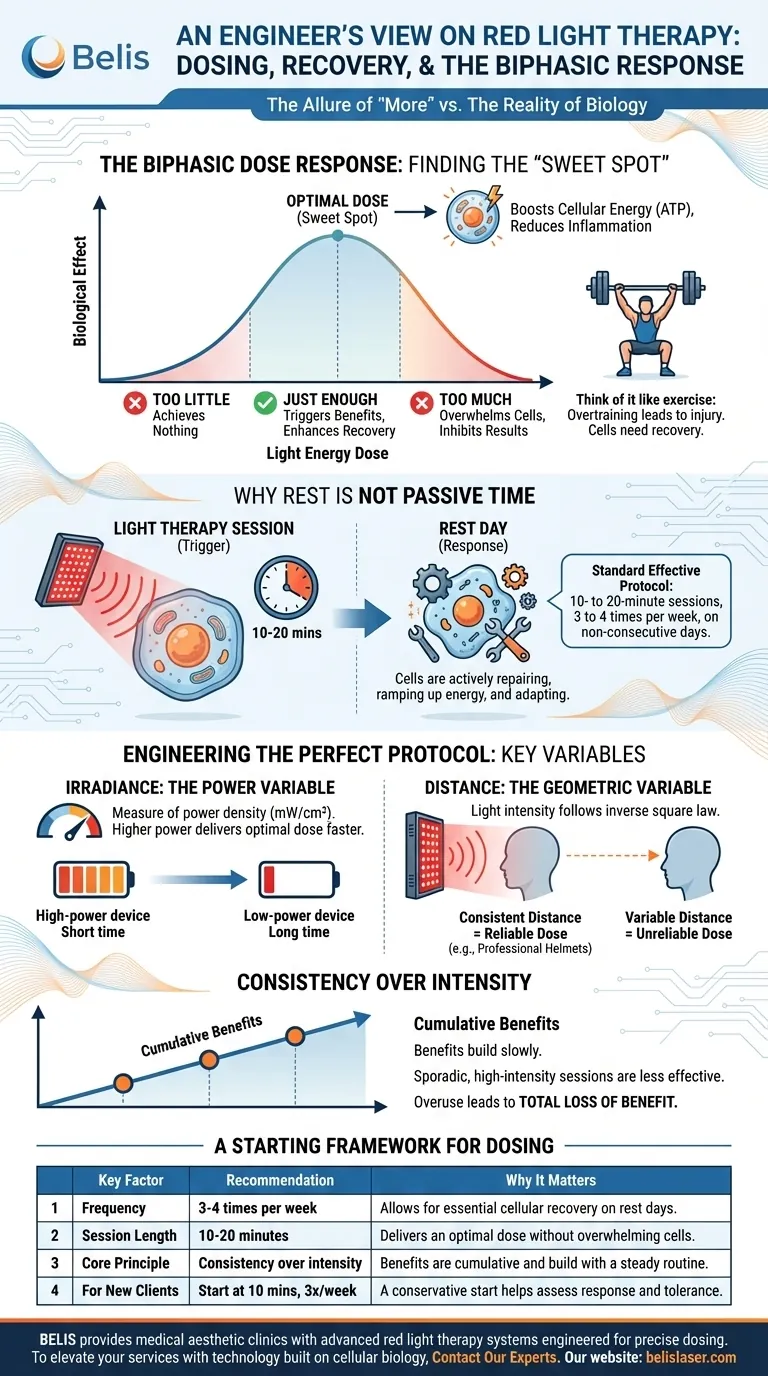
The mechanism governing red light therapy is called the biphasic dose response. It’s a technical term for a simple concept: there is a "sweet spot."
- Too little light energy achieves nothing.
- Just enough light energy triggers a cascade of benefits, like boosting cellular energy (ATP) and reducing inflammation.
- Too much light energy overwhelms the cells, inhibiting those same processes and diminishing the results.
Think of it like exercise. The right amount of stress stimulates muscle growth. Overtraining leads to injury and fatigue. Red light therapy is a form of exercise for your cells, and they need time to recover and adapt.
Why Rest Is Not Passive Time
This brings us to the most overlooked component of a successful red light therapy protocol: the rest day.
Rest days are not about inaction. They are when the real work happens. The light therapy session is the trigger; the rest period is the response.
During these off-days, your cells are actively responding to the light stimulus. They are repairing, ramping up energy production, and carrying out the very functions you aimed to support. Skipping rest to chase faster results is like a farmer pulling on their sprouts to make them grow faster. It disrupts the natural, essential process.
For this reason, a standard, effective protocol is 10- to 20-minute sessions, three to four times per week, on non-consecutive days.
Engineering the Perfect Protocol: Key Variables
A "one-size-fits-all" approach ignores the physics. To deliver the correct dose—that "sweet spot"—clinicians must account for the critical variables of the system. This is where professional-grade equipment becomes non-negotiable.
Irradiance: The Power Variable
Irradiance (mW/cm²) is the measure of power density—how much light energy is delivered to a specific area.
A device with higher irradiance delivers the optimal dose in less time. A lower-power device requires longer sessions to achieve the same effect. Without a precise understanding of your device's power output, you are essentially guessing the dose.
Distance: The Geometric Variable
Light intensity follows the inverse square law; it dissipates rapidly with distance. A panel held 6 inches from the scalp delivers a fraction of the energy of one held at 1 inch.
For applications like hair restoration, consistency is paramount. This is why professional devices like helmets or precisely calibrated panels are designed to ensure a repeatable distance and, therefore, a reliable dose every single session.
Consistency Over Intensity
The benefits of red light therapy are cumulative. They build slowly, with each cycle of stimulation and recovery reinforcing the last.
Sporadic, high-intensity sessions are far less effective than a consistent, moderate routine. The goal is not to shock the system, but to coax it into a new, higher-functioning state over weeks and months. This requires patience and, above all, precision.
The primary risk of overuse is not physical harm, but a total loss of benefit. If you push your cells past the biphasic peak, you simply turn off the positive effects.
A Starting Framework for Dosing
For any clinic or salon, a reliable baseline is essential. This table outlines the core principles for establishing a safe and effective protocol for your clients.
| Key Factor | Recommendation | Why It Matters |
|---|---|---|
| Frequency | 3-4 times per week | Allows for essential cellular recovery on rest days. |
| Session Length | 10-20 minutes | Delivers an optimal dose without overwhelming cells. |
| Core Principle | Consistency over intensity | Benefits are cumulative and build with a steady routine. |
| For New Clients | Start at 10 mins, 3x/week | A conservative start helps you assess response and tolerance. |
Achieving consistent, professional results for clients means controlling these variables with equipment designed for the task. BELIS provides medical aesthetic clinics with advanced red light therapy systems engineered for precise dosing, ensuring every treatment is optimized for maximum biological effect.
To elevate your services with technology built on the principles of cellular biology, Contact Our Experts.
Visual Guide
Related Products
- 9D 7D HIFU Vaginal RF Lifting Treatment
- 7D 12D 4D HIFU Machine Device
- 4D 12D HIFU Machine Device for Skin Tightening
- 12D HIFU Machine Device for Facial HIFU Treatment
- IPL SHR Hair Removal Machine for Permanent Hair Removal
Related Articles
- HIFU is a Process, Not a Procedure: The Physics and Psychology of Skin Remodeling
- HIFU Treatment Explained: The Science Behind Superior Skin Tightening
- Why HIFU Outperforms Other Non-Surgical Treatments for Lasting Facial Rejuvenation
- How HIFU Triggers Natural Collagen Production for Younger-Looking Skin
- How HIFU Outperforms Traditional Anti-Aging Treatments: A Science-Backed Guide















