< ![CDATA[ There is a fundamental human bias: when something works, we want more of it, faster. We see a positive result and assume that doubling the frequency will double the outcome. In the world of medical aesthetics, this manifests as the client who, thrilled with their initial lift, asks, "How soon can I come back?"
The most difficult, and most valuable, part of a practitioner's job is not just operating the technology. It's managing the tension between a client's impatience and the unyielding timeline of human biology. With High-Intensity Focused Ultrasound (HIFU) , this tension is everything. The treatment's success isn't just in the energy delivered, but in the waiting that follows.
The Biological Clock We Can't Rush
A HIFU treatment isn't a finished product. It's the first day of a long-term construction project. The practitioner is the architect who delivers the blueprint; the body is the construction crew, and they work on a non-negotiable schedule.
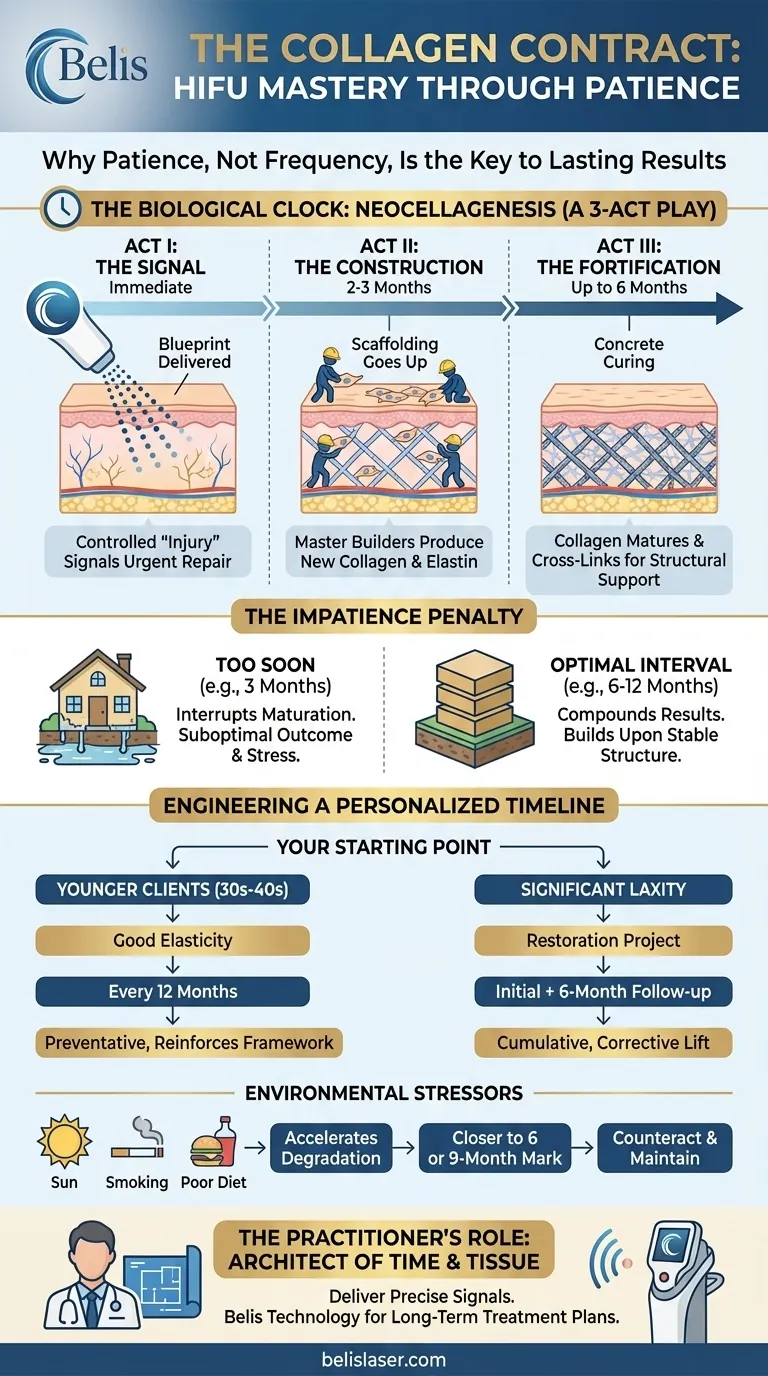
This process, neocollagenesis, is a three-act play unfolding deep within the skin.
-
Act I: The Signal. The HIFU device delivers precise points of thermal energy into the foundational layers of the skin. This doesn't magically create collagen; it creates a controlled "injury," signaling an urgent need for repair. The blueprint has been delivered.
-
Act II: The Construction. Over the next several weeks and months, the body dispatches fibroblast cells to the site. These are the master builders, producing strong, new collagen and elastin fibers. This is why visible results emerge gradually over 2-3 months. The scaffolding is going up.
-
Act III: The Fortification. For up to six months, this newly created collagen matures. It organizes itself, cross-linking into a dense, strong matrix that provides the structural support for lifted, tightened skin. The concrete is curing.
The Impatience Penalty
Understanding this timeline reveals a critical truth: with HIFU, more is not better. It can be worse.
Treating too soon—say, at the three-month mark—is like trying to build the second story while the foundation's concrete is still wet. You aren't building upon a stable structure; you are interrupting a crucial maturation phase. The result is not accelerated improvement but a suboptimal outcome and unnecessary stress on the tissue.
Conversely, waiting too long (18-24 months) incurs the "Cost of Delay." The goal of a proper HIFU schedule is for each session to compound the results of the last. Waiting too long allows the natural aging process to degrade the new foundation, forcing you to essentially start from a weaker position.
Engineering a Personalized Timeline
The standard 6-to-12-month interval is a guideline, not a rigid rule. A masterful practitioner engineers a personalized schedule based on a few key variables.
Your Starting Point
- Younger clients (30s-40s): With good skin elasticity, they often only require annual maintenance. A treatment every 12 months acts as a powerful preventative measure, consistently reinforcing their collagen framework.
- Clients with significant laxity: This is more of a restoration project. An initial treatment followed by a second session at the 6-month mark can create a powerful cumulative effect for a more dramatic, corrective lift.
Environmental Stressors
Lifestyle is a critical variable. Factors like heavy sun exposure, smoking, or poor diet accelerate collagen degradation. For these clients, a schedule closer to the 6 or 9-month mark may be necessary to counteract these external pressures and maintain results.
Summary: Your Strategic Frequency
| Client Profile | Recommended Frequency | Strategic Goal |
|---|---|---|
| Proactive Anti-Aging (30s, good skin) | Every 12 months | Stay ahead of the curve |
| Corrective Lifting (Moderate laxity) | Initial + 6 mo. follow-up | Build a strong foundation |
| Maintenance (Post-correction or at-risk) | Every 6-9 months | Preserve the investment |
The Practitioner's Role: Architect of Time and Tissue
The true artistry of a HIFU treatment lies in this deep understanding of biology and time. A practitioner's value is in their ability to architect a long-term plan that respects the body's natural rhythm.
But even the best architect is limited by their tools.
To deliver that precise "signal" that initiates the entire regenerative process, the equipment must be impeccable. It must deliver focused energy consistently and reliably, every single time. This is where professional-grade technology becomes non-negotiable. At BELIS, we equip medical aesthetics clinics with HIFU systems designed for this very purpose—providing the precision and control needed to execute these elegant, long-term treatment plans effectively.
Mastery in this field comes from pairing this deep biological understanding with technology you can trust. If you're ready to build treatment plans that deliver predictable, lasting results, we're here to help. Contact Our Experts ]]>
Visual Guide
Related Products
- 4D 12D HIFU Machine Device for Skin Tightening and Lifting
- 9D 7D HIFU Vaginal RF Lifting Treatment
- 7D 12D 4D HIFU Machine Device
- 12D HIFU Machine Device for Facial HIFU Treatment
- 4D 12D HIFU Machine Device for Skin Tightening
Related Articles
- How HIFU Outperforms Traditional Anti-Aging Treatments: A Science-Backed Guide
- How HIFU Triggers Natural Collagen Production for Younger-Looking Skin
- HIFU Treatment Explained: The Science Behind Superior Skin Tightening
- How HIFU Delivers Safer, Smarter Anti-Aging Results: Science-Backed Insights
- HIFU vs. Surgery: How to Choose the Right Anti-Aging Treatment for You


















