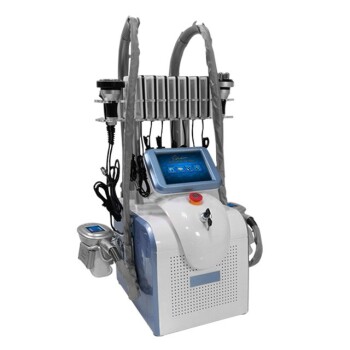
Forced cold air cooling is considered optimal because it provides effective, controlled epidermal protection without the major safety and workflow drawbacks of liquid nitrogen or cryogen sprays. Typically operating at approximately −20°C to −30°C, it removes heat continuously, reduces treatment discomfort, preserves a clear optical path, and adapts to irregular anatomy. This balance is especially valuable during rapid-repetition, non-ablative aesthetic laser procedures.
The advantage of forced cold air is not that it reaches the lowest temperature; it is that it delivers sufficient, uniform cooling within a safer and more controllable operating window. It protects the epidermis while supporting higher treatment fluences and uninterrupted clinical workflow.
Why Epidermal Cooling Matters
It protects the epidermis from competing for laser energy
Epidermal melanin can absorb laser energy intended for deeper structures such as hair follicles or vascular lesions. Without adequate cooling, this competing absorption can cause excessive superficial heating, redness, blistering, crusting, or post-inflammatory hyperpigmentation.
Cooling lowers the epidermal temperature before, during, or immediately after the laser pulse. This helps confine thermal injury to the intended deeper target.
It improves comfort and treatment flexibility
Active cooling provides analgesic effects by reducing heat accumulation in the skin. Patients generally tolerate treatment more comfortably, while practitioners can use higher fluences when clinically appropriate.
This is particularly useful for high-energy or repetitive treatments, including many Nd:YAG-based procedures.
Why Forced Cold Air Performs Well
It provides effective thermal cooling
Reported comparisons show that chilled air can reduce epidermal skin temperature by approximately 45% of its initial value, compared with roughly 49% for ice gels and 41% for liquid nitrogen under the cited conditions.
The exact result depends on airflow, distance, treatment duration, skin characteristics, and device design. However, the key point is that forced air can deliver cooling performance comparable to more aggressive or contact-based methods.
It uses a controlled temperature range
Liquid nitrogen is extremely cold and can cause accidental cryogenic burns, frostbite, and permanent skin lesions if applied incorrectly. Forced air operates at a substantially less extreme temperature, reducing the likelihood of freeze-induced injury.
This makes it easier to integrate into standardized clinical protocols and safer to use across variable treatment areas.
It cools continuously
A forced-air system can provide an uninterrupted stream of cold air before, during, and after laser emission. This is well suited to fast-repetition treatments and large anatomical areas where repeated application of a consumable coolant would slow the procedure.
Continuous cooling also helps manage heat accumulation across successive pulses.
Comparison With Liquid Nitrogen
Liquid nitrogen offers aggressive cooling but little forgiveness
Liquid nitrogen can remove heat rapidly because of its extremely low temperature. That capability is also its principal safety concern.
Small variations in application time, distance, or distribution can produce excessive local cooling. The result may be frostbite, cryogenic burns, or permanent pigmentary and textural changes.
Forced air offers a safer thermal margin
Cold air does not attempt to cool the skin to cryogenic temperatures. Instead, it provides controlled convective heat removal that is generally sufficient to protect the epidermis during appropriate non-ablative laser treatments.
This safer margin is particularly important in professional devices used by multiple operators across different skin types and body contours.
Comparison With Cryogen Sprays
Cryogen sprays can leave a temporary liquid film
Halogenated hydrocarbon sprays may remain on the skin for several hundred milliseconds. If evaporation is delayed, the residual film can interact unpredictably with an incoming laser pulse.
A liquid film or frost layer can also scatter or alter the beam, compromising energy delivery and treatment consistency.
Sprays can increase pigmentary risk
Prolonged or uneven cryogen contact may cause freeze-induced hypopigmentation. The risk is influenced by spray timing, duration, distance, and evaporation behavior.
Forced air avoids direct chemical contact and does not leave a liquid residue on the treatment surface.
Cold air avoids consumable propellants
A forced-air unit does not require recurring cryogen canisters or halogenated propellants. This simplifies logistics, reduces interruptions, and avoids the environmental concerns associated with certain chemical refrigerants.
Why Non-Contact Cooling Helps Clinical Workflow
It preserves the optical path
Cold air does not introduce a gel, liquid layer, or rigid cooling plate between the handpiece and the skin. This minimizes additional interfaces that could refract, reflect, or scatter the laser beam.
The treatment area remains visually clear, allowing the operator to assess the skin continuously.
It adapts to irregular anatomy
A cold-air stream can cool facial contours, joints, delicate orifices, and other uneven surfaces without requiring a rigid plate to maintain full contact.
This is an important advantage over contact cooling, which may be less uniform on anatomically complex areas.
It avoids mechanical compression
Contact cooling can compress the skin. That may be undesirable when evaluating superficial vascular lesions, because compression can temporarily alter their appearance and blood content.
Non-contact cooling preserves the untreated anatomical state immediately before pulse delivery.
It supports rapid, large-area treatments
Forced air is especially practical when the treatment involves many pulses over a large surface. The system can operate continuously without repeatedly replacing ice, applying gel, or recharging a spray canister.
This improves procedural efficiency while maintaining ongoing epidermal protection.
Understanding the Trade-offs
Forced air is not the most powerful cooling method in every situation
Convective air cooling generally has lower thermal conductivity than sapphire contact cooling or cryogen spray. It may therefore remove heat less aggressively in some circumstances.
Its advantage is the overall balance of safety, coverage, continuity, and convenience—not maximum instantaneous cooling power.
Cooling performance depends on system design
Air temperature alone does not determine clinical effectiveness. Airflow rate, nozzle geometry, handpiece integration, treatment distance, pulse repetition rate, and exposure duration all influence the amount of heat removed.
Professional systems should therefore be evaluated as complete cooling platforms rather than by temperature specifications alone.
It is not appropriate for every laser category
Surface cooling is not generally beneficial for high-water-absorption ablative systems such as Er:YAG or CO₂ lasers, where energy is intentionally absorbed at the immediate surface to vaporize tissue.
Cooling selection must match the laser wavelength, pulse structure, target depth, and intended tissue effect.
Cooling does not replace treatment control
Even with active cooling, operators must select appropriate fluence, pulse duration, spot size, repetition rate, and cooling timing. Excessive laser energy can still injure tissue if the treatment parameters exceed the patient’s tolerance.
Cooling is a risk-reduction and performance-enhancement tool, not a substitute for clinical judgment.
How to Apply This to Your Project
The right cooling technology depends on the laser’s tissue target, treatment speed, anatomy, and required safety margin.
- If your primary focus is epidermal safety: Choose controlled forced cold air to reduce heat while avoiding the extreme temperatures and freeze injury risks associated with liquid nitrogen.
- If your primary focus is rapid, large-area treatment: Use continuous forced air to maintain protection without replacing cryogen canisters or repeatedly reapplying contact materials.
- If your primary focus is optical and procedural consistency: Prefer non-contact air cooling because it leaves no liquid film or frost layer that could interfere with the laser beam.
- If your primary focus is complex anatomical areas: Use air cooling where adaptable, non-compressive coverage is more practical than rigid contact plates.
- If your primary focus is ablative surface resurfacing: Reassess whether epidermal cooling is appropriate, since Er:YAG and CO₂ treatments rely on controlled surface absorption and vaporization.
Forced cold air is optimal when the goal is a practical balance of epidermal protection, patient comfort, optical clarity, and uninterrupted laser operation.
Summary Table:
| Feature | Forced Cold Air | Liquid Nitrogen | Cryogen Sprays |
|---|---|---|---|
| Temperature Range | -20°C to -30°C | Extremely cold | Extremely cold |
| Cooling Mechanism | Convective heat removal | Cryogenic freezing | Evaporative cooling |
| Safety | High | Low (risk of frostbite) | Moderate |
| Optical Clarity | Preserved | Not applicable | May leave residue |
| Anatomical Adaptability | High | Low | Moderate |
| Workflow Efficiency | High | Low | Moderate |
Discover how BELIS's advanced laser systems with forced cold air cooling can enhance your clinic's treatment safety and efficiency. Our professional-grade devices are designed for clinics and premium salons, offering precise epidermal protection and superior patient comfort. Contact us today to explore our portfolio and elevate your aesthetic practice — Get in touch!
Related Products
- Fat Freezing Cryolipolysis Machine for Body Contouring
- Fat Freezing Cryolipolysis Machine for Body Contouring
- Cryolipolysis Fat Freezing Machine with Cavitation and Laser Lipolysis
- Cryolipolysis Fat Freezing Machine Cavitation Lipo Laser Machine
- Hydrofacial Machine with Facial Skin Analyzer and Skin Tester
People Also Ask
- What are the main benefits of using a fat freezing machine? Achieve Permanent, Non-Surgical Body Sculpting
- Do fat freezing machines really work? Achieve Non-Invasive Body Contouring
- What are the potential side effects and risks associated with fat freezing? Safety Profile & Rare Risks Explained
- What are the clinical and safety risks of using uncertified or replicate cryolipolysis body contouring equipment? Avoid hyperpigmentation and legal exposure with certified systems.
- What maintenance and service aspects are important when purchasing a fat freezing machine? Maximize ROI & Reliability