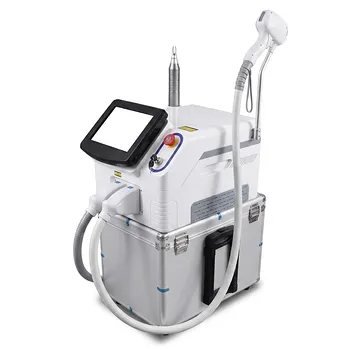
Professional laser hair reduction devices most commonly use three near-infrared wavelengths: 755 nm Alexandrite, 810 nm Diode, and 1064 nm Nd:YAG. These wavelengths target melanin in the hair follicle through selective photothermolysis, while the appropriate session interval depends on the body area’s hair-growth cycle. A practical schedule is every 4 weeks for facial hair, every 6 weeks for the underarms, bikini area, and back, and every 8 weeks for the arms and legs.
The wavelength must match the patient’s skin tone, hair characteristics, and treatment area, while session timing should allow enough follicles to re-enter the active growth phase for effective treatment.
Which Wavelengths Are Used?
755 nm Alexandrite
The 755 nm Alexandrite laser has relatively high melanin absorption and is commonly used for dark hair on lighter skin tones, generally Fitzpatrick skin types I–III.
It can be effective for finer hair, but the higher melanin absorption also requires careful parameter selection because the epidermis contains melanin as well.
810 nm Diode
The 810 nm Diode laser provides an intermediate balance between melanin absorption and tissue penetration.
It is widely used for coarse, dark hair across a broader range of skin types, commonly including Fitzpatrick types I–IV, depending on the device, cooling system, and clinical settings.
1064 nm Nd:YAG
The 1064 nm Nd:YAG laser penetrates more deeply and has lower absorption by epidermal melanin than shorter wavelengths.
This makes long-pulsed Nd:YAG systems the preferred laser option for many patients with darker skin tones, including Fitzpatrick types IV–VI, because they can reduce epidermal injury risk when used correctly.
Multi-Wavelength Systems
Some professional devices combine 755 nm, 808 or 810 nm, and 1064 nm wavelengths in one handpiece or platform.
This approach allows practitioners to adjust treatment more precisely for differences in skin pigmentation, hair thickness, follicular depth, and body location.
How Session Intervals Differ by Body Area
Facial Hair: Every 4 Weeks Initially
Facial hair is typically treated at 4-week intervals, particularly during the first two sessions.
The face has a comparatively short hair-growth cycle, and this interval improves the chance of treating follicles during the active anagen phase, when laser energy is most effective.
From the third session onward, the interval may need to increase based on hair response. Laser treatment can extend the resting phase, so treating too frequently may suppress visible growth without improving follicular destruction.
Underarms, Bikini Area, and Back: Every 6 Weeks
The recommended interval for the underarms, bikini area, and back is approximately 6 weeks.
These areas generally have longer growth cycles than the face, so waiting allows a greater number of follicles to return to a laser-responsive phase.
The exact schedule may be adjusted according to regrowth patterns, skin response, and the patient’s treatment history.
Arms and Legs: Every 8 Weeks
The arms and legs are commonly treated every 8 weeks.
Hair in these larger extremity areas tends to cycle more slowly, making shorter intervals less productive. Scheduling treatment before meaningful regrowth appears may reduce efficiency because fewer follicles are actively growing.
Maintenance Treatments
After the initial course, treatment intervals usually become longer.
Maintenance sessions may be needed one to three times per year, depending on the patient’s hormonal factors, hair density, anatomical location, and degree of long-term reduction.
Why Timing Matters
Laser Energy Works Best During Anagen
Laser hair reduction is most effective when the follicle is in the anagen, or active-growth, phase.
Because follicles do not all grow simultaneously, multiple sessions are necessary to treat different groups as they enter this responsive phase.
Shedding Is Not Immediate Regrowth
Treated hair shafts commonly extrude or shed over approximately 7 to 10 days after treatment.
This normal shedding process should not be mistaken for immediate regrowth or treatment failure.
A Course Requires Multiple Sessions
Most patients require at least three to five treatments for noticeable reduction, while facial areas may require five to six or more sessions.
Facial treatment can be more persistent because of higher follicular density and hormonal influences.
Matching Wavelength to Patient Characteristics
Fair Skin With Dark Hair
Alexandrite at 755 nm is often appropriate for lighter skin with dark hair, particularly when the hair is relatively fine.
The practitioner must still account for recent tanning, epidermal pigmentation, and the patient’s individual response.
Broad Skin and Hair Variation
Diode at 810 nm is a versatile option for many patients with coarse, dark hair and a range of lighter to medium skin types.
Its suitability depends on the specific device and treatment parameters rather than wavelength alone.
Darker Skin Phototypes
Nd:YAG at 1064 nm is generally the safer laser choice for darker skin because it interacts less strongly with epidermal melanin.
Appropriate cooling, conservative settings, and experienced clinical assessment remain essential.
IPL Is Different From Laser
Intense Pulsed Light, or IPL, is not a laser wavelength. IPL produces broad-spectrum, non-coherent light and uses filters to limit the delivered range.
It can be used for hair reduction and other skin treatments, but it should not be described as equivalent to a single 755 nm, 810 nm, or 1064 nm laser.
Understanding the Trade-offs
Shorter Intervals Are Not Automatically Better
Scheduling sessions less than 4 weeks apart can reduce efficacy because too few follicles may be in the active-growth phase.
More frequent treatment can also increase unnecessary exposure without accelerating long-term reduction.
Longer Intervals Delay Progress
Waiting substantially longer than 8 weeks may delay cumulative progress for areas normally treated on a shorter schedule.
However, extending the interval can be appropriate when regrowth is slow or when previous treatment has lengthened the follicular resting phase.
Wavelength Alone Does Not Determine Safety
Skin type, recent sun exposure, hair color, hair thickness, cooling, fluence, pulse duration, and practitioner experience all affect treatment safety and effectiveness.
No wavelength is universally optimal for every patient.
Light Hair Responds Poorly
Laser systems depend primarily on melanin in the hair follicle. Very light, gray, white, or red hair may respond poorly because it contains less of the target pigment.
Applying the Schedule in Practice
A standard starting schedule can be adapted according to regrowth and clinical response.
- If your primary focus is facial hair: Begin with sessions about 4 weeks apart, then consider widening the interval after the first two treatments as regrowth slows.
- If your primary focus is underarms, bikini area, or back: Schedule treatments at approximately 6-week intervals, adjusting for the patient’s visible regrowth pattern.
- If your primary focus is arms or legs: Use approximately 8-week intervals because these areas generally have slower growth cycles.
- If your primary focus is darker skin: Favor appropriately configured 1064 nm Nd:YAG treatment when clinically indicated, with careful cooling and conservative parameter selection.
- If your primary focus is lighter skin with dark hair: Consider 755 nm Alexandrite when the patient’s skin type and treatment history make it appropriate.
- If your primary focus is flexibility across skin and hair types: Consider an appropriate Diode or multi-wavelength platform, while still selecting settings for the individual patient.
Effective treatment depends on combining the right wavelength with an interval that follows the patient’s biology, not simply repeating sessions on a fixed calendar.
Summary Table:
| Wavelength | Best For | Typical Skin Types | Common Intervals |
|---|---|---|---|
| 755 nm Alexandrite | Fine dark hair | I-III | Face: 4 weeks |
| 810 nm Diode | Coarse dark hair | I-IV | Underarms/Bikini/Back: 6 weeks |
| 1064 nm Nd:YAG | Darker skin types | IV-VI | Arms/Legs: 8 weeks |
Ready to offer advanced laser hair reduction? At BELIS, we provide professional-grade medical aesthetic devices trusted by clinics and premium salons worldwide. Our portfolio includes cutting-edge Diode, Alexandrite, and Nd:YAG lasers with clinically proven efficacy and safety. Whether you're expanding your services or upgrading your equipment, our experts will help you choose the perfect solution for your clients. Contact us today to discuss your needs and discover how our technology can elevate your practice. Get in touch now.
Related Products
- 808nm Diode Laser Hair Removal Machine 755+808+1064nm Mixed Wavelength Professional Equipment
- 808nm Diode Laser Hair Removal Machine and Equipment with Picolaser Arm
- Tri Laser Diode Hair Removal Machine Professional Beauty Equipment
- Professional IPL SHR Hair Removal Machine for Laser and IPL Hair Removal
- Diode Tri Laser Hair Removal Machine for Clinic Use
People Also Ask
- How can aesthetic practitioners prevent side effects like paradoxical hair regrowth and thermal burns when performing diode laser hair removal on dark skin? Master safe protocols for Fitzpatrick IV–VI skin.
- How do broad-spectrum noncoherent light sources compare to single-wavelength diode lasers in aesthetic hair removal applications? Find the best fit for your clinic.
- Why is monitoring the revenue rate per hour per physician essential when deciding to invest in high-throughput aesthetic technology like diode hair removal lasers or multi-applicator body sculpting machines? Optimize your practice's profitability
- What are the primary differences in mechanism and pigment dependency between standard laser hair removal devices (Alexandrite, Diode, Nd:YAG) and photosensitizer-assisted light therapies? Discover expert insights and tailored solutions
- How do practitioners select between 755nm Alexandrite, 810nm Diode, and 1064nm Nd:YAG laser wavelengths based on Fitzpatrick skin typing and hair characteristics? Achieve Safe, Effective Hair Removal for Every Skin Type