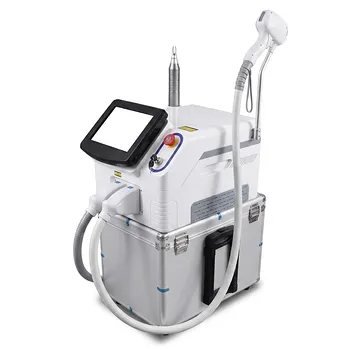
At the atomic level, laser treatment works because different tissue molecules absorb different wavelengths of light. The number and arrangement of protons and electrons define each element’s chemical behavior, while molecular bonds create specific energy states. When a laser photon matches one of those states, the target chromophore—such as water, melanin, or blood-related pigments—absorbs the energy and converts it into a controlled biological effect.
Laser selectivity comes from matching wavelength to the target’s atomic and molecular absorption properties, then controlling how quickly and intensely that energy is delivered. The same wavelength can produce gentle heating, coagulation, vaporization, or photochemical activity depending on fluence, power density, pulse duration, and tissue relaxation.
Why Atomic Structure Determines Laser Absorption
Protons define the element
Every atom is defined by its number of protons. This determines the element’s electronic structure and influences how it interacts with electromagnetic radiation.
Electrons occupy specific energy states around the nucleus. A photon can be absorbed when its energy corresponds to an allowed transition between those states.
Electrons determine energy absorption
In medical laser applications, the relevant interactions generally involve outer-shell or valence electrons and the molecular structures formed by them. These electrons participate in chemical bonding and determine how molecules absorb light.
Visible and near-infrared light typically causes transitions among higher-energy electronic states rather than ejecting tightly bound inner-shell electrons. This is fundamentally different from ionizing radiation, which has enough energy to remove inner electrons and alter atomic structure directly.
Molecules create the clinically important targets
Biological tissues are not collections of isolated atoms. They contain molecules such as water, melanin, hemoglobin-related pigments, proteins, and lipids.
The bonds and geometry within these molecules create characteristic absorption bands. Consequently, the laser interacts with a chromophore—a light-absorbing tissue component—rather than with all tissue uniformly.
How Chromophores Convert Light into Treatment
Water absorbs energy and produces thermal effects
Water is the dominant chromophore for many infrared lasers, including CO₂ and Erbium systems. When water absorbs the laser wavelength, photon energy is converted into molecular motion and heat.
At sufficiently high energy density, this heating can cause rapid vaporization and tissue removal. At lower or more controlled levels, it can produce thermal coagulation or stimulate remodeling without immediate vaporization.
Pigment absorbs selectively
Melanin and other pigments absorb selected visible and near-infrared wavelengths. This allows laser energy to be directed toward pigmented lesions or hair follicles while attempting to limit exposure to surrounding, less pigmented tissue.
The degree of selectivity depends on the difference in absorption between the target and adjacent structures. It also depends on skin tone, pigment concentration, wavelength, pulse duration, and delivered fluence.
Vascular structures absorb through blood-related chromophores
Blood and vascular structures contain chromophores that absorb particular wavelengths more strongly than surrounding tissue. When that energy becomes heat, it can damage or coagulate targeted vessels.
The treatment is effective only when the target absorbs enough energy to reach the desired biological threshold without transferring excessive heat into neighboring skin.
Why Wavelength Is Only Part of the Decision
Wavelength determines absorption and penetration
Wavelength influences which chromophore absorbs the energy and how deeply light can travel before being absorbed or scattered.
A wavelength strongly absorbed at the surface may be useful for superficial ablation. A wavelength with lower surface absorption may penetrate farther and affect deeper structures.
Penetration is therefore governed by the combined effects of absorption, scattering, tissue composition, and wavelength, not wavelength alone.
Pulse duration controls heat distribution
The same amount of energy can have very different effects depending on how quickly it is delivered.
A longer interaction time allows heat to accumulate and spread laterally. This can be useful for controlled heating, but excessive thermal diffusion may injure surrounding tissue.
A short pulse delivers energy rapidly, restricting the treatment effect more closely to the absorbing target when the pulse duration is appropriately matched to the target’s thermal relaxation behavior.
Fluence and irradiance determine treatment intensity
Fluence is the delivered energy per unit area. It determines the total dose received by the tissue.
Irradiance, or power density, describes how rapidly energy is delivered per unit area. Two treatments with the same fluence can produce different outcomes if one delivers that energy in a much shorter time.
How Different Energy Levels Produce Different Tissue Effects
Low power densities can trigger photochemical effects
At lower power densities, absorbed photons may initiate photochemical reactions without generating destructive heat.
This principle is relevant to applications such as photodynamic treatment or fluorescence-based diagnosis, where the objective is molecular activation rather than tissue vaporization.
Moderate power densities produce thermotherapy
Moderate energy delivery raises tissue temperature in a controlled manner. Depending on the temperature and exposure time, this can produce collagen remodeling, cellular stress, coagulation, or apoptosis.
The tissue may be altered without immediate surface disruption, which is useful when the treatment goal involves deeper structural tightening or controlled thermal remodeling.
High power densities cause ablation
High power density can heat water and other tissue components rapidly enough to produce photovaporization or photoablation.
This is the operating principle behind procedures such as ablative resurfacing and precise laser cutting. The clinical benefit is localized tissue removal, but the margin for parameter error is smaller.
The Atomic Principle Must Be Matched to Tissue Biology
Selective absorption protects non-target tissue
A wavelength is clinically useful when the intended target absorbs it more strongly, or can be treated more effectively, than surrounding tissue.
This creates selective energy transfer: the target receives enough energy to produce the desired response while adjacent structures remain below their injury threshold.
Selectivity is never absolute. Scattering, overlapping chromophore absorption, tissue heterogeneity, and heat conduction can all broaden the treatment effect.
Thermal relaxation limits collateral injury
After absorbing laser energy, a target begins to lose heat to surrounding tissue. The relevant timescale is its thermal relaxation time.
If energy is delivered in a period appropriately related to that timescale, heat can remain concentrated within the target. If delivery is too slow or prolonged, heat may spread and increase the risk of collateral damage.
Spot size affects both depth and heat distribution
Spot size influences how energy is distributed across the treatment area and how deeply light may effectively reach.
It must be considered together with wavelength, fluence, pulse width, repetition rate, and the optical properties of the tissue. Changing one parameter can alter the practical effect of all the others.
Understanding the Trade-offs
Greater absorption improves targeting but may reduce depth
Strong chromophore absorption can make treatment highly selective and efficient. However, if energy is absorbed too quickly near the surface, less of it reaches deeper tissue.
A deeper target may require a wavelength and dose that provide adequate penetration without excessive absorption in superficial structures.
Higher fluence increases effect and injury risk
Increasing fluence can move treatment from mild heating toward coagulation or ablation. It can also increase the likelihood of blistering, necrosis, scarring, or post-inflammatory hyperpigmentation.
The correct dose is therefore not simply the highest tolerable setting. It is the lowest dose that reliably produces the intended tissue response.
Longer exposure improves heat accumulation but increases spread
Longer pulses or slower application can generate useful bulk heating. The trade-off is greater lateral thermal diffusion and less precise confinement of the treatment effect.
Short pulses improve temporal precision, but excessively short delivery or poorly selected fluence may fail to heat the target adequately or may create abrupt surface injury.
Atomic selectivity does not replace clinical judgment
A theoretically appropriate wavelength can still produce poor results if the target is misidentified, the tissue is highly variable, or the fluence and pulse duration are unsuitable.
Safe treatment requires integrating molecular absorption with skin type, target depth, tissue condition, cooling, endpoint monitoring, and the specific device’s emission characteristics.
Making the Right Choice for Your Goal
The practical objective is to align the laser’s optical and temporal parameters with the target’s molecular and thermal behavior.
- If your primary focus is chromophore selectivity: Choose a wavelength that is preferentially absorbed by the intended target while accounting for competing absorption and scattering in surrounding tissue.
- If your primary focus is superficial ablation: Use strong surface absorption with controlled fluence and pulse duration so tissue removal occurs without unnecessary lateral heat spread.
- If your primary focus is deeper thermal remodeling: Favor parameters that permit adequate penetration and controlled heat accumulation rather than immediate surface vaporization.
- If your primary focus is minimizing complications: Control fluence, irradiance, pulse width, spot size, and repetition rate together, while respecting tissue-specific thermal relaxation and treatment endpoints.
Understanding atomic and molecular absorption turns laser treatment from simple light delivery into precise control of where energy goes, how tissue responds, and how safely the desired result can be achieved.
Summary Table:
| Parameter | Role in Laser-Tissue Interaction | Clinical Implication |
|---|---|---|
| Wavelength | Determines absorption by chromophores and penetration depth | Select wavelength to match target chromophore (e.g., melanin, water, hemoglobin) |
| Pulse Duration | Controls heat confinement vs. spread | Use short pulses to confine energy to target, longer pulses for bulk heating |
| Fluence (J/cm²) | Total energy delivered per area | Adjust to achieve desired effect (thermal, coagulative, ablative) while minimizing injury |
| Irradiance (W/cm²) | Rate of energy delivery | Balance power density to avoid unwanted tissue effects |
| Thermal Relaxation Time | Time for heat to dissipate from target | Match pulse duration to thermal relaxation for selective damage |
| Spot Size | Affects penetration depth and heat distribution | Larger spot sizes reduce scattering and may increase depth |
Ready to elevate your practice with precise, science-driven laser solutions? BELIS offers a comprehensive range of professional-grade aesthetic devices, including advanced diode, Alexandrite, CO2, Erbium, Nd:YAG, and Pico lasers, as well as IPL and PDT systems. Our technology is engineered to deliver optimal results based on a deep understanding of laser-tissue interaction. Whether you're targeting pigmented lesions, vascular issues, or performing ablative resurfacing, our devices provide the customizability and safety you need. Contact our experts today to find the perfect laser system for your clinic and experience the BELIS difference. Contact us now!
Related Products
- Tri Laser Diode Hair Removal Machine Professional Beauty Equipment
- Fractional CO2 Laser Machine for Skin Treatment
- Fractional CO2 Laser Machine for Skin Treatment
- Clinic Use IPL SHR ND YAG Laser Hair Removal RF Skin Tightening Machine
- Cryolipolysis Fat Freezing Machine and Ultrasonic Cavitation Device
People Also Ask
- How do 800/810 nm diode hair removal lasers compare to 1064 nm long-pulsed Nd:YAG lasers? Discover the Best for Your Patients
- How do broad-spectrum noncoherent light sources compare to single-wavelength diode lasers in aesthetic hair removal applications? Find the best fit for your clinic.
- How can aesthetic practitioners prevent side effects like paradoxical hair regrowth and thermal burns when performing diode laser hair removal on dark skin? Master safe protocols for Fitzpatrick IV–VI skin.
- How do demographic trends in non-surgical procedures like laser hair removal compare to surgical aesthetics, and how should clinics leverage professional diode laser hair removal equipment to meet this demand?
- Why is monitoring the revenue rate per hour per physician essential when deciding to invest in high-throughput aesthetic technology like diode hair removal lasers or multi-applicator body sculpting machines? Optimize your practice's profitability