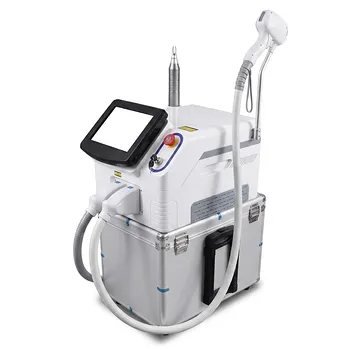
Ablative Er:YAG lasers vaporize tissue more precisely, while fractional CO2 lasers create more residual heat and collagen contraction. For scar revision, Er:YAG is generally favored when minimizing thermal injury and recovery time is the priority, particularly for mild or superficial atrophic scars. Fractional CO2 is often selected for deeper, more extensive, or fibrotic scars because its broader dermal thermal effect promotes stronger collagen shrinkage and remodeling.
The central distinction is the balance between ablation and heat: Er:YAG delivers a higher proportion of precise vaporization with limited collateral thermal damage, whereas fractional CO2 combines ablation with substantial dermal coagulation. The best choice depends on whether the scar requires mainly surface correction or deeper structural remodeling.
How the Lasers Interact With Tissue
Er:YAG Produces Precise Vaporization
Er:YAG operates at approximately 2,940 nm, close to the major absorption peak of water in tissue. Its water absorption is roughly 10 to 15 times higher than that of CO2 laser energy.
Because tissue water absorbs the energy so efficiently, Er:YAG reaches the vaporization threshold at relatively low fluence. Each pulse can remove a thin layer of tissue with a sharp ablation profile and limited heat transfer to adjacent skin.
CO2 Produces Ablation Plus Coagulation
CO2 lasers operate at approximately 10,600 nm and are also strongly absorbed by water, but their tissue effect is less dominated by immediate vaporization. Energy that is not used for ablation remains as heat in the surrounding dermis.
This creates a residual thermal necrosis or coagulation zone. That heat causes collagen contraction, tissue tightening, and dermal remodeling, which can be valuable when scars involve deeper structural changes.
Why Thermal Conduction Matters in Scar Revision
Limited Thermal Damage Favors Faster Recovery
Ablative Er:YAG generally produces a narrow zone of thermal modification, often described as smaller than the zone created by CO2 systems. The result is less thermal buildup, faster re-epithelialization, and a lower likelihood of prolonged post-treatment erythema.
This profile is useful for patients with mild atrophic scars, limited downtime, or greater concern about thermal complications. It also allows the clinician to remove scar edges and superficial irregularities with high control.
Greater Thermal Effect Supports Remodeling
Fractional CO2 creates microscopic treatment columns surrounded by untreated skin, while also delivering meaningful heat into the dermis. This thermal component can contract collagen and stimulate longer-term neocollagenesis.
The trade-off is a more substantial wound-healing response. Recovery is commonly longer than with a conservative Er:YAG treatment, and erythema may persist for longer, depending on treatment density, energy, skin type, and aftercare.
Selecting a Laser for Different Scar Patterns
Mild and Superficial Atrophic Scars
Er:YAG is often the more logical first choice when the principal goal is precise surface correction. It can vaporize elevated scar shoulders or irregular borders while limiting injury to surrounding tissue.
Short-pulsed Er:YAG may require multiple passes to achieve the desired depth. This can be an advantage when gradual control is important, but it may provide less immediate contraction than CO2.
Deep, Extensive, or Fibrotic Scars
Fractional CO2 is generally better suited to scars requiring substantial dermal remodeling. Its deeper thermal effect can help address significant textural irregularity, collagen distortion, and scar-related tissue laxity.
The clinician must balance the expected benefit against the greater inflammatory response and longer recovery. A more aggressive treatment is not automatically better if the scar is superficial or the patient cannot tolerate prolonged erythema.
Scar Borders and Individualized Treatment Zones
Scar revision often focuses on the transition between the depressed scar and surrounding skin. Targeted vaporization of the scar shoulders toward the scar base can soften abrupt borders and improve how light reflects across the surface.
Treatment should be individualized rather than selected solely by laser name. Pulse duration, fluence, density, number of passes, spot size, and whether the system has coagulation-capable modes all affect the final tissue response.
Understanding the Trade-offs
Er:YAG Has Less Immediate Tightening
Traditional short-pulsed Er:YAG produces relatively little thermal contraction. It may therefore be less effective than CO2 when the treatment requires strong tissue tightening or deep collagen shrinkage.
It can also provide less hemostasis during deeper treatment because it generates less coagulation. Bleeding control and treatment depth must be managed accordingly.
CO2 Has Greater Recovery and Inflammatory Burden
Fractional CO2 can produce more swelling, erythema, and prolonged thermal inflammation. It also carries greater risk of pigmentary alteration and other complications when settings are excessive or patient selection is poor.
The risk is influenced by skin phototype, treatment density, wound care, infection prevention, and the clinician’s experience. Fractional delivery reduces the treated surface area but does not eliminate the consequences of thermal injury.
Device Parameters Change the Outcome
The distinction between Er:YAG and CO2 is clinically useful, but it is not absolute. Longer-pulse or dual-mode Er:YAG systems can add coagulation and contraction, while careful CO2 parameter selection can reduce residual thermal damage.
Published numerical values for ablation depth and thermal zones vary substantially between devices and measurement methods. They should be treated as approximate ranges, not universal specifications for every laser platform.
Combination Treatment May Be Reasonable
Some patients benefit from combining precise Er:YAG ablation with a modality or pulse mode that provides greater dermal heating. This approach attempts to preserve Er:YAG’s control and recovery advantages while increasing collagen remodeling.
Combination protocols should be based on the scar’s depth, fibrosis, location, skin type, and tolerance for downtime. They require careful sequencing and parameter selection rather than simply increasing energy.
Making the Right Choice for Your Goal
The clinical decision should be based on the scar’s structural depth and the acceptable recovery burden, not on wavelength alone.
- If your primary focus is precise correction with faster healing: Favor ablative Er:YAG, particularly for mild, superficial, or sharply bordered atrophic scars where limited thermal injury is desirable.
- If your primary focus is deep collagen remodeling and tissue tightening: Favor fractional CO2 when scars are extensive, deep, fibrotic, or associated with substantial textural laxity.
- If your primary focus is balancing ablation with contraction: Consider a variable-pulse or dual-mode Er:YAG system, or a carefully designed combination protocol, when the platform and clinical expertise support it.
- If your primary focus is minimizing complications: Use conservative, individualized parameters and account for skin phototype, downtime tolerance, erythema risk, and the need for staged treatment.
Er:YAG prioritizes controlled vaporization and recovery, while fractional CO2 prioritizes thermal remodeling; the appropriate scar treatment is the one that matches the scar’s depth to the patient’s tolerance for thermal injury and downtime.
Summary Table:
| Feature | Er:YAG Laser | CO2 Fractional Laser |
|---|---|---|
| Wavelength | ~2,940 nm | ~10,600 nm |
| Water absorption | Very high (10-15x CO2) | High |
| Primary tissue effect | Precise vaporization | Ablation + coagulation |
| Thermal damage | Minimal | Significant |
| Collagen contraction | Less | More |
| Suitability | Superficial, mild scars | Deep, fibrotic scars |
| Recovery time | Faster | Longer |
| Common side effects | Mild erythema | Prolonged erythema, swelling |
Need expert guidance on choosing between Er:YAG and CO2 fractional lasers for your clinic? BELIS offers a wide range of professional-grade aesthetic lasers, including both Er:YAG and CO2 fractional systems, tailored for clinics and premium salons. Our team can help you select the ideal device for your patients' scar revision needs, with advanced technology, comprehensive training, and reliable support. Contact us today to learn more and elevate your aesthetic practice!
Related Products
- Q Switch Nd Yag Laser Machine Tattoo Removal Nd Yag Machine
- Clinic Use IPL SHR ND YAG Laser Hair Removal RF Skin Tightening Machine
- Clinic Use IPL and SHR Hair Removal Machine with Nd Yag Laser Tattoo Removal
- Ultrasonic Cavitation Machine Lipo Laser Device
- 808nm Diode Laser Hair Removal Machine 755+808+1064nm Mixed Wavelength Professional Equipment
People Also Ask
- How does laser fluence influence pigment clearance vs. safety? Balancing Speed and Skin Integrity in Tattoo Removal
- What is the documented effectiveness of Q-switched Nd:YAG lasers for tattoo removal? Gold Standard Results
- How should wavelength and fluence settings be adjusted on Nd:YAG and Q-switched lasers when treating darker skin tones? Optimize Safety & Efficacy
- Which laser modalities and treatment schedules are recommended for clinical laser tattoo removal procedures? Q-Switched Nd:YAG and 6–12 Week Intervals Preferred for Safe, Effective Results
- How are Q-switched lasers used for tattoo removal? Advanced Photoacoustic Technology for Clear Skin