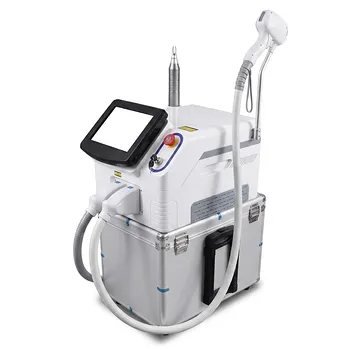
In aesthetic resurfacing, 2,940 nm Er:YAG lasers are absorbed by water far more strongly than 10,600 nm CO2 lasers. Water absorbs Er:YAG energy approximately 10 to 16 times more efficiently, so the energy is confined to a much thinner tissue layer. This produces precise ablation with a smaller zone of collateral thermal damage, while CO2 lasers penetrate more deeply and deliver greater residual heat, coagulation, and collagen contraction.
Er:YAG is primarily an ablation-precision tool; CO2 provides more thermal remodeling. The choice is therefore a balance between controlled superficial tissue removal and the stronger coagulation and tightening effects of deeper thermal injury.
Why Water Absorption Determines Resurfacing Behavior
Er:YAG Aligns Closely With Water’s Absorption Peak
The 2,940 nm Er:YAG wavelength is close to water’s primary absorption peak near 3,000 nm. Because skin contains a high proportion of water, Er:YAG energy is absorbed rapidly at the tissue surface.
This rapid absorption causes near-instantaneous vaporization of the targeted tissue. Energy has less opportunity to diffuse into adjacent structures as heat.
CO2 Energy Penetrates More Deeply
The 10,600 nm CO2 wavelength is also absorbed by water, but less efficiently than Er:YAG. As a result, CO2 energy penetrates farther before being fully absorbed.
The deeper energy distribution increases thermal diffusion into surrounding tissue. That diffusion is responsible for both CO2’s therapeutic benefits and its greater thermal burden.
How the Lasers Differ in Tissue Thermal Damage
Er:YAG Creates a Narrow Thermal Zone
Er:YAG resurfacing generally leaves a small zone of collateral thermal injury, commonly reported in the approximate range of 5 to 40 micrometers, depending on pulse duration, fluence, spot size, and delivery mode.
Some equipment configurations may produce somewhat different values. The consistent principle is that the residual thermal zone is substantially smaller than with traditional full-field CO2 treatment.
CO2 Produces More Coagulation
CO2 lasers typically create a broader residual thermal zone, often approximately 40 to 120 micrometers, with some full-field configurations producing even greater thermal injury.
This heat coagulates tissue around the ablation channel. It can improve hemostasis and stimulate dermal collagen contraction, but it also increases erythema, recovery time, and the risk of prolonged thermal effects.
Ablation Depth Is More Predictable With Er:YAG
Er:YAG systems can remove tissue in a relatively linear, energy-dependent manner, often around 3 to 4 micrometers per joule per square centimeter. Actual removal depends on the device and treatment parameters.
This behavior allows clinicians to build treatment depth through controlled passes. It is particularly useful when the goal is fine epidermal peeling or carefully limited resurfacing.
What This Means for Clinical Performance
Er:YAG Favors Precision and Recovery
The smaller thermal footprint generally supports faster re-epithelialization, less prolonged erythema, and lower thermal stress. Reported recovery can be approximately one to two weeks for appropriately selected ablative treatments, although treatment depth and patient factors remain decisive.
The reduced heat burden may also lower the likelihood of some complications, including prolonged pigmentary change, compared with aggressive full-field CO2 resurfacing.
CO2 Favors Hemostasis and Remodeling
CO2’s broader thermal effect provides stronger coagulation, hemostasis, collagen contraction, and dermal remodeling. These effects can be advantageous when treatment goals include more substantial rhytid reduction or skin tightening.
The same thermal deposition can require longer recovery and increase the risk of persistent erythema, delayed pigmentary changes, scarring, and other complications when treatment is deep or repeated.
Pulse Duration Changes the Balance
Wavelength alone does not determine the final tissue response. Er:YAG pulse duration, fluence, repetition rate, spot size, scanning pattern, and number of passes all influence whether treatment is predominantly ablative or includes a meaningful coagulative component.
Variable-pulsed Er:YAG equipment can extend pulse duration to add controlled thermal coagulation. This narrows, but does not eliminate, the practical distinction between the two platforms.
Understanding the Trade-offs
Greater Precision Does Not Mean Greater Overall Effect
Er:YAG’s efficient water absorption makes it highly precise, but minimal thermal damage also means less immediate collagen contraction and hemostasis.
CO2 may produce a stronger visible tightening response in some deeper resurfacing applications because it deposits more heat into the dermis. That benefit must be weighed against the associated recovery and complication profile.
Treatment Depth Still Carries Risk
Multiple Er:YAG passes can increase total tissue removal and thermal exposure. The ability to control depth does not make aggressive treatment risk-free.
Likewise, fractional delivery can reduce the treated surface area and recovery burden for either wavelength, but it does not remove the need for appropriate patient selection, parameter control, and aftercare.
Numerical Comparisons Are Approximate
Values such as absorption ratios, ablation per joule, and thermal-zone width vary across sources and equipment. Pulse duration, cooling, beam profile, tissue hydration, and whether treatment is fractional or full-field can materially change the result.
The most reliable comparison is therefore qualitative: Er:YAG confines energy and heat more superficially, while CO2 distributes more energy into surrounding tissue.
How to Apply This to Your Equipment Choice
The appropriate platform depends on whether the primary objective is controlled ablation or stronger thermal remodeling.
- If your primary focus is precise superficial resurfacing: Choose Er:YAG when fine-depth ablation, reduced collateral thermal injury, and shorter recovery are the main priorities.
- If your primary focus is coagulation and skin tightening: Choose CO2 when deeper thermal remodeling, hemostasis, and collagen contraction justify greater downtime and thermal risk.
- If your primary focus is parameter flexibility: Consider a variable-pulsed or fractional Er:YAG system when you need precise ablation with the option to introduce controlled coagulation.
- If your primary focus is treating higher-risk skin types: Er:YAG may offer a more conservative thermal profile, but wavelength alone does not eliminate pigmentary or scarring risk.
Understanding water absorption and thermal diffusion allows clinicians to match the laser platform and treatment parameters to the desired balance of precision, remodeling, recovery, and safety.
Summary Table:
| Feature | Er:YAG (2,940 nm) | CO2 (10,600 nm) |
|---|---|---|
| Water absorption coefficient | High (approx. 10-16x CO2) | Lower (approx. 10-16x lower than Er:YAG) |
| Energy absorption depth | Very superficial | Deeper |
| Residual thermal damage zone | 5-40 μm (approx.) | 40-120 μm (approx.) |
| Ablation precision | High, predictable | Lower, more thermal spread |
| Coagulation and hemostasis | Minimal | Strong |
| Collagen contraction | Less | More |
| Healing time | Generally faster | Generally slower |
| Suitable for | Precision ablation, lighter resurfacing, pigmented skin | Deeper resurfacing, skin tightening, hemostasis |
Ready to elevate your aesthetic practice with advanced laser technology? At BELIS, we specialize in professional-grade aesthetic equipment for clinics and premium salons. Our portfolio includes Er:YAG and CO2 lasers, designed to meet diverse resurfacing needs. Whether you prioritize precision (Er:YAG) or thermal remodeling (CO2), our experts can help you select the right system. Benefit from OEM/ODM support, certifications, and reliable supply. Contact us today to discuss your requirements and how we can boost your clinical outcomes and profitability.
Related Products
- Q Switch Nd Yag Laser Machine Tattoo Removal Nd Yag Machine
- Clinic Use IPL SHR ND YAG Laser Hair Removal RF Skin Tightening Machine
- Clinic Use IPL and SHR Hair Removal Machine with Nd Yag Laser Tattoo Removal
- Ultrasonic Cavitation Machine Lipo Laser Device
- 808nm Diode Laser Hair Removal Machine 755+808+1064nm Mixed Wavelength Professional Equipment
People Also Ask
- What is the documented effectiveness of Q-switched Nd:YAG lasers for tattoo removal? Gold Standard Results
- How does laser fluence influence pigment clearance vs. safety? Balancing Speed and Skin Integrity in Tattoo Removal
- How should wavelength and fluence settings be adjusted on Nd:YAG and Q-switched lasers when treating darker skin tones? Optimize Safety & Efficacy
- Which laser modalities and treatment schedules are recommended for clinical laser tattoo removal procedures? Q-Switched Nd:YAG and 6–12 Week Intervals Preferred for Safe, Effective Results
- How are Q-switched lasers used for tattoo removal? Advanced Photoacoustic Technology for Clear Skin