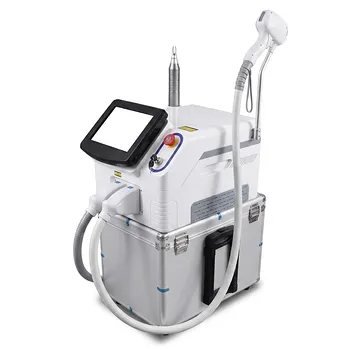
RF is combined with diode lasers or IPL to overcome the limits of light-only hair removal. Optical energy targets melanin in the hair shaft, while RF adds heat through electrical tissue interaction rather than relying entirely on pigment absorption. This combination can improve follicular heating, allow lower optical fluence, and broaden treatment options for fine or relatively fair hair and darker skin types.
Core takeaway: Optical energy provides selective targeting where melanin is present; RF adds a pigment-independent thermal mechanism. Used together, they can improve energy delivery while reducing reliance on high optical fluence—but they do not eliminate the biological and technical limitations of treating very low-pigment hair.
Why Optical-Only Hair Removal Has Limitations
Optical energy depends on melanin
Diode lasers and IPL work primarily through selective photothermolysis. Their light is absorbed by melanin in the hair shaft and follicle, converted into heat, and used to damage structures responsible for regrowth.
This creates a practical limitation: fine, blonde, red, gray, and white hairs contain less usable melanin. With less chromophore available, the follicle absorbs less optical energy and may not reach a sufficiently damaging temperature.
Skin pigmentation also absorbs light
Melanin is present in the epidermis as well as the hair. In darker skin, some optical energy can be absorbed by the epidermis rather than being confined to the follicle.
This can reduce the safety margin and increase the risk of excessive epidermal heating, burns, or post-inflammatory hyperpigmentation if optical fluence is too high.
What RF Adds to the Treatment
RF does not depend primarily on melanin
Radiofrequency energy interacts with tissue electrically, with heating influenced by factors such as tissue impedance and current distribution rather than only by optical pigment absorption.
Consequently, RF can contribute thermal energy even when the hair contains relatively little melanin. It provides an additional mechanism for heating follicular structures that light alone may not adequately affect.
RF can complement optical preheating
In electro-optical systems, the optical component may first heat the follicle wherever melanin is available. That heating can alter the follicle’s electrical characteristics, allowing subsequent RF energy to concentrate more effectively in the treated region.
The exact current distribution depends on the device design, electrode configuration, pulse sequence, and tissue conditions. The principle is best understood as complementary energy delivery, not as a guarantee that RF will selectively destroy every low-pigment follicle.
Why the Combination Can Improve Hair Removal
It addresses fine and fair hair
The optical component can provide initial follicular targeting, while RF supplies additional heat without requiring the follicle to absorb all treatment energy through melanin.
This may improve outcomes for fine, blonde, red, or other low-pigment hairs, although results remain variable. Very white or fully depigmented hair can still be difficult because the optical component has little or no melanin target.
It can reduce the required optical fluence
Because RF contributes to the total thermal effect, practitioners may not need to rely exclusively on high optical fluence to heat the follicle.
Lower optical fluence can reduce unwanted absorption in the epidermis, particularly when treating darker skin. However, lower settings are not automatically safer or more effective; they must be matched to the device and treatment protocol.
It may increase the safety margin for darker skin
RF is not absorbed by epidermal melanin in the same way as optical energy. Adding RF can therefore reduce the need to deliver intense light energy through highly pigmented epidermis.
This can support safer treatment of darker phototypes, including Fitzpatrick IV–VI, but it does not remove risk. Cooling, pulse settings, skin assessment, and appropriate clinical technique remain essential.
How Diode Lasers and IPL Fit Into the Combination
Diode laser systems
A diode laser generally delivers light within a narrower wavelength range selected for strong absorption by melanin and suitable penetration into the follicle.
When RF is added, the laser continues to provide targeted optical preheating while RF contributes pigment-independent thermal energy. The result is a dual-mechanism approach rather than a replacement of the laser’s optical function.
IPL systems
IPL uses a broad spectrum of filtered light rather than a single laser wavelength. Its effectiveness similarly depends substantially on the presence of suitable melanin in the hair and the relationship between hair and skin pigmentation.
RF can supplement IPL by adding a non-optical heating pathway and potentially reducing the amount of IPL energy required for follicular treatment.
Understanding the Trade-offs
RF does not make all light hair equally treatable
The common claim that RF makes white hair fully treatable is too broad. RF can add thermal energy, but effective follicular destruction still depends on energy reaching the relevant structures at an adequate, controlled temperature.
Results for white or very low-pigment hair are therefore less predictable than marketing language may suggest. A test area and realistic counseling are important.
More energy does not necessarily mean better results
Combining two energy sources increases the number of treatment variables. Excessive total heating can still cause pain, burns, blistering, scarring, or pigmentary changes.
The goal is controlled follicular heating, not simply maximizing RF current or optical fluence.
Device claims are not interchangeable
“RF-assisted laser” and “RF-assisted IPL” can describe substantially different technologies. Electrode arrangement, RF frequency, delivery timing, contact method, cooling, pulse duration, and monitoring all affect how energy is distributed.
Clinical performance should therefore be evaluated from the specific device’s evidence and protocol, not from the technology label alone.
Hair reduction is not always permanent removal
Hair follicles can recover, and hair cycles differ by body area. A combined system may improve reduction, but it does not guarantee permanent removal after a fixed number of treatments.
Maintenance treatments and individual biological variation remain relevant.
Making the Right Choice for Your Goal
The correct reason to combine RF with optical energy depends on whether the priority is efficacy, safety, or broader patient suitability.
- If your primary focus is treating fine or fair hair: Use the RF component to supplement the limited melanin-based heating, while setting realistic expectations for blonde, red, gray, and white hair.
- If your primary focus is treating darker skin types: Use RF to reduce dependence on high optical fluence, while maintaining conservative protocols and appropriate epidermal protection.
- If your primary focus is maximizing follicular targeting: Choose a system whose optical and RF pulses are designed to work together, rather than assuming that any separate laser, IPL, and RF devices will produce the same synergy.
- If your primary focus is clinical safety: Prioritize device-specific training, test spots, cooling, skin assessment, and careful control of total delivered energy.
The practical value of RF–optical technology is its complementary mechanism: it can make follicular heating more versatile and reduce reliance on melanin, but sound protocols and realistic expectations remain essential.
Summary Table:
| Aspect | Optical-Only (Laser/IPL) | RF-Optical Combination |
|---|---|---|
| Energy absorption | Depends on melanin in hair | Optical targets melanin, RF adds pigment-independent heat |
| Suitable hair types | Dark, coarse hair best | Better for fine, fair, or low-pigment hair |
| Skin types | Risk in darker skin | Safer for darker skin (Fitzpatrick IV–VI) |
| Treatment variables | Fewer factors | More variables; requires careful protocol |
| Outcome | Effective for selected candidates | Improved versatility, but not universal |
Elevate your clinic's hair removal results with BELIS's advanced RF-combined systems. Designed for professionals, our Diode and IPL platforms integrate cutting-edge RF to safely and effectively treat diverse skin and hair types. Contact us today to schedule a consultation and discover the perfect solution for your practice. Get in touch.
Related Products
- 808nm Diode Laser Hair Removal Machine 755+808+1064nm Mixed Wavelength Professional Equipment
- 808nm Diode Laser Hair Removal Machine and Equipment with Picolaser Arm
- Tri Laser Diode Hair Removal Machine Professional Beauty Equipment
- Diode Laser SHR Trilaser Hair Removal Machine for Clinic Use
- Clinic Diode Laser Hair Removal Machine with SHR and Trilaser Technology
People Also Ask
- How can aesthetic practitioners prevent side effects like paradoxical hair regrowth and thermal burns when performing diode laser hair removal on dark skin? Master safe protocols for Fitzpatrick IV–VI skin.
- How do broad-spectrum noncoherent light sources compare to single-wavelength diode lasers in aesthetic hair removal applications? Find the best fit for your clinic.
- Why is monitoring the revenue rate per hour per physician essential when deciding to invest in high-throughput aesthetic technology like diode hair removal lasers or multi-applicator body sculpting machines? Optimize your practice's profitability
- What are the primary differences in mechanism and pigment dependency between standard laser hair removal devices (Alexandrite, Diode, Nd:YAG) and photosensitizer-assisted light therapies? Discover expert insights and tailored solutions
- How do practitioners select between 755nm Alexandrite, 810nm Diode, and 1064nm Nd:YAG laser wavelengths based on Fitzpatrick skin typing and hair characteristics? Achieve Safe, Effective Hair Removal for Every Skin Type