
Laser hair removal is a powerful technology, but it is not universally safe or effective for everyone. Certain medical conditions, medications, and skin or hair characteristics make some individuals unsuitable for treatment. People with light-sensitive disorders like porphyria, those taking photosensitizing drugs like steroids or certain antibiotics, and individuals on anticoagulants or gold therapy are generally advised against the procedure due to high risks of adverse reactions.
The suitability of laser hair removal is not arbitrary; it is dictated by the physics of how lasers interact with pigment. The procedure's safety and success depend on a favorable contrast between skin and hair color, the absence of medical conditions that impair skin healing or cause light sensitivity, and avoiding medications that could trigger a harmful reaction.
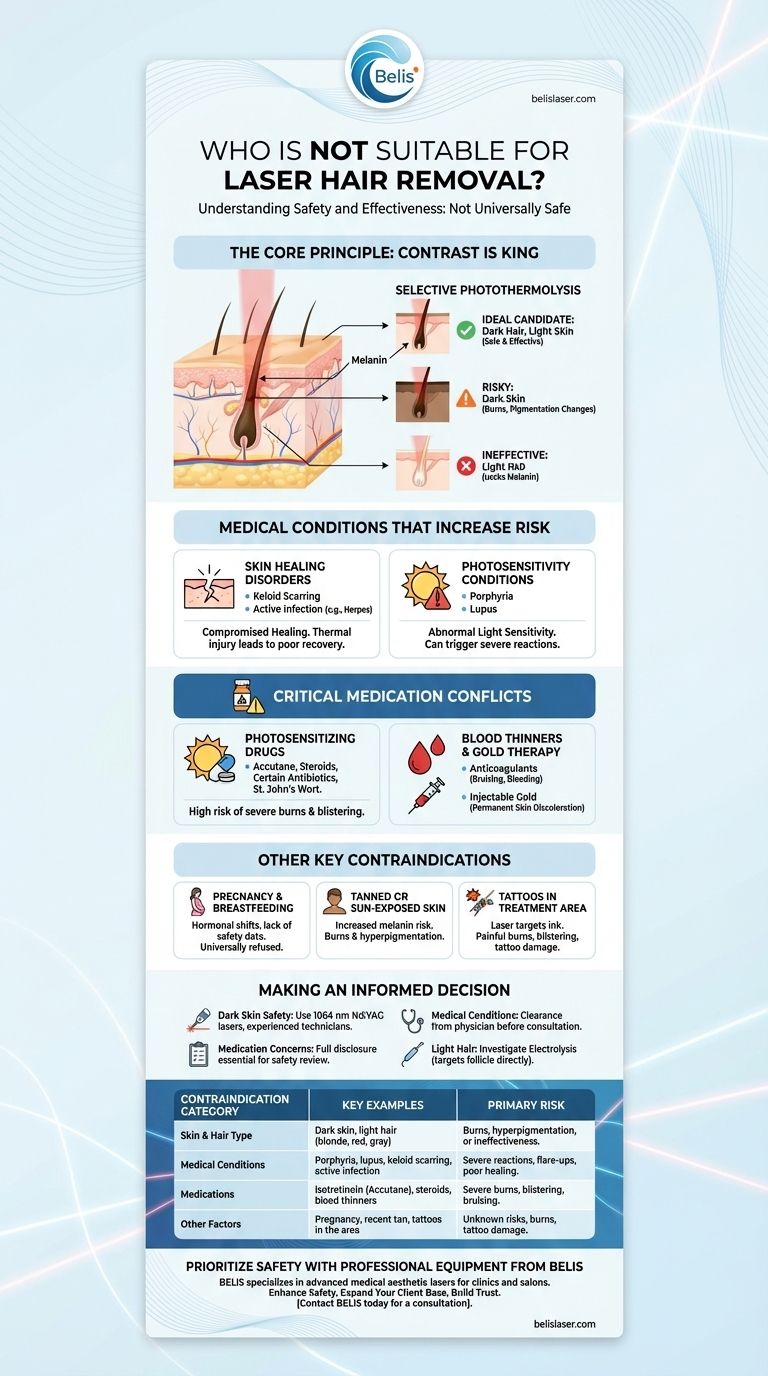
The Core Principle: Why Contrast is King
How Lasers Target Hair
Laser hair removal works through a process called selective photothermolysis. In simple terms, the laser emits a beam of light at a specific wavelength that is absorbed by the melanin, or pigment, within the hair follicle.
This light energy converts to heat, which damages the follicle and inhibits its ability to grow new hair. The treatment is most effective on hairs in the active growth (anagen) phase.
The Critical Role of Pigment
Because the laser targets pigment, the ideal candidate has dark, coarse hair and light skin. This high contrast allows the laser to precisely target the melanin in the hair follicle while leaving the surrounding, less-pigmented skin unharmed.
When skin is dark, it contains more melanin and will absorb more laser energy. This significantly increases the risk of burns, blistering, and pigmentation changes. Conversely, if hair is very light (blonde, gray, white, or red), it lacks sufficient melanin to absorb the laser's energy, making the treatment ineffective.
Medical Conditions That Increase Risk
Disorders Affecting Skin Healing
The laser creates a controlled thermal injury in the skin. If your body's healing process is compromised, you are not a good candidate.
This includes individuals with a history of keloid scarring or those with an active infection, such as a herpes simplex outbreak, in the planned treatment area.
Conditions Triggered by Light
Certain medical conditions make the body abnormally sensitive to light. Exposing the skin to a high-intensity laser can trigger severe reactions or flare-ups.
Individuals with porphyria, an inherited metabolic disorder, or autoimmune diseases like lupus that involve photosensitivity should not undergo laser therapy.
Understanding the Trade-offs: Critical Medication Conflicts
A complete and honest disclosure of all medications and supplements to your provider is non-negotiable. Many common drugs can cause dangerous interactions with laser treatments.
Photosensitizing Medications
This is the most common and critical medication conflict. Photosensitizing drugs make your skin highly reactive to UV or concentrated light, dramatically increasing the risk of severe burns and blistering.
Common culprits include isotretinoin (Accutane), steroids, tetracycline antibiotics, and even herbal supplements like St. John's Wort. Treatment should be postponed for several months after discontinuing such medications.
Anticoagulants (Blood Thinners)
Medications that thin the blood, or anticoagulants, interfere with normal clotting. This elevates the risk of bruising and a specific type of bleeding under the skin known as purpura at the treatment site.
Gold Therapy
Though less common today, patients who have received injectable gold therapy for arthritis are unsuitable for laser treatment. The laser can interact with the gold deposits in the skin, causing a permanent blue-gray skin discoloration called chrysiasis.
Other Key Contraindications
Pregnancy and Breastfeeding
While there is no data proving laser hair removal is harmful during pregnancy, no studies have confirmed its safety. Due to hormonal shifts and an abundance of caution, practitioners universally refuse to treat pregnant or breastfeeding individuals.
Tanned or Recently Sun-Exposed Skin
A tan is a sign of skin damage and increased melanin production. Treating tanned skin is extremely risky, as the laser cannot easily distinguish between the pigment in your hair and the pigment in your skin, leading to burns and hyperpigmentation. You must avoid sun exposure for several weeks before and after treatment.
Tattoos in the Treatment Area
Do not get laser hair removal over a tattoo. The laser will target the dark ink pigment just as it targets hair pigment, which can cause painful burns, blistering, and permanently damage or distort the tattoo.
Making an Informed Decision
A consultation with a board-certified dermatologist or a highly experienced technician is the only way to determine your true suitability.
- If your primary focus is safety with dark skin: Seek a clinic that uses lasers with longer wavelengths (like a 1064 nm Nd:YAG) specifically designed for darker skin tones and is run by technicians with extensive experience in this area.
- If your primary focus is navigating medication concerns: You must provide a complete list of all medications, vitamins, and supplements to your provider for a thorough safety review.
- If your primary focus is dealing with a medical condition: Always get clearance from your specialist or primary care physician before scheduling a laser consultation.
- If your primary focus is treating light-colored hair: Understand that laser hair removal is not a viable option and you should instead investigate electrolysis, which targets the follicle directly without relying on pigment.
Ultimately, a thorough and honest consultation with a qualified professional is the most critical step to ensuring a safe and effective outcome.
Summary Table:
| Contraindication Category | Key Examples | Primary Risk |
|---|---|---|
| Skin & Hair Type | Dark skin, light hair (blonde, red, gray) | Burns, hyperpigmentation, or ineffectiveness |
| Medical Conditions | Porphyria, lupus, keloid scarring, active infection | Severe reactions, flare-ups, poor healing |
| Medications | Isotretinoin (Accutane), steroids, blood thinners | Severe burns, blistering, bruising |
| Other Factors | Pregnancy, recent tan, tattoos in the area | Unknown risks, burns, tattoo damage |
Prioritize Safety with Professional Equipment from BELIS
Ensuring patient safety and achieving optimal results starts with using the right technology. BELIS specializes in professional medical aesthetic equipment, including advanced laser systems designed for efficacy and safety across diverse skin types.
We serve medical aesthetics clinics and premium beauty salons, helping you:
- Enhance Treatment Safety: Our equipment incorporates features for precise control, minimizing risks for your clients.
- Expand Your Client Base: Utilize technology suitable for a wider range of skin tones safely and effectively.
- Build Trust and Reputation: Deliver consistent, high-quality results that keep clients coming back.
Ready to invest in technology that protects your patients and your business? Let our experts guide you to the ideal solution.
Contact BELIS today for a personalized consultation and discover how our professional-grade lasers can become a cornerstone of your practice's success.
Visual Guide
Related Products
- Diode Tri Laser Hair Removal Machine for Clinic Use
- Diode Laser SHR Trilaser Hair Removal Machine for Clinic Use
- Clinic Diode Laser Hair Removal Machine with SHR and Trilaser Technology
- Clinic Use IPL SHR ND YAG Laser Hair Removal RF Skin Tightening Machine
- Trilaser Diode Hair Removal Machine for Beauty Clinic Use
People Also Ask
- What are the advantages of the Constant Motion Technique? Elevate Your Clinic's Laser Hair Removal Results
- What is the recommended treatment interval for diode laser hair removal? Achieve Max Hair Reduction with 45-Day Sessions
- How can aesthetic practitioners prevent side effects like paradoxical hair regrowth and thermal burns when performing diode laser hair removal on dark skin? Master safe protocols for Fitzpatrick IV–VI skin.
- How do broad-spectrum noncoherent light sources compare to single-wavelength diode lasers in aesthetic hair removal applications? Find the best fit for your clinic.
- Why can traditional high-energy pulse (HR) modes lead to adverse skin reactions? Understanding Thermal Injury Risks
















