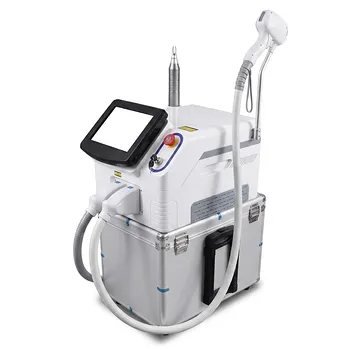
Combined RF–optical systems address the two central weaknesses of light-only hair removal: melanin-dependent optical energy can overheat dark epidermis, while low-melanin hair absorbs too little light. By using diode laser or IPL to preheat the follicle and bipolar RF to deliver additional heat through electrical impedance, these systems can reduce optical fluence while maintaining follicular damage.
The key mechanism is electro-optical synergy: optical energy provides selective preheating, and the resulting lower impedance directs RF current toward the heated follicle. Because RF heating does not depend primarily on melanin, this combination can improve safety for darker skin and effectiveness for finer, lighter hair.
Why Light-Only Hair Removal Has Two Fundamental Limitations
Dark skin increases optical safety risk
Diode lasers and IPL systems rely largely on melanin absorption to convert light into heat. In darker skin, epidermal melanin competes with the hair for that energy, increasing the risk of excessive epidermal heating, burns, blistering, and post-inflammatory pigment changes.
This often requires reducing optical fluence or using other conservative settings. The trade-off is that lower fluence may provide insufficient thermal damage to the follicle.
Light-colored hair provides a weak target
Blond, red, gray, and white hair contains less melanin than dark hair. Consequently, the hair shaft absorbs less optical energy and produces less heat at the follicle.
This is why conventional laser or IPL treatment is generally least predictable for fine or lightly pigmented hair.
How the Combined Mechanism Works
Optical energy preheats the hair shaft
The diode laser or IPL component still performs an important role: it deposits initial heat into whatever pigment is present in the hair shaft and follicular structure.
Even when the hair is not dark, this preheating can alter the electrical properties of the target tissue and create a more favorable path for RF energy.
Heating lowers electrical impedance
As the follicular region becomes heated, its electrical impedance decreases. In practical terms, the preheated follicle becomes an easier path for electrical current to follow.
This is the central link between the optical and RF components. The light does not need to deliver all the destructive heat by itself; it helps identify and condition the target for the RF phase.
Bipolar RF concentrates along the lower-impedance path
Bipolar RF generates heat through tissue resistance rather than depending on melanin as a chromophore. Once the follicular region has been selectively preheated, RF current preferentially travels through that lower-impedance area.
The resulting thermal effect can extend around the hair shaft and affect follicular structures involved in regrowth, including regions near the outer root sheath and bulge.
The two energies share the thermal workload
The optical component supplies targeted preheating, while RF adds chromophore-independent thermal energy. Together, they can produce sufficient follicular heating without requiring the optical component to provide the entire treatment dose.
This is the practical meaning of electro-optical synergy: the energies are not simply added independently; the first changes the tissue so the second can act more selectively.
Why This Helps Treat Darker Skin
Lower optical fluence reduces epidermal exposure
Because RF contributes to follicular heating, the system can often operate with a lower optical fluence than a light-only treatment would require.
That reduces the amount of optical energy absorbed by epidermal melanin. Lower epidermal absorption can reduce the likelihood of excessive heating and pigmentary complications, particularly in darker Fitzpatrick skin types.
RF is not governed by epidermal melanin
RF energy is delivered according to electrical properties such as tissue impedance, not solely according to the concentration of melanin in the skin.
This gives the practitioner a second energy pathway that is less affected by the competition between dark epidermis and the hair shaft.
Safety still depends on treatment parameters
RF is not automatically risk-free for dark skin. Excessive RF energy, poor coupling, inadequate cooling, or inappropriate electrode contact can still cause unwanted heating.
The advantage is greater control over the balance of optical and electrical energy, not immunity from thermal injury.
Why This Helps With Light-Colored Hair
RF supplies a non-melanin-dependent mechanism
Light hair may not absorb enough laser or IPL energy to reach follicle-damaging temperatures. RF helps compensate because its thermal effect depends on electrical impedance rather than hair-pigment density alone.
This can improve the rationale for treating fine, blond, red, or otherwise poorly pigmented hair compared with optical energy alone.
Optical preheating can still provide targeting assistance
The light component does not necessarily need to destroy the follicle independently. Its role can be to provide enough initial heating to make the follicular pathway electrically favorable for the RF current.
The less pigmented the hair, however, the weaker this initial optical interaction may be. Results therefore remain more variable than with strongly pigmented terminal hair.
White hair remains a particularly difficult case
White hair contains little or no melanin, so the optical component has very limited ability to preheat it. RF may still provide a chromophore-independent mechanism, but treatment response should not be presented as equivalent to that of dark hair.
Some protocols have investigated adjunctive approaches, such as topical aminolevulinic acid with RF/IPL, to increase follicular photosensitivity. These approaches are protocol-specific and should not be assumed to apply to every combined device.
Understanding the Trade-offs
Combined systems do not eliminate the need for pigment
The RF component reduces dependence on melanin, but the combined mechanism may still use optical preheating to improve targeting. Extremely light or white hair can therefore remain challenging.
The technology broadens the treatment range; it does not guarantee reliable clearance for every hair color or texture.
More energy pathways require more precise control
A combined platform introduces additional variables, including optical fluence, RF power, pulse timing, electrode contact, skin cooling, and treatment overlap.
Poor coordination between these parameters can reduce efficacy or increase discomfort and thermal risk.
Hair biology still limits outcomes
Hair-removal systems damage active follicular structures, but hair cycles, follicle depth, hair thickness, hormonal influences, and treatment schedule all affect the final result.
Multiple sessions are generally required, and “permanent hair removal” should be distinguished from long-term hair reduction.
Device claims should be evaluated carefully
Terms such as safe for all skin types or effective on all hair colors are too broad without details about the device, protocol, hair characteristics, and operator training.
The relevant question is not whether RF is inherently safe or whether IPL is inherently effective, but how the specific system controls energy delivery for the specific patient.
How to Apply This to Your Treatment Goal
The mechanism is most useful when the optical and RF components are selected and controlled as complementary, rather than treated as interchangeable sources of heat.
- If your primary focus is treating dark skin: Favor a system and protocol that can reduce optical fluence while using controlled bipolar RF, with appropriate cooling, skin assessment, and conservative test spots.
- If your primary focus is treating blond, red, or fine hair: Look for a platform that uses RF to supplement limited optical absorption, while recognizing that response may be less predictable than with dark terminal hair.
- If your primary focus is treating white hair: Ask specifically how the device creates follicular targeting when little or no melanin is present, and do not assume that a combined system will provide reliable clearance.
- If your primary focus is minimizing complications: Prioritize operator experience, parameter selection, cooling, electrode contact, and a documented test area over the device’s marketing label.
Understanding the impedance-guided interaction between optical preheating and RF delivery allows you to judge combined hair-removal systems by their actual mechanism rather than by broad claims about laser or RF technology.
Summary Table:
| Mechanism | Role in Treatment | Benefit | Limitation |
|---|---|---|---|
| Optical preheating | Deposits initial heat into hair pigment | Selectively targets hair follicle | Weak if hair is light or white |
| RF energy | Adds chromophore-independent heat | Bypasses melanin dependence | Requires proper electrode contact and control |
| Impedance-guided synergy | RF follows preheated, lower-impedance path | Improves follicular targeting | Needs precise parameter coordination |
| Lower optical fluence | Reduces epidermal energy absorption | Improves safety for dark skin | May under-treat if RF not optimized |
Explore our advanced RF-combined hair removal systems at BELIS. Our medical-grade devices combine diode laser or IPL with bipolar RF to safely and effectively treat a wider range of skin and hair types. Contact us today to learn how our technology can enhance your clinic's offerings and deliver superior results for your clients. Contact us.
Related Products
- 808nm Diode Laser Hair Removal Machine 755+808+1064nm Mixed Wavelength Professional Equipment
- Clinic Diode Laser Hair Removal Machine with SHR and Trilaser Technology
- Diode Laser SHR Trilaser Hair Removal Machine for Clinic Use
- 808nm Diode Laser Hair Removal Machine and Equipment with Picolaser Arm
- Diode Tri Laser Hair Removal Machine for Clinic Use
People Also Ask
- How do 800/810 nm diode hair removal lasers compare to 1064 nm long-pulsed Nd:YAG lasers? Discover the Best for Your Patients
- How do broad-spectrum noncoherent light sources compare to single-wavelength diode lasers in aesthetic hair removal applications? Find the best fit for your clinic.
- How can aesthetic practitioners prevent side effects like paradoxical hair regrowth and thermal burns when performing diode laser hair removal on dark skin? Master safe protocols for Fitzpatrick IV–VI skin.
- Why is monitoring the revenue rate per hour per physician essential when deciding to invest in high-throughput aesthetic technology like diode hair removal lasers or multi-applicator body sculpting machines? Optimize your practice's profitability
- How do different energy fluences in professional diode hair removal lasers affect hair follicle tissue at the cellular level? Unlock Optimal Safety and Efficacy