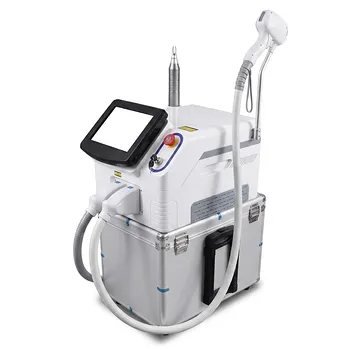
The key clinical advantage is chromophore conversion: sequential delivery of a 595 nm PDL pulse immediately followed by a 1064 nm Nd:YAG pulse makes the vessel more receptive to the second wavelength. The PDL converts oxyhemoglobin into methemoglobin, which absorbs 1064 nm energy more strongly than normal hemoglobin, enabling effective thermocoagulation at lower Nd:YAG fluence.
Sequential dual-wavelength treatment uses one wavelength to prepare the vascular target and the second to treat it more efficiently. This can improve clearance of resistant vessels while reducing the energy—and therefore the thermal burden—required from either wavelength alone.
How the Sequential Mechanism Works
The 595 nm pulse prepares the vessel
The 595 nm PDL is strongly absorbed by hemoglobin and is well suited to superficial red vascular structures. Its initial pulse deposits targeted energy in the vessel and converts oxyhemoglobin into methemoglobin.
The initial exposure may also promote micro-clot formation within the vessel, creating additional targets for the following wavelength.
The 1064 nm pulse exploits the conversion
The subsequent 1064 nm Nd:YAG pulse encounters methemoglobin, whose absorption coefficient at 1064 nm is substantially higher than that of standard hemoglobin. As a result, more of the second pulse’s energy can be absorbed by the prepared vascular target.
This allows the Nd:YAG pulse to produce vessel heating and thermocoagulation using lower fluence levels than might be required when treating the same target with a single wavelength.
Timing is central to the benefit
The wavelengths are not simply used independently during the same treatment. The closely sequenced delivery is what allows the first pulse to alter the chromophore before the second pulse arrives.
That creates a photothermal synergy: the first wavelength improves the optical absorption of the second.
What This Means Clinically
Better treatment of resistant superficial vessels
Some bright-red superficial vessels can be difficult to clear with conventional single-wavelength treatment. Sequential treatment is particularly relevant to fine vessels, including lesions under approximately 0.1 mm, where improving energy absorption can be clinically valuable.
The approach may also support treatment of vascular lesions that respond incompletely to a single PDL or Nd:YAG wavelength.
Broader vascular depth coverage
The two wavelengths address different optical and anatomical strengths. The 595 nm PDL is primarily effective for superficial vascular targets, while the 1064 nm Nd:YAG provides greater penetration into deeper dermal structures.
This makes the platform more adaptable across red superficial vessels and deeper or bluish vascular changes, although treatment parameters must still be selected according to vessel depth, diameter, skin type, and lesion characteristics.
Potentially lower thermal side effects
Because the second wavelength is absorbed more efficiently after chromophore conversion, clinicians may not need to compensate with unnecessarily high fluence. Lower energy requirements can reduce unwanted thermal injury and may help limit procedural discomfort, post-treatment hyperpigmentation, and scarring.
This is a risk-reduction advantage, not a guarantee of complication-free treatment. Appropriate cooling, pulse duration, fluence, endpoint assessment, and patient selection remain essential.
Why It Can Improve on Single-Wavelength Treatment
Single-wavelength treatment has a narrower optical strategy
A single wavelength must both reach the vessel and generate sufficient absorption to produce the desired vascular injury. If absorption is limited or the target is deeper than the wavelength’s strongest treatment range, increasing fluence may increase collateral heating as well as therapeutic effect.
Sequential technology addresses this limitation by changing the target before delivering the deeper-penetrating pulse.
The two wavelengths perform complementary roles
The PDL acts as the preparatory wavelength, modifying the blood chromophore. The Nd:YAG then acts as the therapeutic follow-through, using the altered chromophore to improve absorption at 1064 nm.
The advantage is therefore not simply having two lasers available. It is the ability to use them in a biologically and optically coordinated sequence.
Treatment can be more versatile
A combined system can be used across a wider range of vascular presentations than a device optimized for only superficial red vessels or only deeper blue vessels. This may be useful for clinics treating mixed vascular cases, including superficial telangiectasias, venous lakes, leg veins, and capillary malformations.
Understanding the Trade-offs
Lower fluence does not eliminate treatment risk
Even with improved absorption, both wavelengths deliver thermal energy to tissue. Excessive fluence, inappropriate pulse timing, inadequate cooling, or poor target selection can still cause burns, pigmentary changes, scarring, or other adverse effects.
The technology improves the treatment window; it does not replace clinical judgment.
Not every vascular lesion needs sequential treatment
Small, superficial lesions may respond well to a single appropriate wavelength. Sequential delivery is most compelling when the lesion is resistant, contains vessels at different depths, or requires a more efficient interaction between superficial targeting and deeper penetration.
Using both wavelengths routinely may add complexity without adding meaningful benefit in every case.
Outcomes depend on more than wavelength
Clinical response is also influenced by vessel diameter, depth, blood oxygenation, skin phototype, lesion location, fluence, pulse duration, cooling, and the number of treatment sessions. Claims of improved clearance should therefore be interpreted as potential advantages of the treatment strategy rather than guaranteed outcomes for every patient.
Equipment and workflow matter
A practical system must deliver the pulses with reliable timing and consistent energy output. Clinicians should also consider handpiece design, cooling capability, maintenance, consumables, training requirements, and whether the platform supports the vascular indications most relevant to their patient population.
Making the Right Choice for Your Goal
Sequential dual-wavelength technology is most valuable when the clinical objective requires both efficient superficial targeting and deeper vascular heating.
- If your primary focus is resistant superficial red vessels: Use the sequential mechanism to convert hemoglobin into a stronger 1064 nm absorber before Nd:YAG delivery, potentially improving thermocoagulation at lower fluence.
- If your primary focus is deeper or mixed-depth vascular lesions: Choose the combined platform for the complementary reach of 595 nm PDL and 1064 nm Nd:YAG, while tailoring parameters to vessel depth and diameter.
- If your primary focus is reducing treatment morbidity: Treat the lower-fluence advantage as a potential safety margin, not a substitute for conservative settings, cooling, endpoint monitoring, and appropriate patient selection.
- If your primary focus is equipment versatility: Evaluate whether the system can address the full range of vascular lesions in your practice rather than assuming sequential delivery is necessary for every case.
The core benefit is simple: the first wavelength makes the vessel a better target for the second, improving treatment efficiency while potentially reducing unnecessary thermal exposure.
Summary Table:
| Advantage | Mechanism | Clinical Benefit |
|---|---|---|
| Chromophore conversion | PDL converts oxyhemoglobin to methemoglobin, which absorbs Nd:YAG better | Enhanced thermocoagulation at lower fluence |
| Broader depth coverage | PDL targets superficial vessels; Nd:YAG penetrates deeper | Effective for mixed-depth lesions |
| Reduced thermal side effects | Lower fluence possible due to improved absorption | Less discomfort, lower risk of pigmentation/scarring |
| Versatility | Two wavelengths in one system | Treat a wider range of vascular lesions |
Enhance your clinic's vascular treatment capabilities with BELIS's advanced dual-wavelength technology. Our systems offer chromophore conversion for efficient, safer outcomes. Contact us today to learn more and schedule a demo — Get in touch with our experts and see how BELIS can elevate your practice.
Related Products
- Tri Laser Diode Hair Removal Machine Professional Beauty Equipment
- 808nm Diode Laser Hair Removal Machine 755+808+1064nm Mixed Wavelength Professional Equipment
- Professional Face and Vaginal 7D HIFU System for HIFU Clinic Treatments
- Clinic Use IPL SHR ND YAG Laser Hair Removal RF Skin Tightening Machine
- Clinic Use IPL and SHR Hair Removal Machine with Nd Yag Laser Tattoo Removal
People Also Ask
- How can aesthetic practitioners prevent side effects like paradoxical hair regrowth and thermal burns when performing diode laser hair removal on dark skin? Master safe protocols for Fitzpatrick IV–VI skin.
- How do broad-spectrum noncoherent light sources compare to single-wavelength diode lasers in aesthetic hair removal applications? Find the best fit for your clinic.
- How do demographic trends in non-surgical procedures like laser hair removal compare to surgical aesthetics, and how should clinics leverage professional diode laser hair removal equipment to meet this demand?
- Why is monitoring the revenue rate per hour per physician essential when deciding to invest in high-throughput aesthetic technology like diode hair removal lasers or multi-applicator body sculpting machines? Optimize your practice's profitability
- What are the primary differences in mechanism and pigment dependency between standard laser hair removal devices (Alexandrite, Diode, Nd:YAG) and photosensitizer-assisted light therapies? Discover expert insights and tailored solutions