
In essence, Radio Frequency (RF) is the invisible force that enables all modern wireless communication. It allows us to transmit information—from a simple voice call to high-definition video—through the air without physical cables. This is accomplished by creating and controlling electromagnetic waves at a specific frequency, which then act as a carrier for the data you want to send.
RF isn't a single entity, but a vast spectrum of energy. By selecting and controlling a specific frequency, we create unique, non-interfering channels for every wireless device, from your car radio and GPS to your home’s Wi-Fi network.
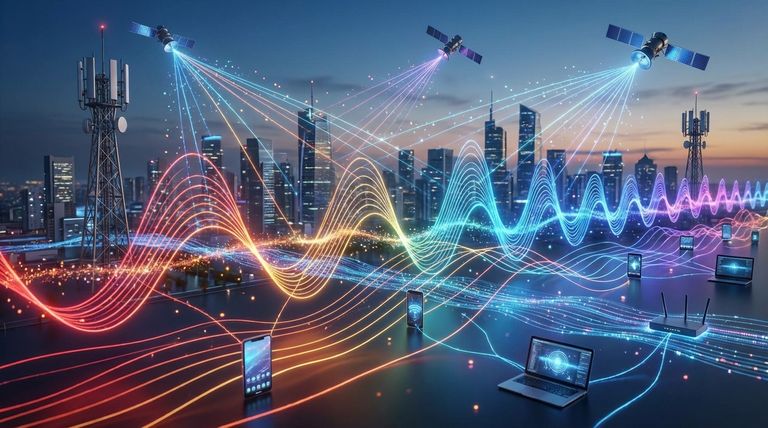
The Core Principle: Frequency as a Carrier
What is a "Frequency"?
Think of frequency as a unique highway lane for data. It is the rate at which an electromagnetic wave oscillates, or cycles, per second. This rate is measured in Hertz (Hz).
A lower frequency, like that used for AM radio, means fewer wave cycles per second. A much higher frequency, like for 5G or Wi-Fi, means billions of cycles per second.
How RF Carries Information
A raw frequency on its own is just a steady, silent wave. To make it carry information, we must modulate it—slightly altering its properties in a specific pattern that a receiver can decode.
Imagine the frequency is a blank piece of paper. Modulation is the act of "writing" your message onto it. This can be done by changing the wave's power (Amplitude Modulation or AM) or its exact frequency (Frequency Modulation or FM), among other methods.
The RF Spectrum: A Shared Resource
The usable RF spectrum ranges from a few Hertz all the way up to 300 Gigahertz (GHz). This is a finite, shared resource that must be carefully managed to prevent chaos.
Government bodies, like the FCC in the United States, allocate specific frequency bands for specific purposes. This is why your garage door opener doesn't interfere with a nearby airport's control tower—they are assigned completely different "lanes" on the RF highway.
How Frequency Dictates Performance
Different frequencies have fundamentally different physical properties. The choice of which frequency to use for a technology is a deliberate engineering decision based on these characteristics.
Low Frequencies (e.g., AM Radio, Submarines)
Low-frequency waves are very long and can travel great distances. They are also adept at bending around large obstacles and penetrating materials like water and earth, but they can't carry much data.
Mid-Range Frequencies (e.g., Wi-Fi, 4G LTE, Bluetooth)
This is the "sweet spot" for most consumer technology. It offers a practical balance between data-carrying capacity (bandwidth) and decent range, making it ideal for use within a home, office, or city block.
High Frequencies (e.g., 5G mmWave, Satellite Links)
Extremely high frequencies can carry an enormous amount of data, enabling gigabit speeds. However, these signals are very short-range and are easily blocked by walls, leaves, and even rain, requiring a direct line of sight for best performance.
Understanding the Trade-offs
There is no "perfect" frequency. Every wireless technology represents a compromise between competing physical realities. Choosing a frequency always involves balancing these critical trade-offs.
Bandwidth vs. Range
This is the most fundamental trade-off. As you go higher in frequency, you generally gain access to more bandwidth (higher potential speed), but you sacrifice signal range.
Penetration vs. Capacity
Lower frequencies penetrate physical obstacles like walls far better than higher frequencies. This is why your 2.4 GHz Wi-Fi signal often has better "reach" than your faster 5 GHz signal.
The Challenge of Interference
Because the RF spectrum is crowded, signals can bleed into each other, causing interference. This is a primary cause of dropped calls or slow Wi-Fi in dense areas like apartment buildings, where many devices are competing for the same frequency bands.
Making the Right Choice for Your Goal
Understanding these principles helps you diagnose problems and make better decisions about the technology you use every day.
- If your primary focus is range and coverage: Lower-frequency signals (like 2.4 GHz Wi-Fi) are superior for covering a larger area and penetrating walls.
- If your primary focus is speed and data capacity: Higher-frequency signals (like 5 GHz Wi-Fi or 5G mmWave) are required for tasks like 4K streaming or large file downloads.
- If your primary focus is reliability: Recognizing that high frequencies are blocked by physical objects can help you troubleshoot issues by, for example, moving your Wi-Fi router to a more central location.
Ultimately, understanding what RF frequency does is the key to demystifying the wireless world that powers our modern lives.
Summary Table:
| Frequency Range | Common Uses | Key Characteristics |
|---|---|---|
| Low Frequencies | AM Radio, Submarines | Long range, good penetration, low data capacity |
| Mid-Range Frequencies | Wi-Fi, 4G LTE, Bluetooth | Balanced range and bandwidth, ideal for home/office use |
| High Frequencies | 5G mmWave, Satellite Links | High speed/data capacity, short range, easily blocked |
Ready to leverage professional-grade technology for your business? BELIS specializes in advanced medical aesthetic equipment, providing clinics and premium beauty salons with reliable, high-performance solutions. Whether you need precise energy delivery or robust connectivity for your devices, our expertise ensures optimal performance. Contact us today to discover how our technology can enhance your services and drive growth.
Visual Guide
