
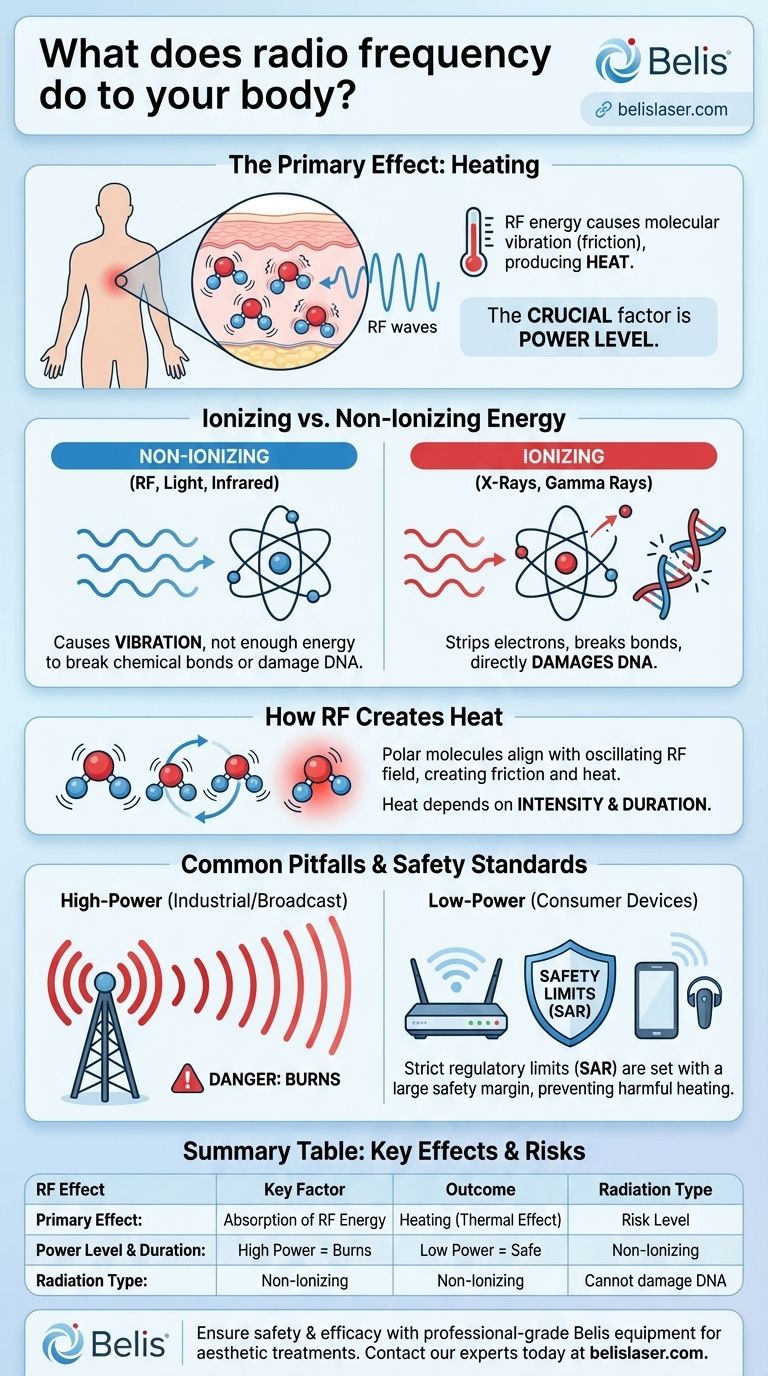
The primary, scientifically established effect of radio frequency (RF) energy on the human body is heating. When RF radiation is absorbed in large enough amounts, it causes molecules in body tissue to vibrate. This molecular friction produces heat, and at very high power levels, this can lead to burns and tissue damage.
The crucial factor is the power level of the exposure. While high-power industrial RF sources can be dangerous, the low-power RF energy from everyday devices like cell phones and Wi-Fi routers is not sufficient to cause this harmful heating effect.

The Fundamental Divide: Ionizing vs. Non-Ionizing Energy
To understand the real-world impact of RF, we must first distinguish it from more dangerous types of radiation. This is the single most important concept in the discussion.
What is Non-Ionizing Radiation?
Radio frequency is a form of non-ionizing radiation. This means it has enough energy to make atoms vibrate or move, but not enough energy to knock electrons out of those atoms.
This category also includes other familiar energy forms like infrared radiation, visible light, and extremely low-frequency (ELF) radiation from power lines.
The Danger of Ionizing Radiation
In contrast, ionizing radiation—such as X-rays and gamma rays—carries immense energy. This type of radiation can strip electrons from atoms, breaking chemical bonds and directly damaging DNA.
This DNA-level damage is why ionizing radiation is a known cause of cancer and cellular destruction, even at lower doses over time.
Why This Distinction Is Critical
The biological effects of non-ionizing RF energy are fundamentally different from those of ionizing radiation. Because RF cannot break chemical bonds, its primary interaction with the body is through thermal (heating) effects, not direct cellular damage.
How RF Energy Creates Heat
The mechanism by which RF energy heats tissue is straightforward and is the same principle used in a microwave oven.
The Mechanism of Thermal Effects
Human tissue contains a high percentage of water, and water molecules are "polar"—they have a positive and a negative end.
When exposed to an RF field, these polar molecules rapidly try to align themselves with the field. As the field oscillates, the molecules vibrate and rotate, creating friction that generates heat.
The Role of Power and Duration
The amount of heat produced depends directly on the intensity (power) and duration of the RF exposure.
A very high-power source, like an industrial heater or a powerful broadcast antenna, can transfer a significant amount of energy quickly, leading to a dangerous temperature rise. Low-power sources, like a Wi-Fi router, transfer extremely small amounts of energy that dissipate without any noticeable temperature change.
Common Pitfalls and Safety Standards
The public conversation around RF is often clouded by a misunderstanding of power levels and safety regulations.
The Threshold for Harm
The known risk from RF exposure is tied to this heating effect. Harm only occurs when the RF energy is intense enough to overwhelm the body's ability to dissipate heat, causing a significant increase in tissue temperature.
How Safety Limits Are Set
Regulatory agencies worldwide set exposure limits for all consumer devices that emit RF energy.
These limits, often measured as the Specific Absorption Rate (SAR), are established with a very large safety margin. They are set many times lower than the lowest power level known to cause any harmful heating in the body.
Exposure from Everyday Devices
Devices like cell phones, Bluetooth headsets, and Wi-Fi routers operate at extremely low power levels that are compliant with these strict safety standards. The minimal energy they emit does not produce any significant or harmful heating of body tissue.
Making the Right Choice for Your Goal
Evaluating the risk of RF energy requires context. The source and its power level are what matter.
- If your primary focus is high-power industrial or broadcast equipment: You must follow all mandated safety protocols, as these sources can generate enough energy to cause severe thermal burns.
- If your primary focus is consumer electronics (phones, Wi-Fi, 5G): The scientific consensus is that these low-power devices do not produce harmful heating effects, as their output is well within established international safety limits.
Ultimately, understanding that the proven risk from RF is based on heat, not DNA damage, is the key to accurately evaluating exposure from different sources.
Summary Table:
| RF Effect | Key Factor | Outcome |
|---|---|---|
| Primary Effect | Absorption of RF Energy | Heating of body tissue (thermal effect) |
| Risk Level | Power Level & Duration | High power can cause burns; low power (consumer devices) is safe |
| Radiation Type | Non-Ionizing | Cannot damage DNA; fundamentally different from X-rays |
Ensure the safety and efficacy of your aesthetic treatments with professional-grade equipment.
BELIS specializes in manufacturing advanced, safe, and reliable medical aesthetic equipment that utilizes controlled radio frequency technology. Our devices are engineered for precise results and maximum client safety, helping medical aesthetics clinics and premium beauty salons deliver superior treatments.
Contact our experts today to learn how our technology can enhance your service offerings and grow your business.
Visual Guide
Related Products
- Ultrasonic Cavitation Radiofrecuency Machine for Body Slimming
- IPL SHR+Radio frecuency machine
- RF Microneedling Machine Micro Needle Radio Frequency Machine
- RF Microneedling Machine Micro Needle Radio Frequency Machine
- EMSlim RG Laser Body Sculpting and Slimming Machine
People Also Ask
- What are the pros and cons of the ultrasonic cavitation slimming treatment? A Guide to Painless Body Contouring
- Does an ultrasonic cavitation machine also tighten the skin? Achieve Total Body Contouring with RF Synergy
- How does radiofrequency technology in slimming machines promote fat reduction? The Science of Non-Invasive Sculpting
- How should one prepare for an ultrasonic cavitation appointment? 5 Essential Tips for Maximum Fat Loss Results
- What areas of the body are targeted for ultrasonic cavitation? Best Zones for Effective Body Contouring








