
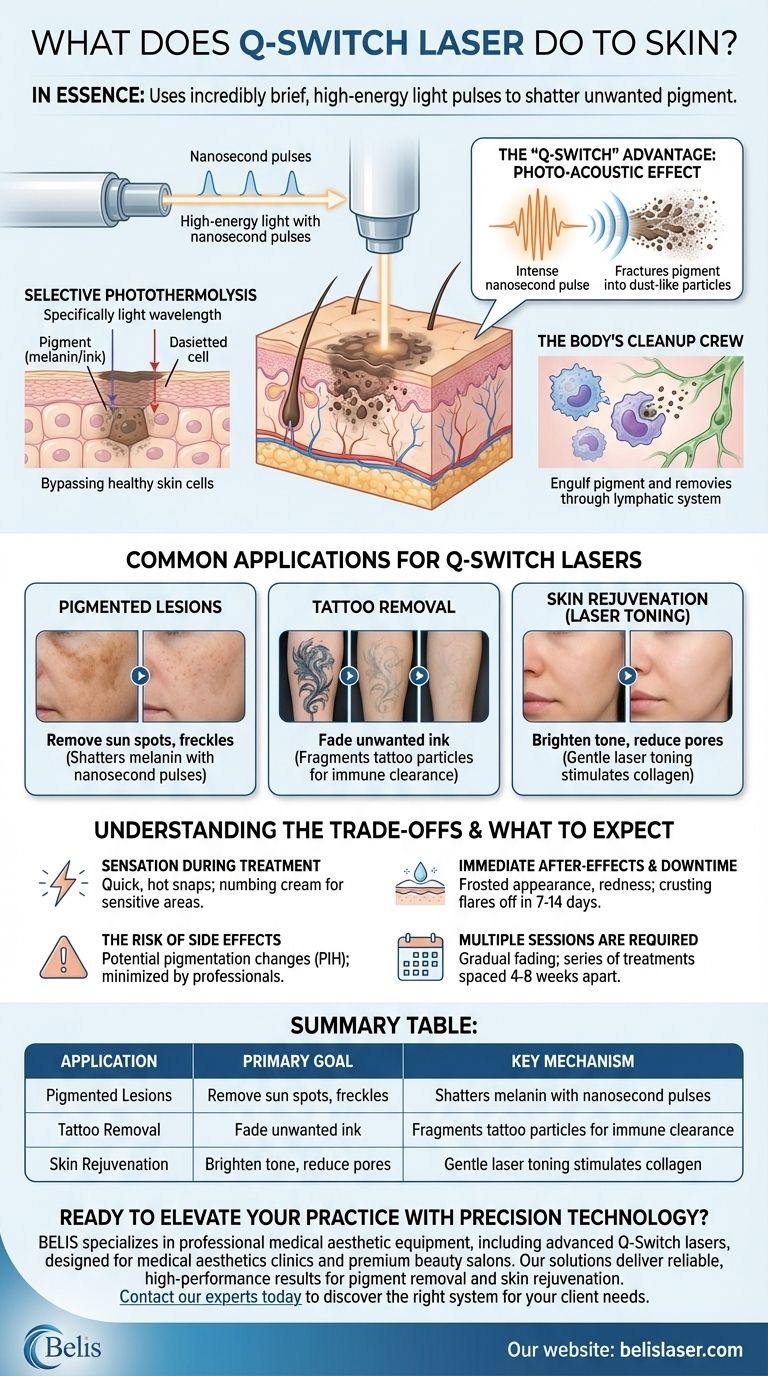
In essence, a Q-Switch laser uses incredibly brief, high-energy light pulses to shatter unwanted pigment within the skin. These pigments can be natural, such as the melanin in sunspots and freckles, or artificial, like the ink in a tattoo. The laser energy is absorbed by the pigment, causing it to fragment into microscopic particles without harming the surrounding skin, allowing the body’s immune system to naturally clear them away.
The power of the Q-Switch laser lies in its precision. By delivering energy in extremely short bursts (nanoseconds), it selectively destroys pigment particles while minimizing heat damage to surrounding healthy tissue, making it a highly effective tool for clearing specific discolorations.
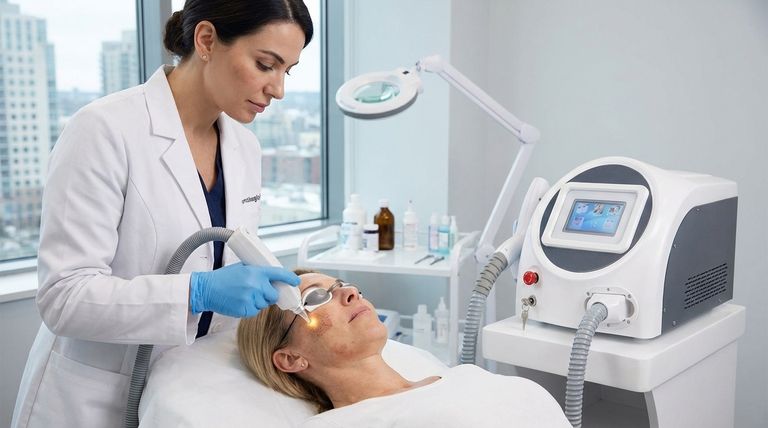
How a Q-Switch Laser Actually Works
To understand its effect, you must understand its unique mechanism. The technology is based on delivering a massive amount of energy in an infinitesimally small amount of time.
The Principle: Selective Photothermolysis
The laser emits a specific wavelength of light that is strongly absorbed by the target pigment (melanin or tattoo ink) but poorly absorbed by the surrounding water and tissue in the skin.
This selective absorption means the energy is concentrated precisely where it's needed, leaving healthy skin cells largely unaffected.
The "Q-Switch" Advantage: A Photo-Acoustic Effect
The "Q-Switch" is a component that allows the laser to produce extremely short, intense pulses, lasting just billionths of a second (nanoseconds).
This rapid energy delivery doesn't just heat the pigment; it creates a photo-acoustic shockwave that vibrates and shatters the pigment into much smaller, dust-like particles. Think of it as shattering a large rock into tiny pebbles rather than slowly melting it.
The Body's Cleanup Crew
Once the pigment is fragmented into microscopic particles, the body’s immune cells (specifically macrophages) can identify them as waste.
These cells engulf and carry away the tiny pigment fragments through the lymphatic system, causing the spot or tattoo to gradually fade over a period of weeks.
Common Applications for Q-Switch Lasers
This specific mechanism makes the Q-Switch laser a highly versatile tool for several distinct dermatological goals.
Removing Pigmented Lesions
This is the most common use. It is highly effective for discrete, benign pigmented spots caused by sun exposure and aging. This includes solar lentigines (age spots), freckles, and Café-au-lait macules.
Tattoo Removal
The Q-Switch laser is a gold standard for tattoo removal. Different wavelengths are used to target different ink colors (e.g., one for black and blue inks, another for red and orange). The laser shatters the ink particles, allowing the body to clear them over multiple sessions.
Skin Rejuvenation (Laser Toning)
When used at lower settings across the entire face, the laser can provide a gentle rejuvenating effect known as laser toning or a "Carbon Peel." This application helps improve overall skin tone, reduce pore size, and provides a mild stimulus for new collagen production with virtually no downtime.
Understanding the Trade-offs and What to Expect
While effective, it is critical to have realistic expectations and understand the potential side effects.
The Sensation During Treatment
Most patients describe the feeling as a series of quick, hot snaps against the skin, similar to a small rubber band being snapped. For sensitive areas or larger treatments, a topical numbing cream may be applied beforehand.
Immediate After-effects and Downtime
Immediately after treating a dark spot, the area may appear white or "frosted," followed by redness and mild swelling for a few hours. The treated spot will then darken and form a thin crust that flakes off naturally within 7-14 days. For general laser toning, there is typically only mild, transient redness.
The Risk of Side Effects
The primary risk is a change in skin pigmentation. Post-Inflammatory Hyperpigmentation (PIH), or a temporary darkening of the skin, can occur, especially in individuals with darker skin types. Less commonly, hypopigmentation (lightening of the skin) can happen. These risks are significantly minimized when the procedure is performed by a highly experienced, qualified professional.
Multiple Sessions Are Required
This is not a single-session cure. For both pigmented lesions and tattoos, the fading process is gradual. A series of treatments, typically spaced 4-8 weeks apart, is necessary to achieve the desired clearance as the body needs time to flush out the shattered pigment particles.
Making the Right Choice for Your Goal
Use this guide to determine if a Q-Switch laser aligns with your objective.
- If your primary focus is removing specific dark spots (sunspots, freckles): A Q-Switch laser is a gold-standard treatment, offering targeted removal with high precision.
- If your primary focus is removing an unwanted tattoo: This is one of the most effective technologies available, but be prepared for a multi-session journey dependent on ink colors and depth.
- If your primary focus is overall skin brightening and reducing pore size: A gentle, full-face Q-Switch procedure known as laser toning can provide subtle rejuvenation with minimal downtime.
- If your primary focus is treating deep wrinkles or significant skin laxity: A Q-Switch laser offers only mild benefits; you should explore other technologies like fractional ablative lasers or radiofrequency.
Understanding this mechanism empowers you to work with a qualified professional to determine if it is the optimal path to achieving your specific skin goals.
Summary Table:
| Application | Primary Goal | Key Mechanism |
|---|---|---|
| Pigmented Lesions | Remove sun spots, freckles | Shatters melanin with nanosecond pulses |
| Tattoo Removal | Fade unwanted ink | Fragments tattoo particles for immune clearance |
| Skin Rejuvenation | Brighten tone, reduce pores | Gentle laser toning stimulates collagen |
Ready to elevate your practice with precision technology? BELIS specializes in professional medical aesthetic equipment, including advanced Q-Switch lasers, designed for medical aesthetics clinics and premium beauty salons. Our solutions deliver reliable, high-performance results for pigment removal and skin rejuvenation. Contact our experts today to discover the right system for your client needs.
Visual Guide
Related Products
- Q Switch Nd Yag Laser Machine Tattoo Removal Nd Yag Machine
- Cryolipolysis Fat Freezing Cavitation Lipo Laser Machine
People Also Ask
- What is the documented effectiveness of Q-switched Nd:YAG lasers for tattoo removal? Gold Standard Results
- How does laser fluence influence pigment clearance vs. safety? Balancing Speed and Skin Integrity in Tattoo Removal
- How should wavelength and fluence settings be adjusted on Nd:YAG and Q-switched lasers when treating darker skin tones? Optimize Safety & Efficacy
- Which laser modalities and treatment schedules are recommended for clinical laser tattoo removal procedures? Q-Switched Nd:YAG and 6–12 Week Intervals Preferred for Safe, Effective Results
- How are Q-switched lasers used for tattoo removal? Advanced Photoacoustic Technology for Clear Skin

