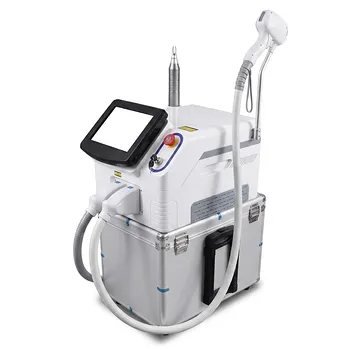
The primary epidermal cooling technologies are sapphire contact cooling, dynamic cryogen spray, chilled topical gels, and forced chilled air. Sapphire windows and cryogen sprays generally provide the strongest, most targeted thermal protection, while gels and air cooling offer simpler but usually less intense heat removal. Their safety profiles depend not only on the cooling method, but also on laser wavelength, fluence, pulse duration, skin phototype, treatment technique, and device maintenance.
Active cooling protects epidermal melanin—the main competing chromophore—so laser energy can reach the hair follicle with less risk of epidermal injury. Contact cooling and cryogen spray typically provide the greatest thermal protection, but neither eliminates the need for appropriate settings, skin assessment, and trained operation.
Why Epidermal Cooling Matters
The epidermis competes with the hair follicle
Hair-removal lasers target melanin in the follicle, but epidermal melanin also absorbs laser energy. This is particularly important for darker skin phototypes, where greater epidermal melanin absorption can increase the risk of overheating.
Cooling reduces the epidermis’s thermal load while allowing useful fluence to reach deeper follicular structures. It can also improve patient comfort and reduce treatment-related erythema, blistering, and pigmentary changes.
Cooling is a risk-control measure, not a guarantee
Effective cooling may permit higher fluence or more comfortable treatment, but it does not compensate for excessive energy, poor coupling, inadequate skin assessment, or incorrect pulse settings. Thermal injury remains possible if the treatment parameters are inappropriate.
The Main Cooling Technologies
Sapphire window contact cooling
A sapphire contact system uses a cooled crystal window held firmly against the skin. Water or another cooling system circulates through the handpiece, removing heat by direct conduction before and during laser delivery.
The primary safety advantage is consistent, localized cooling when the window maintains good contact. It can substantially reduce epidermal temperature and pain, and it is commonly integrated into diode systems and other medical aesthetic platforms.
Because the cooling surface is in direct contact with the patient, the handpiece requires rigorous cleaning and disinfection between patients. Poor contact, uneven pressure, or inadequate maintenance can reduce cooling performance or create infection-control concerns.
Dynamic cryogen spray cooling
Dynamic cryogen cooling delivers a short spray immediately before, and in some systems around, the laser pulse. Evaporation rapidly extracts heat from the superficial epidermis without requiring the handpiece to remain in contact with the skin.
Its main safety strength is rapid, high-efficiency superficial cooling. It is particularly associated with alexandrite systems and can be useful when strong epidermal protection is needed without continuous contact.
The principal limitation is uniformity. Uneven spray timing, distance, coverage, or droplet distribution can create areas of under-cooling, while excessive or poorly controlled exposure can produce cold-related injury. Correct synchronization between the spray and laser pulse is therefore essential.
Chilled topical gels
Refrigerated hydrogel provides passive conductive cooling between the skin and the treatment surface. It can improve optical coupling, reduce friction, and provide modest relief from heat and discomfort.
Gels are generally simpler and less mechanically complex than integrated active cooling systems. However, their cooling effect is usually less rapid and less precisely controlled than sapphire contact cooling or dynamic cryogen.
Cooling may become inconsistent if the gel layer is too thin, warms during treatment, or is applied unevenly. Gel hygiene and single-patient-use or manufacturer-approved handling procedures are also important.
Forced chilled air
Forced-air systems direct cooled air continuously onto the treatment area without touching the skin. This provides non-contact cooling before, during, and after laser pulses.
The non-contact design reduces concerns associated with repeated handpiece contact and can be useful for patient comfort or for large treatment areas. Its limitation is that air cooling generally removes heat less directly than a well-coupled sapphire window or evaporating cryogen.
Performance can vary with airflow, distance, room conditions, and treatment speed. It may therefore be used as a standalone comfort measure or combined with contact cooling, gel, or other active systems.
How Their Safety Profiles Compare
Highest and most consistent thermal protection
Sapphire contact cooling and dynamic cryogen spray generally provide the strongest epidermal protection among the listed technologies.
Sapphire cooling offers controlled, localized conductive heat removal. Cryogen spray offers very rapid evaporative cooling, but its safety depends more heavily on accurate timing and uniform coverage.
Moderate protection with simpler operation
Chilled gels and forced chilled air can improve comfort and reduce superficial heating, but they typically provide less intense or less localized cooling.
They may be appropriate when treatment parameters are conservative or when used as part of a combined cooling strategy. They should not automatically be treated as equivalent to an integrated active cooling system.
Safety for darker skin phototypes
Darker skin contains more epidermal melanin, increasing competition between the epidermis and the follicle for absorbed laser energy. Strong, reliable cooling can therefore be particularly valuable when treating higher Fitzpatrick phototypes.
However, cooling alone does not make every wavelength or fluence safe for every patient. Careful parameter selection, test spots where appropriate, and monitoring of the immediate skin response remain necessary.
Safety across laser types
Cooling is relevant to diode, alexandrite, and Nd:YAG hair-removal systems, although the preferred cooling configuration may differ by device design and wavelength.
The cooling method should be evaluated as part of the complete laser platform rather than judged independently. A well-designed system combines wavelength selection, pulse control, fluence management, skin-contact sensing where available, and effective cooling.
Understanding the Trade-offs
Stronger cooling can support higher fluence—but increases operational responsibility
Cooling can reduce epidermal heating and may allow clinicians to use fluences that are more effective against the follicle. It does not remove the need to balance follicular injury against epidermal tolerance.
Higher fluence remains a treatment risk if cooling is interrupted, uneven, poorly coupled, or incorrectly matched to the patient’s skin and hair characteristics.
Contact systems require infection-control discipline
Sapphire windows and other contact tips touch the patient directly. They therefore require validated cleaning and disinfection procedures between treatments, along with attention to gel residue and surface integrity.
A technically effective cooling system can still create avoidable clinical risk if its contact surfaces are not properly reprocessed.
Cryogen systems require precise control
Cryogen spray can deliver excellent superficial cooling, but its safety depends on spray duration, timing, distribution, and distance from the skin.
Overcooling or uneven cooling may create cold injury or leave untreated areas insufficiently protected. Automated delivery improves consistency, but staff must still verify correct operation.
Cooling does not prevent every adverse effect
Possible complications include prolonged erythema, edema, blistering, post-inflammatory hyperpigmentation or hypopigmentation, and, less commonly, scarring. These outcomes can result from excessive laser exposure, patient factors, inadequate aftercare, or equipment and technique problems.
Cooling reduces risk; it does not eliminate it.
Making the Right Choice for Your Goal
The most appropriate technology depends on the device, patient population, treatment area, and required fluence.
- If your primary focus is maximum epidermal protection: Prefer a well-maintained sapphire contact system or a precisely synchronized dynamic cryogen spray, with settings matched to skin phototype and wavelength.
- If your primary focus is treating darker skin phototypes: Prioritize reliable active cooling, conservative parameter selection, and close monitoring rather than relying on cooling alone.
- If your primary focus is non-contact comfort: Forced chilled air offers continuous relief without handpiece contact, but may provide less direct thermal protection than contact or cryogen systems.
- If your primary focus is operational simplicity: Chilled gels are straightforward and useful for coupling and comfort, but their temperature and coverage are less controlled.
- If your primary focus is clinical safety: Evaluate cooling together with wavelength, pulse parameters, skin assessment, test-spot practice, maintenance, and infection-control procedures.
The safest laser hair-removal system is not simply the one with the coldest cooling method, but the one that consistently matches effective cooling with appropriate treatment parameters and disciplined clinical technique.
Summary Table:
| Cooling Technology | Mechanism | Key Advantage | Main Limitation | Safety Profile |
|---|---|---|---|---|
| Sapphire Contact | Direct conduction through cooled window | Consistent, localized cooling | Requires good contact; hygiene must be maintained | Highest thermal protection when well-applied |
| Dynamic Cryogen Spray | Evaporative cooling via cryogen spray | Rapid, superficial cooling | Timing and coverage must be precise | High protection but depends on accurate delivery |
| Chilled Topical Gels | Passive conductive cooling | Simple, improves coupling | Less intense and less controlled | Moderate protection, suitable for conservative use |
| Forced Chilled Air | Non-contact cooled air stream | Comfort, no skin contact | Less direct heat removal | Moderate protection, often used as adjunct |
Ensure the highest safety and satisfaction for your patients with advanced laser hair removal systems. At BELIS, we specialize in professional-grade aesthetic devices exclusively for clinics and premium salons. Our portfolio includes advanced laser platforms with integrated epidermal cooling technologies—such as sapphire contact and dynamic cryogen systems—designed to maximize efficacy while protecting diverse skin types. Whether you're upgrading existing equipment or expanding your services, our expert team can help you select the ideal system and provide comprehensive training and support. Contact us today to schedule a consultation and elevate your practice with BELIS's trusted technology. Get in touch now →
Related Products
- Clinic Diode Laser Hair Removal Machine with SHR and Trilaser Technology
- Tri Laser Diode Hair Removal Machine Professional Beauty Equipment
- Clinic Use IPL SHR ND YAG Laser Hair Removal RF Skin Tightening Machine
- Diode Tri Laser Hair Removal Machine for Clinic Use
- 808nm Diode Laser Hair Removal Machine 755+808+1064nm Mixed Wavelength Professional Equipment
People Also Ask
- How can aesthetic practitioners prevent side effects like paradoxical hair regrowth and thermal burns when performing diode laser hair removal on dark skin? Master safe protocols for Fitzpatrick IV–VI skin.
- How do broad-spectrum noncoherent light sources compare to single-wavelength diode lasers in aesthetic hair removal applications? Find the best fit for your clinic.
- What are the advantages of the Constant Motion Technique? Elevate Your Clinic's Laser Hair Removal Results
- Why can traditional high-energy pulse (HR) modes lead to adverse skin reactions? Understanding Thermal Injury Risks
- Why is a 40-ms pulse width critical for Fitzpatrick skin types III-V? The Key to Safe & Effective Laser Hair Removal