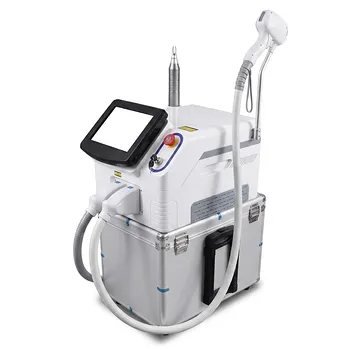
355 nm solid-state lasers can provide effective, highly targeted treatment for selected chronic skin lesions, but their main operational limitation is treatment speed. These systems commonly use neodymium-doped yttrium orthovanadate (Nd:YVO₄) as the laser medium and generate a monochromatic 355 nm output in the UVA range. Although clinical improvement and few reported side effects are important advantages, exposure times of up to 25 minutes for one lesion—and total sessions exceeding an hour—can materially reduce patient throughput.
The clinical value of a 355 nm laser is its precise, wavelength-dependent interaction with selected skin targets; the purchasing and workflow question is whether that precision justifies longer treatment times and lower throughput.
What Defines a 355 nm Solid-State Dermatology Laser?
The wavelength and laser medium
A 355 nm system emits near-UVA radiation. In the reference configuration, the output is associated with an Nd:YVO₄ solid-state laser medium, which is a core hardware characteristic rather than a minor component.
The medium determines the wavelength produced. Since skin chromophores—including melanin, hemoglobin, and water—absorb different wavelengths differently, the laser medium helps define which lesions may respond to treatment.
Monochromatic, targeted energy
The 355 nm output is monochromatic, meaning it concentrates energy at a specific wavelength rather than delivering a broad spectrum of light.
This spectral specificity supports targeted treatment, but it does not make the device universally suitable for every dermatologic condition. Clinical usefulness depends on whether the lesion and its relevant tissue targets interact favorably with 355 nm energy.
Clinical Characteristics
Potential for improvement in chronic lesions
The primary reference describes 355 nm solid-state lasers as capable of producing significant clinical improvement in selected chronic skin lesions.
This is best understood as a targeted-treatment capability, not a general claim that the technology is appropriate for all chronic lesions. Diagnosis, lesion depth, treatment parameters, and patient factors remain decisive.
Reported tolerability
The available description indicates minimal reported side effects in the relevant clinical applications.
That observation should be interpreted cautiously. Reported tolerability may depend on the treatment protocol, patient selection, lesion characteristics, and follow-up period; it should not be treated as a guarantee of risk-free treatment.
Clinical precision versus treatment area
The system’s principal clinical strength is controlled delivery at a defined wavelength. This may be valuable when a practitioner wants to address a specific lesion rather than expose a large surrounding area to nonspecific energy.
However, the same targeted approach can become time-intensive when lesions are large, numerous, or distributed across multiple body sites.
Why Wavelength Selection Matters
Different targets absorb different wavelengths
Skin contains several important optical targets, including melanin, hemoglobin, and water. Each has its own absorption behavior across the electromagnetic spectrum.
Consequently, changing the laser wavelength changes the balance of energy absorbed by the target and surrounding tissue. This is why wavelength selection must follow the clinical objective rather than device availability alone.
The laser medium is a hardware-level indicator
The laser medium provides a practical way to understand what a system is designed to produce. It can help distinguish equipment intended for pigment-related, vascular, or ablative applications.
That classification is useful during procurement, but it is not a substitute for reviewing the device’s validated indications, treatment protocols, safety controls, and clinical evidence.
Operational Considerations for Clinics
Treatment time per lesion
A major limitation is exposure duration. Treatment of a single lesion may require up to approximately 25 minutes, according to the primary reference.
This duration can be acceptable for carefully selected lesions where precision and clinical response are more important than speed. It becomes more challenging when the clinic treats multiple lesions per patient.
Total session length
Overall treatment sessions may extend beyond one hour. This affects not only the patient’s time in the clinic but also room utilization, clinician availability, and scheduling flexibility.
A system that performs well clinically may still be operationally inefficient if its treatment duration conflicts with the practice’s appointment model.
Patient throughput
Long exposures reduce the number of patients a clinic can treat in a given day compared with faster monochromatic or excimer laser systems.
The relevant comparison is therefore not simply whether the 355 nm system works. It is whether its clinical benefit, target population, and revenue model justify the opportunity cost of longer appointments.
Workflow planning
Clinics should account for more than the laser-on time. Scheduling must include patient preparation, positioning, lesion targeting, parameter verification, post-treatment assessment, documentation, and room turnover.
For small numbers of highly selected lesions, these demands may be manageable. For high-volume treatment, they can become a significant constraint.
Understanding the Trade-offs
Efficacy versus efficiency
The central trade-off is targeted clinical efficacy versus operational speed. A 355 nm system may offer meaningful improvement with minimal reported side effects in appropriate cases, but it may require substantially more treatment time than faster alternatives.
Neither characteristic should be evaluated in isolation. A faster system is not automatically better if it is less appropriate for the intended lesion, while a clinically effective system may be commercially unsuitable if appointments are too long.
Precision versus scalability
A focused wavelength can support precise treatment, but precision does not necessarily scale efficiently across many lesions.
Practices should distinguish between a device optimized for individual, difficult, or chronic lesions and one intended for rapid treatment of large patient volumes.
Reported outcomes versus general applicability
Positive clinical reports do not establish that every patient or lesion will respond similarly. The primary reference supports efficacy for targeted chronic lesions, not universal dermatologic performance.
Before adoption, clinicians should verify the evidence for the specific conditions they intend to treat and ensure that the planned protocol matches the device’s validated use.
What Buyers and Practitioners Should Evaluate
Clinical fit
Define the target lesions before assessing the equipment. The key question is whether 355 nm energy is clinically relevant to the intended indications and whether the expected benefit is meaningful compared with available alternatives.
Evidence and safety documentation
Review published outcomes, treatment parameters, contraindications, adverse-event reporting, and follow-up data for the intended use.
“Minimal reported side effects” is encouraging, but it should be confirmed against the device’s instructions for use and the clinic’s own risk-management requirements.
Throughput and scheduling
Model realistic treatment capacity using the potential 25-minute per-lesion exposure and sessions that may exceed an hour.
The evaluation should include expected appointment duration, daily patient volume, staffing, room occupancy, and the financial effect of longer visits.
Comparison with alternatives
Compare the system with faster monochromatic or excimer laser platforms on the same criteria:
- Clinical indication and evidence
- Treatment time
- Number and size of lesions treated per session
- Reported tolerability
- Operator workflow
- Patient throughput
- Total cost of ownership
The correct comparison is application-specific. A device should not be selected solely because it has a shorter wavelength, higher speed, or a particular laser medium.
Making the Right Choice for Your Goal
A 355 nm solid-state laser is best assessed as a specialized clinical and operational platform, not merely as a wavelength.
- If your primary focus is targeted treatment of selected chronic lesions: Prioritize lesion-specific clinical evidence, treatment precision, and reported tolerability over maximum throughput.
- If your primary focus is high patient volume: Examine exposure and total session times carefully, because treatments of up to 25 minutes per lesion may constrain daily capacity.
- If your primary focus is equipment selection: Use the Nd:YVO₄ medium and 355 nm output as starting indicators, then verify the system’s validated indications and safety documentation.
- If your primary focus is clinic profitability: Model room time, staffing, scheduling, and opportunity cost against faster monochromatic or excimer alternatives.
The right 355 nm system is one whose clinical advantages are strong enough—and operationally manageable enough—to justify its longer treatment workflow.
Summary Table:
| Aspect | Clinical Characteristics | Operational Considerations |
|---|---|---|
| Wavelength & Medium | Monochromatic 355 nm UVA from Nd:YVO4 | Determines spectral specificity and target interaction |
| Efficacy | Significant improvement in selected chronic lesions | May require long exposure of up to 25 min/lesion |
| Side Effects | Minimal reported side effects | Tolerability depends on protocol and patient selection |
| Targeted vs. Broad | Precise, wavelength-dependent interaction | Longer sessions (>1 hour) lower patient throughput |
| Best Fit | Suitable for targeted treatment of chronic lesions | Must model appointment durations and room utilization |
| Comparison | Clinical efficacy must outweigh speed limitations | Compare with faster alternatives on total cost and workflow |
Ready to elevate your clinic's offerings with advanced aesthetic technology? BELIS provides professional-grade laser and energy-based systems, including 355 nm solid-state lasers, tailored for clinics and premium salons. Our portfolio also features diode and Alexandrite lasers, CO2 fractional, Nd:YAG, Pico, IPL, and more. With certified quality and OEM/ODM support, we help you expand treatment capabilities and boost profitability. Contact us today to find the perfect solution for your practice—schedule a consultation now! #ContactForm
Related Products
- Tri Laser Diode Hair Removal Machine Professional Beauty Equipment
- Clinic Use IPL SHR ND YAG Laser Hair Removal RF Skin Tightening Machine
- 808nm Diode Laser Hair Removal Machine 755+808+1064nm Mixed Wavelength Professional Equipment
- 808nm Diode Laser Hair Removal Machine and Equipment with Picolaser Arm
- Multifunctional Laser Hair Growth Machine Device for Hair Growth
People Also Ask
- How do 800/810 nm diode hair removal lasers compare to 1064 nm long-pulsed Nd:YAG lasers? Discover the Best for Your Patients
- How do broad-spectrum noncoherent light sources compare to single-wavelength diode lasers in aesthetic hair removal applications? Find the best fit for your clinic.
- How can aesthetic practitioners prevent side effects like paradoxical hair regrowth and thermal burns when performing diode laser hair removal on dark skin? Master safe protocols for Fitzpatrick IV–VI skin.
- How do demographic trends in non-surgical procedures like laser hair removal compare to surgical aesthetics, and how should clinics leverage professional diode laser hair removal equipment to meet this demand?
- Why is monitoring the revenue rate per hour per physician essential when deciding to invest in high-throughput aesthetic technology like diode hair removal lasers or multi-applicator body sculpting machines? Optimize your practice's profitability