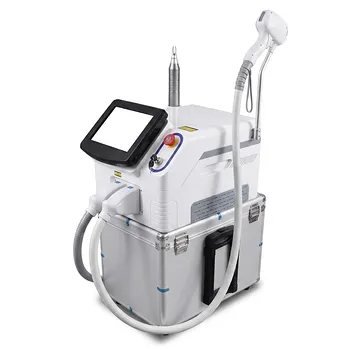
Liquid cooling and saline flushing improve Nd:YAG laser treatment by keeping the fiber tip and tissue surface clear and cool. In bare-fiber applications, stagnant blood absorbs 1064 nm energy near the tip, causing coagulation and carbon buildup that can destroy the fiber’s transmission characteristics. Continuous flushing with neutral 0.9% saline removes blood, while surface cooling protects tissue from charring and allows more energy to reach deeper target layers.
The central principle is controlled heat management: saline flushing preserves a clean optical path, and liquid cooling limits superficial temperature rise. Together, they maintain more predictable Nd:YAG energy delivery while reducing tip carbonization and unintended vaporization.
Why the Fiber Tip Carbonizes
Blood concentrates heat at the tip
When blood remains around a bare fiber tip, it rapidly absorbs 1064 nm Nd:YAG radiation. The resulting localized heating causes coagulation and carbonization directly at the emission site.
Carbonization changes the treatment mechanism
A clean fiber distributes energy into tissue for controlled thermal coagulation. Once carbon forms on the tip, the carbonized material absorbs energy locally, shifting the interaction toward rapid surface heating and vaporization.
The damaged tip reduces predictability
Carbon buildup can obstruct or distort optical output and may destroy the fiber’s emitting end. Strong tissue crepitation or visible charring should be treated as a warning that the fiber no longer has its intended transmission characteristics.
How Saline Flushing Improves Energy Delivery
It clears blood from the emission zone
Continuous flushing with neutral 0.9% NaCl saline displaces stagnant blood surrounding the fiber tip. This reduces absorption immediately at the output surface and helps the fiber deliver energy into the intended tissue volume.
It maintains a cleaner optical interface
The flush helps prevent coagulated blood and debris from accumulating on the tip. By preserving a clear output surface, it supports more uniform energy transmission and delays the formation of the carbon layer that causes uncontrolled heating.
It cools the irradiated surface
Saline applied to the tissue surface removes heat from the superficial layer. Because saline does not significantly absorb 1064 nm Nd:YAG radiation, the beam can continue into deeper tissue while the surface is protected from excessive burning and carbonization.
How Active Liquid Cooling Extends Treatment
It lowers contact-surface temperature
In an actively cooled applicator, precooled liquid circulates around the emitting portion, often in a counter-current flow. This removes heat from the applicator-tissue interface and reduces the risk of superficial thermal injury.
It permits more sustained power delivery
By controlling surface temperature, liquid cooling can support higher power levels or longer treatment durations than an uncooled interface may tolerate. The treatment’s maximum temperature can shift deeper into the target tissue, increasing the volume of thermal coagulation while protecting the surface.
It separates surface protection from tissue heating
The objective is not to eliminate heat, since tissue heating is required for coagulation. The objective is to prevent excessive heat at the fiber tip and tissue surface so that useful optical energy is deposited deeper and more evenly.
Cooling the Nd:YAG Laser Source
The laser rod and optical cavity also require cooling
High-average-power Nd:YAG systems generate substantial internal heat from lamp excitation, quantum defects, spontaneous emission, and light absorption. Purified water circulated around the laser rod and pumping lamps removes this heat from the crystal and optical cavity.
Thermal control preserves beam quality
Without adequate internal cooling, thermal lensing can distort the beam profile and affect pulse or output-energy consistency. Stable cooling protects optical components from thermal stress and helps the delivery system provide repeatable energy.
Source cooling and tip flushing serve different purposes
Water cooling inside the laser protects the laser source and maintains output stability. Saline flushing or applicator cooling at the treatment site protects the fiber tip and tissue interface; both are important, but they address different thermal problems.
Understanding the Trade-offs
Cooling does not compensate for excessive power
A cooled system reduces surface temperature, but it does not make any power level or exposure duration inherently safe. Treatment parameters still need to match the applicator, tissue, and intended coagulation depth.
Excessive flushing can affect procedural control
A saline stream must be sufficient to clear blood and cool the interface without obscuring the field, displacing the applicator, or interfering with the intended tissue contact. Flow should therefore be controlled and consistent.
Carbonization still requires inspection
Flushing and cooling reduce the likelihood of tip damage but do not eliminate it. The fiber should be monitored during treatment, particularly when crepitation, visible charring, or an unexpected change in tissue response occurs.
A carbonized fiber must be re-prepared
If carbonization is present, continuing to use the tip can produce uncontrolled surface vaporization instead of predictable coagulation. The affected end should be removed and the fiber re-prepared according to the applicable device and clinical protocol; the referenced preparation method involves cutting back approximately 2 cm and stripping about 5 mm of coating and cladding from the new tip.
How to Apply This to Your Procedure
Liquid management should be treated as part of the energy-delivery system, not as an optional accessory.
- If your primary focus is protecting the fiber tip: Use continuous, controlled 0.9% saline flushing to clear blood and debris from the emission zone, and inspect the tip throughout treatment.
- If your primary focus is deeper coagulation: Cool the superficial tissue layer so that the surface remains below the carbonization threshold while 1064 nm energy penetrates into underlying tissue.
- If your primary focus is prolonged or high-power operation: Use an applicator with active liquid cooling and ensure the Nd:YAG source itself has adequate purified-water cooling.
- If your primary focus is predictable tissue response: Use conservative power and exposure settings, monitor for charring or crepitation, and re-prepare any carbonized fiber before continuing.
Effective liquid cooling and flushing preserve a clean optical interface, control surface temperature, and keep Nd:YAG energy focused on predictable deep-tissue coagulation rather than unintended tip vaporization.
Summary Table:
| Mechanism | Function | Benefit |
|---|---|---|
| Saline flushing | Clears blood and debris from fiber tip | Prevents carbonization, maintains clean optical path |
| Surface cooling | Lowers tissue surface temperature | Allows deeper energy penetration, reduces charring |
| Active applicator cooling | Cools applicator-tissue interface | Supports higher power, longer treatment durations |
| Internal source cooling | Cools laser rod and optical cavity | Maintains beam quality and output consistency |
Elevate your clinic's laser capabilities with BELIS's advanced Nd:YAG systems. Our professional-grade equipment, designed exclusively for clinics and premium salons, ensures precise energy delivery with integrated cooling technologies. Contact our experts today to learn how BELIS can enhance your aesthetic treatments and patient satisfaction. Contact us now for a personalized consultation.
Related Products
- Q Switch Nd Yag Laser Machine Tattoo Removal Nd Yag Machine
- Clinic Use IPL and SHR Hair Removal Machine with Nd Yag Laser Tattoo Removal
- Clinic Use IPL SHR ND YAG Laser Hair Removal RF Skin Tightening Machine
- Ultrasonic Cavitation Machine Lipo Laser Device
- 808nm Diode Laser Hair Removal Machine 755+808+1064nm Mixed Wavelength Professional Equipment
People Also Ask
- How does laser fluence influence pigment clearance vs. safety? Balancing Speed and Skin Integrity in Tattoo Removal
- What is the documented effectiveness of Q-switched Nd:YAG lasers for tattoo removal? Gold Standard Results
- How are Q-switched lasers used for tattoo removal? Advanced Photoacoustic Technology for Clear Skin
- What are the additional functions of the Q-Switch ND:YAG laser system? Unlock Advanced Skin Rejuvenation and Firming
- Is Q Switched Nd:YAG laser good? The Gold Standard for Tattoo & Pigment Removal