
To get better results from laser hair removal, you must prepare your skin and hair before the procedure, commit to the full treatment schedule, and follow all aftercare instructions. The most critical actions include shaving the area 24 hours beforehand, rigorously avoiding sun exposure, and disclosing any medications you are taking to your technician. These steps are not merely suggestions; they are essential for maximizing the laser's effectiveness and ensuring your safety.
The success of your laser hair removal is determined as much by your preparation and aftercare as it is by the treatment itself. The goal is to create the ideal conditions for the laser to work: a clear target (the hair follicle) with maximum contrast against the skin, and a calm, healthy healing environment afterward.
Optimizing the Target: Why Preparation is Non-Negotiable
The laser needs a perfect target to work efficiently. Your preparation phase is entirely about creating that target and removing potential obstacles that can decrease effectiveness or increase risk.
Shave, Don't Pluck or Wax
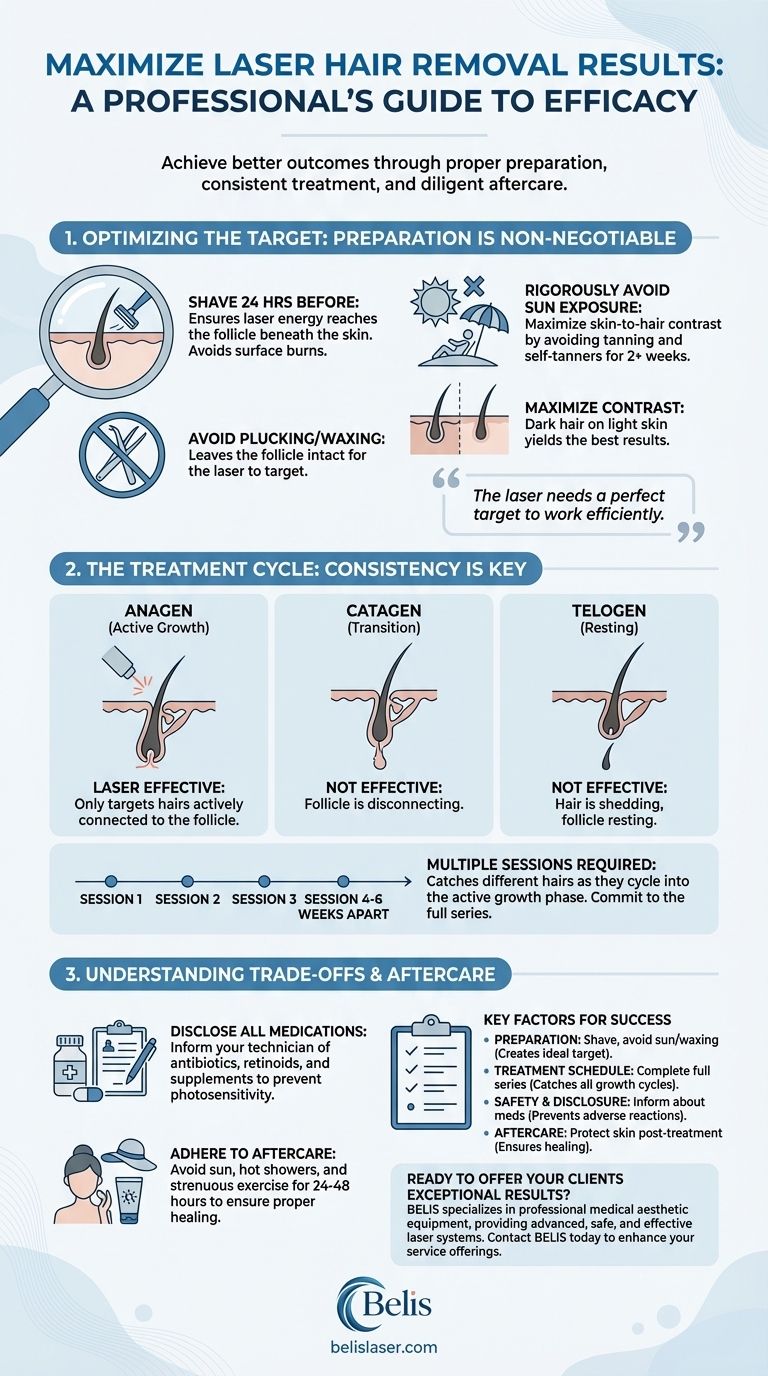
Shaving the treatment area 12-24 hours before your appointment is mandatory. This ensures the laser's energy travels directly to the hair follicle beneath the skin.
Hair left above the skin will absorb the laser's energy, scorching the surface and preventing the heat from reaching the follicle where it needs to work. This not only wastes the treatment's energy but can also increase the risk of skin burns.
Crucially, avoid plucking, waxing, or tweezing for at least four weeks prior to treatment. These methods remove the entire hair follicle, leaving nothing for the laser to target.
Maximize Contrast by Avoiding the Sun
The principle of laser hair removal relies on the contrast between the dark pigment (melanin) in the hair follicle and the lighter pigment of the surrounding skin.
Sun exposure and tanning—including self-tanners—darken the skin. This reduces the critical contrast, forcing the technician to use a lower, less effective laser setting to avoid burning your skin.
For the best results, you must avoid all sun exposure on the treatment area for at least two weeks before your appointment.
The Treatment Cycle: Why Consistency is Key
Laser hair removal is a process, not a one-time event. Understanding the biology of hair growth is essential to appreciating why a full course of treatments is necessary.
Targeting the Active Growth Phase
Your hair grows in three phases: anagen (active growth), catagen (transition), and telogen (resting). The laser is only effective on hairs that are in the anagen phase, when the follicle is actively connected to the hair.
Because only a fraction of your hair is in the anagen phase at any given time, multiple sessions, typically spaced 4-6 weeks apart, are required. This schedule is designed to catch different hairs as they cycle into their active growth phase.
Completing the Full Series
Skipping appointments or extending the time between them allows hair follicles to go through their growth cycles untreated. This ultimately leads to a longer, less effective, and more expensive treatment course. Commit to the full series of sessions recommended by your provider for a permanent reduction.
Understanding the Trade-offs and Risks
While highly effective, success requires awareness of potential complications. Your choices directly influence the safety and outcome of the procedure.
Disclose All Medications
Certain medications can make your skin photosensitive, meaning it becomes much more reactive to light and heat. This dramatically increases the risk of burns, blisters, or hyperpigmentation from the laser.
You must inform your technician of all medications you are taking, including antibiotics, retinoids (like Accutane), and even certain herbal supplements. An expert will know which substances are contraindicated and can adjust your treatment plan accordingly.
Manage Expectations
Laser hair removal provides significant hair reduction, not 100% hair elimination forever. Hormonal changes later in life can sometimes stimulate new hair growth.
The results are also highly dependent on hair color and skin type. The ideal candidate has dark, coarse hair and light skin. Treatments on fine, light-colored hair are typically less effective.
Adhere to Aftercare
After treatment, the skin is sensitive and the follicles are open. Following aftercare instructions is crucial for preventing irritation and side effects.
This typically includes avoiding sun exposure, hot showers, saunas, and strenuous exercise for at least 24-48 hours. Using a soothing lotion and sun protection is also vital for proper healing.
A Checklist for Maximizing Your Investment
To ensure you achieve the best possible outcome, align your actions with your primary goal.
- If your primary focus is safety and avoiding side effects: Be completely transparent with your provider about all medications, supplements, and recent sun exposure.
- If your primary focus is getting the most effective results: Rigorously avoid sun exposure for at least two weeks before each session to maximize skin-to-hair contrast.
- If your primary focus is efficiency and value: Commit to the full, uninterrupted schedule of sessions recommended by your technician to target every hair growth cycle.
Ultimately, taking an active, informed role in your treatment plan is the single best way to ensure your investment yields smooth, long-lasting results.
Summary Table:
| Key Factor | Action Required | Why It Matters |
|---|---|---|
| Preparation | Shave 24h before; avoid sun/waxing | Creates ideal target for laser, prevents burns |
| Treatment Schedule | Complete full series, 4-6 weeks apart | Catches all hair growth cycles for permanent reduction |
| Safety & Disclosure | Inform technician of all medications | Prevents photosensitivity reactions and burns |
| Aftercare | Avoid sun, heat, exercise for 48h | Ensures proper healing and minimizes side effects |
Ready to offer your clients exceptional laser hair removal results?
BELIS specializes in professional medical aesthetic equipment, providing advanced, safe, and effective laser systems designed for medical aesthetics clinics and premium beauty salons. Our technology ensures superior performance and client satisfaction.
Contact BELIS today to discover how our professional equipment can enhance your service offerings and drive your business growth.
Visual Guide
Related Products
- Diode Tri Laser Hair Removal Machine for Clinic Use
- Diode Laser SHR Trilaser Hair Removal Machine for Clinic Use
- Clinic Diode Laser Hair Removal Machine with SHR and Trilaser Technology
- Clinic Use IPL SHR ND YAG Laser Hair Removal RF Skin Tightening Machine
- Trilaser Diode Hair Removal Machine for Beauty Clinic Use
People Also Ask
- What are the advantages of the Constant Motion Technique? Elevate Your Clinic's Laser Hair Removal Results
- How can aesthetic practitioners prevent side effects like paradoxical hair regrowth and thermal burns when performing diode laser hair removal on dark skin? Master safe protocols for Fitzpatrick IV–VI skin.
- How do broad-spectrum noncoherent light sources compare to single-wavelength diode lasers in aesthetic hair removal applications? Find the best fit for your clinic.
- Why can traditional high-energy pulse (HR) modes lead to adverse skin reactions? Understanding Thermal Injury Risks
- Why is a 40-ms pulse width critical for Fitzpatrick skin types III-V? The Key to Safe & Effective Laser Hair Removal
















