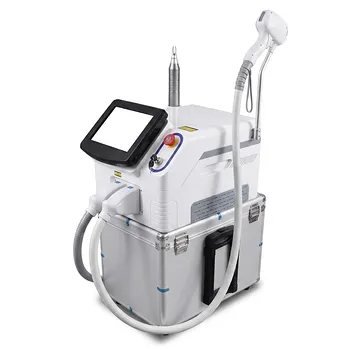
Choose the wavelength by balancing hair melanin against epidermal melanin. In general, 755 nm Alexandrite is best suited to lighter skin with dark, pigmented hair; 800–900 nm Diode systems provide a versatile middle option; and 1064 nm Nd:YAG is usually the safest choice for darker skin types, particularly when the hair is coarse and dark. The lighter or finer the hair, the more important it is to recognize that low pigment limits treatment response regardless of wavelength.
The practical rule is simple: use the shortest effective wavelength when there is strong skin–hair contrast, and move toward longer wavelengths as epidermal melanin increases. Hair color, thickness, depth, tanning status, cooling, pulse duration, and test-spot response must be considered alongside Fitzpatrick type.
How Wavelength Changes Treatment Risk and Response
Melanin absorption drives both efficacy and risk
Laser hair removal relies primarily on melanin absorption within the hair shaft and follicle. Higher absorption can improve follicular heating, but it also increases the possibility that the surrounding epidermis will absorb excessive energy.
This creates the central clinical trade-off: shorter wavelengths generally target melanin more efficiently, while longer wavelengths reduce superficial epidermal absorption and penetrate more deeply.
Skin–hair contrast is more useful than skin type alone
Fitzpatrick classification provides a useful starting point, but it does not fully describe treatment risk. Two patients with the same phototype may differ substantially in tanning, baseline pigmentation, hair density, follicle depth, and response to heat.
A patient’s current skin color, including recent sun or tanning exposure, should be assessed rather than relying only on their usual phototype.
Hair pigment and diameter determine likely response
Dark brown and black hair contain more melanin and generally respond better than blond, red, gray, or white hair. Coarse terminal hair is usually easier to target than fine or vellus hair because it contains a larger chromophore and absorbs more total energy.
Very fine or lightly pigmented hair may respond poorly even when the skin is an appropriate phototype. Increasing fluence indiscriminately can raise the risk of epidermal injury without producing proportional follicular benefit.
Selecting Among Alexandrite, Diode, and Nd:YAG
755 nm Alexandrite: strongest option for high-contrast, lighter skin
Alexandrite lasers at 755 nm have relatively high melanin absorption. They are commonly favored for Fitzpatrick types I–III, particularly when the hair is medium to coarse and brown or black.
They can also be considered in selected type IV patients when the skin is non-tanned, the hair–skin contrast is favorable, and conservative testing confirms epidermal safety. They are generally less suitable when epidermal melanin is high or the patient has recently tanned.
Best profile for Alexandrite
- Typical skin types: I–III
- Most favorable hair: dark brown to black, medium or coarse
- Potential limitation: blond, red, gray, and very fine hair may respond weakly because of insufficient melanin
- Main concern: increased epidermal absorption in darker or recently tanned skin
800–900 nm Diode: a flexible middle-range choice
Diode systems commonly operate around 800–810 nm, with some platforms extending into other near-infrared wavelengths. They provide a compromise between melanin absorption and dermal penetration.
They are often useful for Fitzpatrick types II–V, provided treatment parameters and cooling are appropriate. Their suitability depends heavily on the specific device, pulse duration, spot size, cooling system, and patient’s current pigmentation.
Best profile for Diode
- Typical skin types: II–V, with careful parameter selection
- Most favorable hair: brown to black, especially medium or coarse hair
- Potential limitation: safety margins narrow as epidermal pigmentation and recent tanning increase
- Main advantage: broad clinical versatility across lighter and intermediate skin types
A diode laser should not automatically be treated as equivalent to an Nd:YAG simply because it is marketed for darker skin. Wavelength, pulse characteristics, cooling, and operator technique all affect safety.
1064 nm Nd:YAG: preferred when epidermal melanin is a major concern
The 1064 nm Nd:YAG wavelength has lower absorption by epidermal melanin and penetrates more deeply than shorter wavelengths. This generally makes it the preferred option for Fitzpatrick types IV–VI, especially when the hair is coarse and dark.
Its lower melanin absorption also means that it may require different treatment parameters and may appear less immediately responsive than Alexandrite in lighter skin. It remains dependent on adequate hair pigment.
Best profile for Nd:YAG
- Typical skin types: IV–VI
- Most favorable hair: coarse, dark brown to black
- Potential limitation: less efficient for fine or lightly pigmented hair
- Main advantage: greater epidermal safety margin in darker skin when used correctly
Nd:YAG is not risk-free. Excessive fluence, insufficient cooling, poor technique, or treatment of recently tanned skin can still produce burns or pigmentary complications.
Match the Device to the Patient Profile
Fitzpatrick I–II with dark, coarse hair
Alexandrite is often the most efficient first choice because the skin contains relatively little competing melanin and the hair provides a strong target.
Diode may also be effective, particularly when deeper penetration or device availability is important. Nd:YAG is usually unnecessary unless there are specific clinical or equipment considerations.
Fitzpatrick I–III with medium brown or black hair
Alexandrite and Diode are both reasonable options. The choice should reflect hair thickness, follicle depth, treatment area, cooling capacity, and the patient’s tolerance.
Very fine hair may require realistic counseling because wavelength selection cannot compensate for a weak melanin target.
Fitzpatrick III–IV with dark hair
Diode can be a useful intermediate option, while Alexandrite may remain appropriate only when there is strong contrast and no recent tanning. As epidermal pigmentation increases, Nd:YAG becomes increasingly attractive from a safety perspective.
A test spot is particularly valuable when the patient is near the boundary between device categories.
Fitzpatrick IV–VI with coarse, dark hair
Long-pulsed Nd:YAG is generally the preferred starting wavelength because it minimizes relative epidermal melanin absorption.
Longer-wavelength Diode systems may also be used in suitable patients, but the treatment should include robust epidermal cooling and conservative parameter selection. Alexandrite is generally less appropriate because of its higher superficial melanin absorption.
Any skin type with blond, red, gray, or white hair
These hair colors contain insufficient or altered melanin for reliable laser targeting. Gray and white hair generally respond poorly to conventional laser hair removal, regardless of whether Alexandrite, Diode, or Nd:YAG is selected.
Fine blond or red hair may also show limited response. Patients should be informed that increasing energy to compensate for absent pigment may increase injury risk rather than improve results.
Parameters Must Support the Wavelength
Pulse duration should reflect hair thickness
Pulse duration is not interchangeable with wavelength. Coarse hair and deeper follicles may require different thermal delivery than fine hair, and the selected pulse should be appropriate for the follicle’s thermal relaxation behavior.
The device manufacturer’s validated parameters and the practitioner’s clinical assessment should guide adjustments rather than wavelength alone.
Cooling protects the epidermis
Contact, cryogen, or air cooling can reduce epidermal temperature and expand the safety margin, particularly when treating pigmented skin.
Cooling does not eliminate risk. It must be combined with appropriate fluence, pulse duration, spot size, overlap control, and treatment technique.
Test spots are essential near safety boundaries
A test spot is especially important for darker phototypes, recently changed pigmentation, uncertain tanning status, or patients with an unclear response history.
The practitioner should assess immediate endpoints and delayed skin response before treating a large area. Absence of an immediate reaction does not guarantee absence of delayed pigmentary injury.
Understanding the Trade-offs
Alexandrite offers efficiency but a narrower pigment safety margin
The 755 nm wavelength can produce strong follicular absorption in light skin with dark hair. Its disadvantage is that epidermal melanin competes more strongly for the energy as skin pigmentation increases.
Using Alexandrite on darker or tanned skin without suitable precautions can increase the risk of burns, blistering, and post-inflammatory hyperpigmentation or hypopigmentation.
Nd:YAG improves safety in dark skin but may be less efficient
Nd:YAG generally offers better protection against superficial melanin absorption, but its lower melanin absorption can reduce efficiency compared with Alexandrite in lighter skin.
It may also be less effective for fine or lightly pigmented hair. A safer wavelength is not automatically a more effective wavelength for every hair profile.
Diode is versatile but not universally optimal
Diode systems occupy a useful middle ground, but their performance varies considerably among platforms. A nominal wavelength does not describe the full clinical behavior of a device.
Practitioners should evaluate the actual emission profile, pulse structure, cooling method, spot size, and validated indications rather than selecting solely by the label “Diode.”
Fitzpatrick type should not replace individual assessment
Fitzpatrick type is a classification tool, not a complete risk model. Recent tanning, medications, photosensitivity, history of dyschromia, and prior laser reactions can materially change the treatment plan.
The safest selection is therefore a wavelength-and-parameter decision, not a wavelength-only decision.
Making the Right Choice for Your Goal
Use the following as a starting framework, then confirm the decision with current skin assessment, device-specific parameters, cooling, and test-spot evaluation.
- If your primary focus is maximum efficiency in Fitzpatrick I–III skin with coarse dark hair: Consider a 755 nm Alexandrite system when the skin is non-tanned and the hair provides strong pigment contrast.
- If your primary focus is versatility across light-to-medium skin types with brown or black hair: Consider an 800–900 nm Diode system, with parameters selected for the patient’s skin pigmentation and hair diameter.
- If your primary focus is treating Fitzpatrick IV–VI skin safely: Prefer a 1064 nm Nd:YAG system, particularly for coarse dark hair, and use appropriate cooling and conservative test-spot protocols.
- If your primary focus is treating fine, blond, red, gray, or white hair: Set realistic expectations because limited melanin may make conventional laser hair removal ineffective regardless of wavelength.
- If your primary focus is minimizing complications in an uncertain or recently tanned patient: Delay treatment when appropriate, reassess the current skin tone, and use test spots before treating a larger area.
The best wavelength is the one that provides sufficient follicular heating while preserving the epidermis—and that decision must account for both skin and hair, not either characteristic alone.
Summary Table:
| Wavelength | Typical Skin Types | Favorable Hair | Main Advantage | Main Limitation |
|---|---|---|---|---|
| 755 nm Alexandrite | I–III | Dark brown/black, medium/coarse | High melanin absorption, efficient in light skin | Higher risk in darker/tanned skin |
| 800–900 nm Diode | II–V | Brown/black, coarse | Versatile middle ground | Safety margin narrows with more pigment |
| 1064 nm Nd:YAG | IV–VI | Coarse, dark | Deeper penetration, safer for dark skin | Less effective for fine/light hair |
At BELIS, we provide professional-grade aesthetic laser systems tailored for clinics and premium salons. Whether you need an Alexandrite, Diode, or Nd:YAG for optimal hair removal, our cutting-edge technology ensures safety and efficacy. Contact our experts today to find the perfect solution for your practice. Contact us.
Related Products
- 808nm Diode Laser Hair Removal Machine 755+808+1064nm Mixed Wavelength Professional Equipment
- Tri Laser Diode Hair Removal Machine Professional Beauty Equipment
- 808nm Diode Laser Hair Removal Machine and Equipment with Picolaser Arm
- Diode Laser SHR Trilaser Hair Removal Machine for Clinic Use
- Professional IPL SHR Hair Removal Machine for Laser and IPL Hair Removal
People Also Ask
- How do 800/810 nm diode hair removal lasers compare to 1064 nm long-pulsed Nd:YAG lasers? Discover the Best for Your Patients
- How can aesthetic practitioners prevent side effects like paradoxical hair regrowth and thermal burns when performing diode laser hair removal on dark skin? Master safe protocols for Fitzpatrick IV–VI skin.
- How do broad-spectrum noncoherent light sources compare to single-wavelength diode lasers in aesthetic hair removal applications? Find the best fit for your clinic.
- Why is monitoring the revenue rate per hour per physician essential when deciding to invest in high-throughput aesthetic technology like diode hair removal lasers or multi-applicator body sculpting machines? Optimize your practice's profitability
- How do different energy fluences in professional diode hair removal lasers affect hair follicle tissue at the cellular level? Unlock Optimal Safety and Efficacy