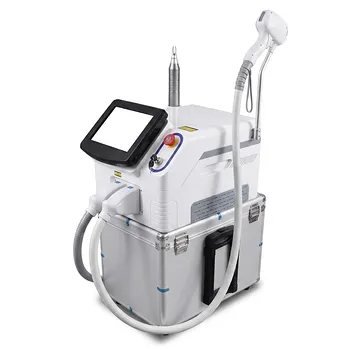
Match the wavelength to the ink—not simply to the tattoo’s appearance. In general, 1064 nm Nd:YAG is preferred for black and dark blue pigments, particularly in darker skin phototypes; 755 nm Alexandrite is highly useful for green, blue, and teal pigments; and 532 nm KTP or frequency-doubled Nd:YAG is used mainly for red, orange, and some yellow or pink pigments. Skin phototype, pigment depth, mixed colors, and the risk of pigmentary change must be assessed before treatment.
The safest selection combines pigment absorption with skin protection. Longer wavelengths such as 1064 nm are usually more forgiving in heavily pigmented skin, while shorter wavelengths such as 532 nm require greater caution because epidermal melanin absorbs them more readily.
How Wavelength Determines Tattoo Response
1064 nm Nd:YAG: black and dark pigments
The 1064 nm Nd:YAG wavelength is the standard choice for black, dark blue, and many dark brown pigments. These inks absorb broadly, and the wavelength penetrates deeply enough to reach pigment in the dermis.
Its relatively low absorption by epidermal melanin makes 1064 nm the preferred starting option for many patients with Fitzpatrick IV–VI skin, where shorter visible wavelengths carry a higher risk of epidermal injury and post-inflammatory pigment alteration.
755 nm Alexandrite: green, blue, and teal pigments
The 755 nm Alexandrite wavelength is particularly effective for green, blue, and teal tattoo pigments. It is often selected when a dark or colored pigment does not respond adequately to 1064 nm treatment.
Although 755 nm can be useful across a range of skin types, it is absorbed more by melanin than 1064 nm. Practitioners should therefore apply greater caution as skin pigmentation increases.
532 nm KTP: red, orange, and warm colors
The 532 nm KTP wavelength, commonly produced by frequency-doubling an Nd:YAG laser, targets red, orange, reddish-purple, and some yellow pigments. These colors generally absorb shorter visible wavelengths more effectively than near-infrared light.
Because 532 nm is also strongly absorbed by epidermal melanin, it presents a greater risk of unwanted epidermal injury, hypopigmentation, or post-inflammatory hyperpigmentation in darker phototypes.
694 nm Ruby: an alternative for green and dark pigments
The 694 nm Ruby wavelength can be effective for green, dark blue, and black pigments. It is another option for pigment absorption in the red portion of the spectrum.
However, Ruby light has greater melanin absorption than 1064 nm. It should therefore be used selectively, with particular attention to the patient’s phototype and history of pigmentary reactions.
How Skin Phototype Changes the Decision
Fitzpatrick I–III
Patients with lighter skin generally have a wider safety margin for visible wavelengths such as 532 nm, 694 nm, and 755 nm. This does not eliminate risk, but epidermal melanin competes less strongly with the tattoo pigment for laser energy.
The appropriate wavelength still depends primarily on the ink color. A light skin phototype does not make 532 nm suitable for black ink when 1064 nm is the better absorber.
Fitzpatrick IV–VI
For darker skin phototypes, 1064 nm Nd:YAG is commonly favored for black and dark blue ink because its longer wavelength is less absorbed by epidermal melanin. This helps reduce collateral heating and the risk of pigmentary complications.
Shorter wavelengths can still be clinically useful, particularly for red or green pigments, but they require more conservative treatment planning, careful patient selection, and appropriate test spots.
Skin phototype is not the only risk factor
Recent tanning, a history of post-inflammatory hyperpigmentation, keloid formation, or previous adverse responses can affect treatment safety. The practitioner should evaluate the actual skin condition at the treatment site rather than relying on phototype alone.
A darker tattoo may also absorb energy more efficiently than a pale or degraded tattoo, so the visual intensity and density of the ink matter as well.
A Practical Pigment-to-Wavelength Framework
Black and dark blue
Start by considering 1064 nm Nd:YAG, especially for deeply placed pigment or darker skin. Black ink can absorb multiple wavelengths, but 1064 nm often provides the most favorable balance of penetration and epidermal safety.
For lighter skin, 755 nm Alexandrite or 694 nm Ruby may also be useful depending on the ink composition and response.
Green, blue, and teal
Consider 755 nm Alexandrite as the principal option for green and blue pigments. 694 nm Ruby may also be effective, particularly for green and dark blue ink.
If a color appears resistant, the limitation may reflect the pigment’s chemical composition rather than an incorrect wavelength alone.
Red, orange, and yellow
Use 532 nm KTP or frequency-doubled Nd:YAG for red and orange pigments, as well as selected yellow or warm-toned inks. Yellow is often more difficult to clear and may respond inconsistently.
These colors demand particular caution in darker skin because the wavelength is strongly absorbed by melanin.
White, flesh-toned, and cosmetic pigments
White, flesh-toned, and some cosmetic pigments can be difficult to treat because they may absorb standard tattoo-removal wavelengths poorly. Pigments containing titanium dioxide or iron oxides can sometimes undergo paradoxical darkening after laser exposure.
For these pigments, the practitioner should not assume that simply increasing energy or switching among standard wavelengths will solve the problem. A specialist assessment and test spot are important before broader treatment.
Why Multi-Wavelength Assessment Matters
Tattoos rarely contain one perfectly pure pigment
Professional tattoos may contain blends, shading, overlapping colors, or white ink used to lighten another shade. A visually blue area may therefore contain components that respond differently to 1064 nm and 755 nm.
Treatment should be planned by color region, not only by the tattoo as a whole. Different sections may require different wavelengths and separate treatment strategies.
Pigment depth affects the result
Ink located deeper in the dermis may be better approached with a more penetrating wavelength such as 1064 nm. Shallow, dense, or superficial pigment may respond differently from dilute shading, even when the visible color is identical.
The practitioner should consider depth, density, age of the tattoo, and prior treatment history when interpreting treatment response.
Test spots confirm real-world absorption
Tattoo-ink chemistry varies significantly between manufacturers and formulations. A small test spot can reveal whether the selected wavelength produces an appropriate clinical response and whether the surrounding skin shows excessive reaction.
This is especially important for multicolored tattoos, cosmetic pigments, darker skin phototypes, and colors known to be difficult or unpredictable.
Understanding the Trade-offs
Longer wavelengths improve safety in darker skin but are color-selective
The 1064 nm wavelength is generally safer for epidermal melanin, but it is not the best choice for every color. It is highly useful for black and dark blue ink but may be inefficient for red, orange, and many green pigments.
Choosing 1064 nm solely because the patient has dark skin may protect the epidermis but fail to target the pigment effectively.
Shorter wavelengths improve color targeting but increase melanin competition
The 532 nm, 694 nm, and 755 nm wavelengths can be highly effective for selected colors, yet they are absorbed more readily by epidermal melanin than 1064 nm. This creates a narrower safety margin in darker phototypes.
The correct response is not to avoid these wavelengths categorically, but to use them only when the pigment justifies their selection and to manage risk carefully.
One wavelength may not clear a multicolored tattoo
A single wavelength rarely provides optimal absorption for every color in a complex tattoo. Multi-wavelength Q-switched or picosecond systems can provide broader coverage, but equipment capability does not replace diagnostic judgment.
The practitioner must still identify the pigment, assess the skin, and confirm the response rather than treating every color with every available wavelength.
Laser type and wavelength are separate decisions
Q-switched and picosecond platforms differ in pulse duration and tissue interaction, but the wavelength still has to match the pigment. A picosecond device does not automatically make an unsuitable wavelength appropriate.
Clinical settings, spot size, cooling, treatment intervals, and endpoint assessment also influence safety, so wavelength selection should be part of a complete protocol rather than an isolated equipment decision.
Applying the Selection Process
Step 1: Map the tattoo by pigment color
Separate black, blue, green, red, orange, yellow, white, and flesh-toned regions. Do not assume that a mixed shade will behave like its dominant visible color.
Step 2: Identify the most appropriate wavelength
Use 1064 nm primarily for black and dark blue, 755 nm or 694 nm for green and selected blue pigments, and 532 nm for red, orange, and selected warm colors.
Step 3: Adjust for phototype and pigmentary risk
Give additional weight to 1064 nm when treating dark skin and dark pigments. Use visible wavelengths cautiously in Fitzpatrick IV–VI skin because of their greater interaction with epidermal melanin.
Step 4: Confirm with a test spot
Use a test spot when ink composition is uncertain, the tattoo contains cosmetic or white pigment, the patient has darker skin, or previous treatment has produced an unexpected response.
Making the Right Choice for Your Goal
- If your primary focus is treating black or dark blue ink: Select 1064 nm Nd:YAG as the usual first-line wavelength, particularly for deeply placed pigment or darker skin phototypes.
- If your primary focus is treating green, blue, or teal ink: Consider 755 nm Alexandrite, with 694 nm Ruby as another possible option where appropriate.
- If your primary focus is treating red or orange ink: Consider 532 nm KTP or frequency-doubled Nd:YAG, while applying increased caution in darker skin.
- If your primary focus is treating a multicolored tattoo: Use a multi-wavelength approach and evaluate each color region separately rather than relying on one wavelength.
- If your primary focus is treating white or cosmetic pigment: Perform a cautious test spot first because some formulations may respond poorly or darken paradoxically.
Effective wavelength selection means matching pigment absorption, skin phototype, pigment depth, and clinical risk before delivering treatment.
Summary Table:
| Wavelength | Best for Pigments | Skin Phototype Caution |
|---|---|---|
| 1064 nm Nd:YAG | Black, dark blue | Safe for all, preferred in IV-VI |
| 755 nm Alexandrite | Green, blue, teal | Use caution in III-VI |
| 532 nm KTP | Red, orange, yellow | High caution in IV-VI |
| 694 nm Ruby | Green, dark blue, black | Use caution in III-VI |
Master Tattoo Removal with Precision
Partner with BELIS to access advanced laser systems (Q-Switched Nd:YAG, Picosecond, Alexandrite) designed for clinics and premium salons. Our technology supports multi-wavelength treatment for optimal results across skin types and ink colors. Benefit from OEM/ODM support, CE certifications, and reliable supply.
Contact us today to elevate your aesthetic practice with trusted solutions.
Related Products
- Pico Laser Tattoo Removal Machine Picosure Picosecond Laser Machine
- Clinic Use IPL and SHR Hair Removal Machine with Nd Yag Laser Tattoo Removal
- Q Switch Nd Yag Laser Machine Tattoo Removal Nd Yag Machine
- Tri Laser Diode Hair Removal Machine Professional Beauty Equipment
- 808nm Diode Laser Hair Removal Machine 755+808+1064nm Mixed Wavelength Professional Equipment
People Also Ask
- How does a laser tattoo removal machine work? Shattering Ink with Precision Light
- Why is the precise adjustment of energy density, or fluence, critical during picosecond laser tattoo removal procedures?
- How does the pulse duration of a laser system influence the efficacy of tattoo ink clearance? Master Picosecond Tech
- What role does picosecond laser equipment play in tattoo removal? Faster Results & Advanced Precision
- What are the technical advantages of Picosecond laser equipment? Achieve Superior Tattoo Removal & Faster Skin Healing