
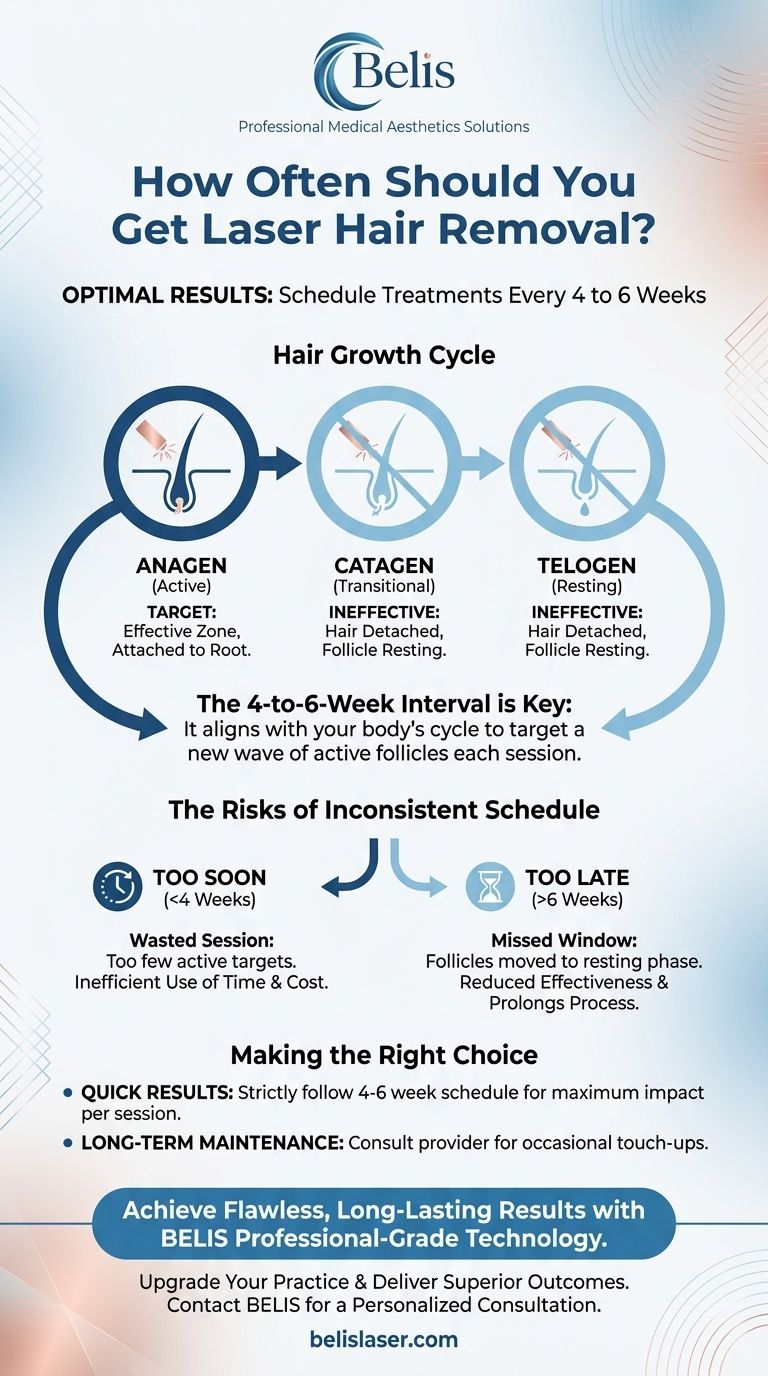
For optimal results, laser hair removal treatments are typically scheduled every 4 to 6 weeks. This specific interval is not arbitrary; it is strategically designed to align with your body's natural hair growth cycle. Sticking to this schedule is the single most important factor for achieving a significant and permanent reduction in hair.
The success of laser hair removal depends entirely on targeting hair follicles during their active growth phase. Spacing treatments 4 to 6 weeks apart ensures that each session effectively targets a new wave of follicles as they enter this critical window, preventing wasted treatments and leading to faster, more permanent results.

Why This Specific Timing is Critical
To understand the 4-to-6-week rule, you must first understand how your hair grows. It's a constant, staggered cycle, and the laser is only effective during one specific phase.
The Target: The Anagen (Active) Phase
The laser works by sending concentrated light down the hair shaft to destroy the follicle at its root. This process is only effective when the hair is actively growing and firmly connected to its root. This is known as the anagen phase.
The Ineffective Phases: Catagen and Telogen
At any given time, a significant portion of your hair is in a transitional (catagen) or resting (telogen) phase. During these stages, the hair has detached from the root and is preparing to shed.
A laser treatment during these phases is ineffective because the energy cannot reach and destroy the follicle's growth center.
Staggered Cycles Demand Staggered Treatments
The crucial point is that not all hairs are in the same phase at the same time. Only a percentage of your hair is in the active anagen phase during any given session.
The 4-to-6-week interval is the scientifically determined sweet spot. It allows enough time for a new group of dormant follicles to enter their active anagen phase, providing fresh targets for the next treatment.
The Risks of an Inconsistent Schedule
Deviating from the recommended schedule is the most common reason for unsatisfactory results. Both waiting too long and treating too soon undermine the entire process.
What Happens if You Wait Too Long?
If you miss the 4-to-6-week window, follicles that had entered the anagen phase will have already moved on to the resting phase. This means your treatment will be significantly less effective, as there will be fewer viable targets for the laser.
Essentially, you miss the window of opportunity, which prolongs the total number of sessions you'll need and increases the overall cost.
Why You Shouldn't Treat Too Soon
Treating more frequently than every 4 weeks is equally inefficient. Not enough time has passed for a new batch of hair follicles to have entered the active growth phase.
This leads to a session with very few targets, wasting both your time and money without contributing to a better outcome.
Listen to Your Provider
While 4 to 6 weeks is the standard, your dermatologist or technician is the ultimate authority. They will observe your specific regrowth pattern and may make slight adjustments to your schedule to maximize the effectiveness for your body.
Making the Right Choice for Your Goal
Adhering to a consistent schedule is the foundation of a successful laser hair removal journey.
- If your primary focus is achieving results quickly and cost-effectively: Strictly follow the 4 to 6-week schedule recommended by your provider to ensure every single session delivers maximum impact.
- If your primary focus is long-term maintenance after your initial sessions: Consult your dermatologist about a touch-up schedule, which might be once or twice a year to manage any follicles that become active over time.
Ultimately, disciplined and consistent timing is the key that unlocks the permanent results you are investing in.
Summary Table:
| Timing | Purpose & Rationale |
|---|---|
| Every 4-6 Weeks | Targets a new group of hair follicles as they enter the active growth (anagen) phase, ensuring maximum effectiveness per session. |
| Too Soon (<4 Weeks) | Ineffective; not enough time has passed for new follicles to enter the target growth phase. |
| Too Late (>6 Weeks) | Misses the optimal window; active follicles may have moved to a resting phase, reducing treatment impact. |
Achieve Flawless, Long-Lasting Results with BELIS
Strict adherence to the treatment schedule is crucial, but so is using the right professional-grade technology. BELIS specializes in advanced, safe, and effective medical aesthetic equipment designed specifically for clinics and premium salons.
Upgrade your practice and deliver superior outcomes to your clients. Let our experts help you select the ideal laser system for your needs.
Contact BELIS today for a personalized consultation and discover how our professional equipment can enhance your service offerings and business growth.
Visual Guide
Related Products
- Diode Tri Laser Hair Removal Machine for Clinic Use
- Diode Laser SHR Trilaser Hair Removal Machine for Clinic Use
- Clinic Diode Laser Hair Removal Machine with SHR and Trilaser Technology
- Clinic Use IPL SHR ND YAG Laser Hair Removal RF Skin Tightening Machine
- Trilaser Diode Hair Removal Machine for Beauty Clinic Use
People Also Ask
- What are the advantages of the Constant Motion Technique? Elevate Your Clinic's Laser Hair Removal Results
- How can aesthetic practitioners prevent side effects like paradoxical hair regrowth and thermal burns when performing diode laser hair removal on dark skin? Master safe protocols for Fitzpatrick IV–VI skin.
- How do broad-spectrum noncoherent light sources compare to single-wavelength diode lasers in aesthetic hair removal applications? Find the best fit for your clinic.
- Why can traditional high-energy pulse (HR) modes lead to adverse skin reactions? Understanding Thermal Injury Risks
- Why is a 40-ms pulse width critical for Fitzpatrick skin types III-V? The Key to Safe & Effective Laser Hair Removal

















