
For optimal results with red light therapy on your head, the standard recommendation is to perform 10 to 20-minute sessions, three to four times per week. It is crucial to incorporate rest days between sessions to allow your cells to respond effectively. While you can use it on two consecutive days, a schedule with built-in recovery time is broadly considered more effective for long-term benefits.
The core principle of red light therapy is not about maximizing exposure, but about delivering a consistent, optimal dose. Success hinges on understanding that cellular stimulation requires a subsequent recovery period; therefore, rest days are as important as the treatment sessions themselves.
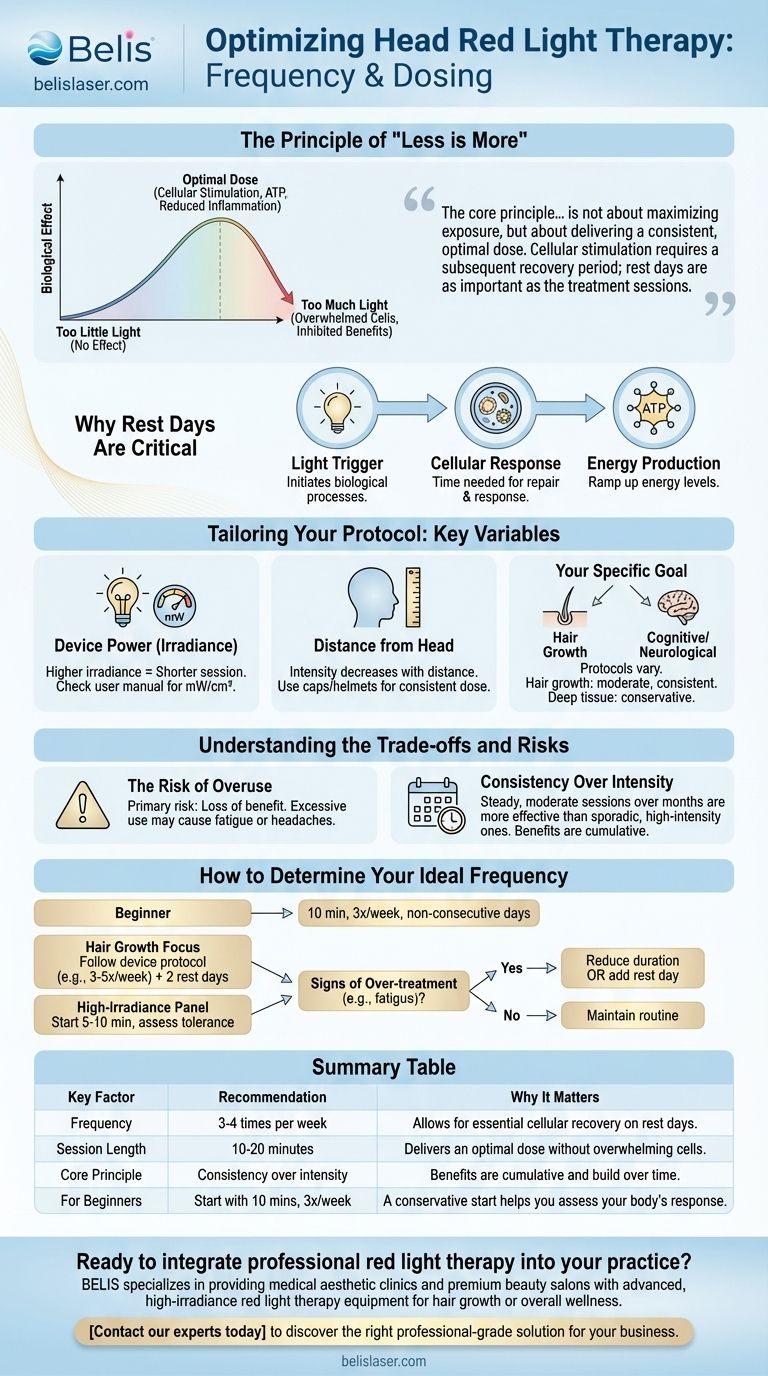
The Principle of 'Less is More' in Red Light Therapy
Many people assume that if some red light is good, more must be better. However, the biological mechanism behind red light therapy follows a principle known as the biphasic dose response, making this assumption incorrect.
Understanding the Biphasic Dose Response
The biphasic dose response can be simply understood as a "sweet spot" effect.
Too little light energy will have no biological effect. An optimal dose of light will stimulate cellular activity, such as increasing ATP (energy) production and reducing inflammation. However, too much light can overwhelm the cells, leading to a decline in benefits and potentially inhibiting the very processes you aim to support.
Think of it like exercise: insufficient training yields no results, the right amount stimulates muscle growth, but overtraining leads to injury and fatigue.
Why Rest Days Are Critical for Cellular Repair
Red light therapy acts as a trigger, initiating a cascade of beneficial biological processes within your cells. These processes do not happen instantaneously.
Your cells need time to respond to the light stimulus, repair themselves, and ramp up their energy production. The rest days you take between sessions are when much of this crucial activity occurs. Skipping them to accelerate results is often counterproductive.
Tailoring Your Protocol: Key Variables to Consider
A "one-size-fits-all" approach is not ideal. The effectiveness of your routine depends on adjusting for several key variables to ensure you are delivering the correct dose.
Device Power (Irradiance)
Irradiance, measured in milliwatts per square centimeter (mW/cm²), is the amount of light energy a device delivers to a surface area. Higher irradiance means a shorter session is needed to deliver the same total energy dose.
Always consult your device's user manual. A reputable manufacturer will provide recommended session times based on the device's power output and its distance from the skin.
Distance from the Head
Light intensity decreases significantly with distance. A device held 6 inches away delivers a much lower energy dose than one held 1 inch away.
For applications like hair growth, devices are often designed as caps or helmets that sit directly on the scalp, ensuring a consistent distance and dose. For panel devices, follow the manufacturer's distance guidelines precisely to avoid under or over-treatment.
Your Specific Goal
Protocols can vary slightly based on the intended target. Treating the scalp for hair growth often involves consistent, moderate sessions aimed at stimulating hair follicles. Protocols targeting deeper tissues for cognitive or neurological support are more experimental and underscore the importance of starting with a conservative approach.
Understanding the Trade-offs and Risks
While red light therapy is considered very safe, improper use can limit its effectiveness and introduce minor issues. Understanding the trade-offs helps you create a smarter protocol.
The Risk of Overuse
The primary risk of red light therapy is not harm, but a loss of benefit. As explained by the biphasic dose response, over-treating can negate the positive effects.
In some cases, excessive use may lead to temporary fatigue or mild headaches. This is a clear signal from your body to reduce session duration or frequency.
Consistency Over Intensity
It is far more effective to maintain a consistent schedule of moderate sessions (e.g., 15 minutes, 3 times a week) over several months than it is to perform sporadic, high-intensity sessions.
The benefits of red light therapy are cumulative. They build up over time with steady, repeated stimulation and recovery cycles.
How to Determine Your Ideal Frequency
Use the following guidelines to establish a safe and effective routine, always prioritizing your body's response over a rigid schedule.
- If you are a complete beginner: Start conservatively with 10-minute sessions, 3 times per week on non-consecutive days.
- If your primary focus is hair growth: Adhere to your device's protocol, which is typically 3-5 sessions per week, but ensure you include at least two rest days.
- If you are using a high-irradiance panel: Begin with shorter sessions of 5-10 minutes to avoid over-treatment and assess your tolerance.
- If you experience any signs of over-treatment (like fatigue): Immediately reduce your session duration or add an extra rest day between treatments.
Ultimately, the key to success is finding the consistent and moderate routine that allows your body to respond and repair effectively.
Summary Table:
| Key Factor | Recommendation | Why It Matters |
|---|---|---|
| Frequency | 3-4 times per week | Allows for essential cellular recovery on rest days. |
| Session Length | 10-20 minutes | Delivers an optimal dose without overwhelming cells. |
| Core Principle | Consistency over intensity | Benefits are cumulative and build over time with a steady routine. |
| For Beginners | Start with 10 mins, 3x/week | A conservative start helps you assess your body's response. |
Ready to integrate professional red light therapy into your practice?
BELIS specializes in providing medical aesthetic clinics and premium beauty salons with advanced, high-irradiance red light therapy equipment. Our devices are engineered for precise dosing and consistent, reliable results for your clients, whether the goal is hair growth or overall wellness.
Contact our experts today to discover the right professional-grade red light therapy solution for your business and enhance your treatment offerings.
Visual Guide
Related Products
- 9D 7D HIFU Vaginal RF Lifting Treatment
- 7D 12D 4D HIFU Machine Device
- 4D 12D HIFU Machine Device for Skin Tightening
- 12D HIFU Machine Device for Facial HIFU Treatment
- IPL SHR Hair Removal Machine for Permanent Hair Removal
People Also Ask
- Is HIFU treatment considered safe and what are the potential risks? A Guide to Safe Non-Invasive Skin Tightening
- Is a HIFU treatment painful? Discover Comfort Levels and Results for Non-Surgical Lifting
- How does HIFU treatment differ from other skin tightening procedures? Compare Non-Invasive Lifting vs. Surgery
- What are the primary benefits of HIFU treatment? Reveal a Youthful V-Line and Firm Skin Non-Invasively
- Why are HIFU systems equipped with multiple treatment handpieces? Precision Depth Control for Superior Skin Results















