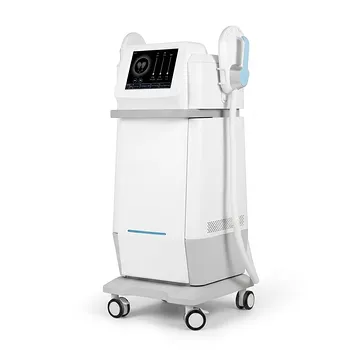
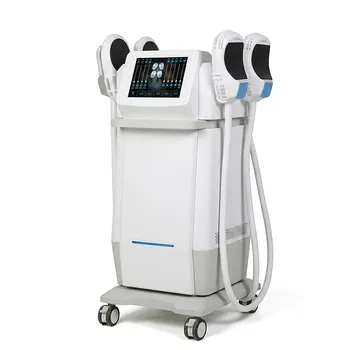
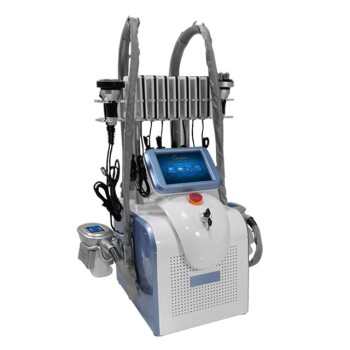
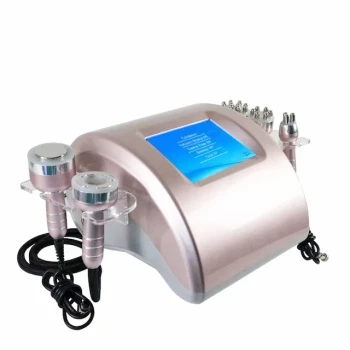
Non-invasive facial sculpting technologies uphold volume preservation by reducing excess submental fat gradually and uniformly while supporting skin contraction. Unlike aggressive liposuction, which can remove too much fat and expose the platysma or create hollow contours, controlled radiofrequency, cavitation, and targeted cryolipolysis are designed to refine localized fullness without stripping away the soft-tissue support that gives the jawline a natural appearance.
Volume preservation does not mean leaving all fat untouched. It means removing only the excess volume required for definition while maintaining balanced soft-tissue coverage and encouraging the skin to conform smoothly to the new contour.
What Volume Preservation Means in the Lower Face
Preserving the Soft-Tissue Envelope
The submental region depends on more than fat alone. Skin, subcutaneous tissue, the platysma, and underlying structures work together to create a smooth cervicomental angle.
Over-excising fat can make the platysma or its edges visibly prominent. The result may be a skeletal or hollow appearance rather than a refined jawline.
Refining Excess Rather Than Removing Everything
The objective is controlled contour improvement, not maximal fat removal. Energy-based technologies can target localized deposits in a more measured way, helping preserve the surrounding volume that maintains facial softness.
This is especially important along the transition between the chin, neck, and jawline, where small imbalances can become visually obvious.
How Controlled Energy Supports Balanced Contours
Uniform Fat Reduction
Specialized submental radiofrequency, cavitation, and targeted cryolipolysis can reduce localized fat deposits without relying on broad, aggressive excision.
When treatment is distributed appropriately, the reduction is more uniform. This lowers the risk of visible depressions, abrupt contour changes, or asymmetry caused by uneven fat removal.
Simultaneous Skin Tightening
Some radiofrequency-based approaches use thermal energy to support skin contraction as tissue volume decreases. This helps the skin adapt to the refined contour instead of remaining loose or contracting irregularly.
The combination of measured fat reduction and skin tightening is central to preserving a smooth, youthful appearance.
Maintaining the Cervicomental Transition
A natural jawline requires continuity between the lower face and neck. Removing excessive submental tissue can disrupt that transition by creating a hollow area beneath the chin.
Controlled sculpting aims to sharpen the cervicomental angle while retaining enough soft-tissue volume to keep the transition gradual and natural.
Why Surgical Over-Excision Can Compromise Volume
Platysmal Skeletonization
Aggressive liposuction may remove the fat layer that visually softens the platysma. When too little tissue remains, the muscle or its edges can become unusually visible.
This is a form of contour overcorrection: the area may look thinner, but not necessarily more youthful or aesthetically balanced.
Irregular Skin Contracture
If fat is removed unevenly or the skin does not adapt smoothly, contraction can produce visible irregularities. These may appear as depressions, tethering, or an unnatural tightness beneath the jaw.
Energy-based approaches that combine controlled reduction with skin tightening are intended to reduce this mismatch between tissue loss and skin adaptation.
Loss of Facial Softness
The lower face should be defined without appearing depleted. Preserving an appropriate amount of subcutaneous volume helps maintain the soft, continuous contours associated with a youthful profile.
Understanding the Trade-offs
Gradual Results Require Appropriate Expectations
Non-invasive sculpting generally emphasizes controlled refinement rather than an immediate, dramatic reduction. Patients seeking substantial tissue removal may not achieve their desired result with energy-based treatment alone.
The appropriate method depends on the amount and distribution of submental fat, skin quality, and the degree of laxity present.
Volume Preservation Still Requires Precision
Non-invasive does not mean risk-free or automatically uniform. Incorrect energy settings, unsuitable patient selection, or poorly planned treatment distribution can still produce uneven results or insufficient correction.
Clinical assessment and conservative treatment planning remain essential.
Skin Tightening Has Biological Limits
Energy-based skin contraction may improve the appearance of laxity, but it cannot guarantee complete tightening in every patient. Significant excess skin may require a different treatment strategy.
The principle of volume preservation must therefore be balanced with an honest assessment of what the skin and underlying tissues can support.
Making the Right Choice for Your Goal
The key is to match the treatment intensity and technology to the desired degree of correction while protecting the surrounding soft-tissue architecture.
- If your primary focus is natural-looking jawline definition: Prioritize gradual, uniform reduction that preserves enough submental tissue to maintain a soft cervicomental transition.
- If your primary focus is skin laxity: Consider an approach that includes a skin-tightening component, because reducing fat without supporting skin contraction may leave the contour poorly adapted.
- If your primary focus is substantial fat removal: Discuss whether non-invasive treatment can provide enough correction, since controlled sculpting may be less suitable for larger-volume reduction.
- If your primary focus is avoiding a hollow or skeletal appearance: Use conservative treatment planning that protects the soft-tissue layer over the platysma and avoids aggressive overcorrection.
The most balanced submental treatment improves definition by controlling excess volume while preserving the soft-tissue support that makes the result look natural.
Summary Table:
| Technology | Mechanism | Volume Preservation | Skin Tightening |
|---|---|---|---|
| RF (Radiofrequency) | Thermal energy melts fat, stimulates collagen | Gradual, uniform fat reduction | Yes (via collagen contraction) |
| Cavitation (Ultrasound) | Disrupts fat cells via ultrasonic waves | Focused reduction of excess fat | Minimal, depends on frequency |
| Cryolipolysis | Controlled cooling induces fat cell death | Targeted reduction of localized fat | No, but may improve skin texture |
| HIFU (High-Intensity Focused Ultrasound) | Focused ultrasound energy for fat reduction and skin tightening | Precise fat disruption, maintains surrounding volume | Yes (deeper tissue contraction) |
Achieve natural-looking jawline and submental contours with BELIS professional-grade aesthetic solutions. Our advanced devices, including RF, cavitation, HIFU, and Cryolipolysis, ensure precise volume preservation and skin tightening—ideal for clinics and premium salons. Contact us today to explore how our technology can enhance your practice and patient satisfaction. Get in touch with our experts!
Related Products
- 22D HIFU Machine Device Facial Machine
- 12D HIFU Machine Device for Facial HIFU Treatment
- EMSlim Body Slimming Machine for Muscle Building and Beauty
- Ultrasonic Cavitation Machine Lipo Laser Device
- EMS Body Sculpting Slimming Machine EMSlim Body Slimming Machine
People Also Ask
- Is swelling a frequent side effect after a HIFU facial? Expert Insights on HIFU Recovery and Safety
- What is the mechanism of action of High-Intensity Focused Ultrasound (HIFU) devices in noninvasive body sculpting, and how is surrounding tissue protected?
- How do High-Intensity Focused Ultrasound (HIFU) devices function? Master Non-Invasive Face Lifting Technology
- Are home-use HIFU devices a recommended alternative? Why Clinical Safety Beats At-Home Risks
- What are the main functions of a High Intensity Focused Ultrasound (HIFU) machine? Advanced Skin Lifting and Sculpting