
To maximize your laser hair removal results, you must meticulously prepare your skin before each session and strictly adhere to the full treatment schedule provided by your technician. This involves shaving the area 24 hours beforehand, completely avoiding sun exposure, and ceasing all waxing or plucking for at least four weeks prior to your first appointment. These actions ensure the laser has a clear and effective target.
Success in laser hair removal is not determined by the treatment alone, but by how you manage your skin and hair between sessions. Your role is to create the ideal conditions for the laser to work: a preserved hair follicle beneath the skin's surface and a clear contrast between the hair pigment and the skin tone.

Understanding the Mechanism: How the Laser Works
To optimize the process, you must first understand its core principle. The laser is not simply burning away hair; it is a highly targeted process that relies on specific biological conditions.
The Role of Pigment and the Follicle
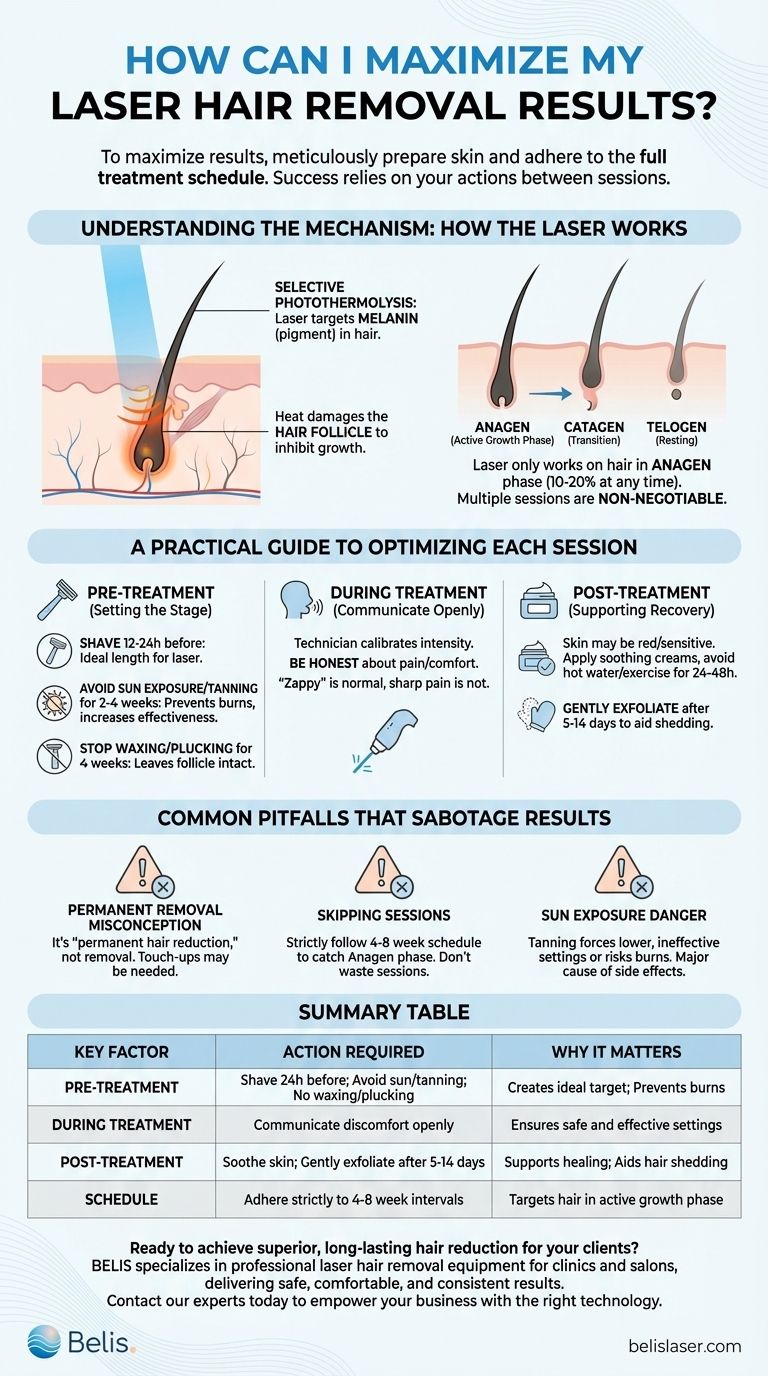
Laser hair removal works through a process called selective photothermolysis. The device emits a concentrated beam of light that is specifically absorbed by the melanin (pigment) in your hair.
This light energy converts to heat, which travels down the hair shaft and damages the hair follicle—the small pocket in the skin from which the hair grows. The goal is to damage the follicle enough to prevent or significantly inhibit future hair growth.
Why the Hair Must Be Present (But Short)
For the laser to work, the hair shaft must be present within the follicle to act as a conduit for the heat. This is why plucking or waxing is strictly forbidden. These methods remove the entire hair from the follicle, leaving no pathway for the laser's energy to reach its target.
Shaving, on the other hand, is ideal. It trims the hair at the surface, which prevents the laser from scorching surface hair while leaving the root and follicle intact below the skin, ready to absorb the energy.
The Critical Importance of the Growth Cycle
Hair grows in three distinct phases: Anagen (active growth), Catagen (transition), and Telogen (resting). A laser can only effectively destroy a follicle when the hair is in the Anagen (active growth) phase.
At any given time, only a fraction of your hair (around 10-20%) is in this active phase. This is the fundamental reason why multiple sessions are non-negotiable. Each treatment targets the current crop of active hairs, and the subsequent sessions are timed to catch the next group as they enter the Anagen phase.
A Practical Guide to Optimizing Each Session
Your actions before, during, and after each appointment directly influence the safety and effectiveness of the outcome.
Pre-Treatment: Setting the Stage for Success
Shave the treatment area 12-24 hours before your appointment. This provides the perfect length—short enough to be safe, but long enough for the follicle to be visible to the laser system.
Avoid all sun exposure, tanning beds, and self-tanners for at least two to four weeks before your session. A tan darkens the skin, reducing the contrast between your hair and skin. This forces the technician to use a lower, less effective laser setting and dramatically increases your risk of burns and discoloration.
Stop waxing, plucking, or using depilatory creams for at least four weeks before your first session and for the entire duration of your treatment course. You must allow the hair follicles to complete their growth cycles naturally so the laser has a target.
During Treatment: Communicate Openly
Your technician calibrates the laser's intensity based on your skin type, hair color, and feedback. Be honest about your pain and comfort level.
What feels "zappy" is normal, but sharp, intolerable pain could indicate the setting is too high for your skin, perhaps due to recent, minor sun exposure you forgot about. Open communication is a critical safety measure.
Post-Treatment: Supporting Recovery and Hair Shedding
Your skin will likely be red and sensitive, similar to a mild sunburn. Follow your technician's advice, which usually includes applying soothing creams like aloe vera and avoiding hot showers, saunas, or intense exercise for 24-48 hours.
About five to fourteen days after treatment, you may notice what looks like regrowth. This is most often the treated hairs being shed from the follicle. You can aid this process by gently exfoliating the area two to three times per week, starting a few days after your session.
Common Pitfalls That Sabotage Results
Avoiding common mistakes is just as important as following the correct procedures. Missteps can waste your time and money, and in some cases, harm your skin.
The "Permanent Removal" Misconception
The FDA-approved terminology for laser hair removal is "permanent hair reduction," not "permanent hair removal." While it can produce a dramatic and long-lasting reduction in hair, it may not eliminate 100% of hairs forever. Hormonal changes or other factors can sometimes trigger new growth, which may require occasional touch-up sessions.
Underestimating the Importance of the Schedule
Skipping an appointment or extending the time between sessions is a critical error. The schedule (typically every 4-8 weeks) is designed to target hair as it enters the active growth phase. If you miss that window, you have to wait for the cycle to come around again, effectively wasting the previous session and extending the overall time and cost of your treatment.
The Danger of Sun Exposure
This cannot be overstated. Tanning before a laser session is the primary cause of adverse side effects. It forces the technician to choose between two bad options: proceeding with a high setting and risking a burn, or using a low, ineffective setting that wastes your money.
Making the Right Choice for Your Goal
Your behavior between treatments will define your outcome. Tailor your focus based on your primary objective.
- If your primary focus is maximum effectiveness: Strictly follow the recommended treatment schedule without deviation and completely cease all waxing or plucking.
- If your primary focus is safety: Be radically honest with your technician about all sun exposure and medication use, even if it means postponing an appointment.
- If your primary focus is cost-efficiency: Commit to the full plan from the start, as completing the series correctly is far cheaper than paying for extra sessions later to fix inconsistent results.
By understanding the principles behind the process, you are no longer a passive recipient of a service but an active partner in achieving your results.
Summary Table:
| Key Factor | Action Required | Why It Matters |
|---|---|---|
| Pre-Treatment | Shave 24h before; Avoid sun/tanning; No waxing/plucking | Creates ideal target for laser; Prevents burns |
| During Treatment | Communicate discomfort openly | Ensures safe and effective laser settings |
| Post-Treatment | Soothe skin; Gently exfoliate after 5-14 days | Supports healing; Aids hair shedding |
| Schedule | Adhere strictly to 4-8 week intervals | Targets hair in active growth phase for maximum reduction |
Ready to achieve superior, long-lasting hair reduction for your clients?
BELIS specializes in providing medical aesthetics clinics and premium beauty salons with professional, reliable, and effective laser hair removal equipment. Our advanced technology is designed to deliver safe, comfortable, and consistent results, enhancing your service offerings and client satisfaction.
Contact our experts today to discover how BELIS can empower your business with the right technology for outstanding outcomes.
Visual Guide
Related Products
- Diode Tri Laser Hair Removal Machine for Clinic Use
- Diode Laser SHR Trilaser Hair Removal Machine for Clinic Use
- Clinic Diode Laser Hair Removal Machine with SHR and Trilaser Technology
- Clinic Use IPL SHR ND YAG Laser Hair Removal RF Skin Tightening Machine
- Trilaser Diode Hair Removal Machine for Beauty Clinic Use
People Also Ask
- What are the advantages of the Constant Motion Technique? Elevate Your Clinic's Laser Hair Removal Results
- How can aesthetic practitioners prevent side effects like paradoxical hair regrowth and thermal burns when performing diode laser hair removal on dark skin? Master safe protocols for Fitzpatrick IV–VI skin.
- How do broad-spectrum noncoherent light sources compare to single-wavelength diode lasers in aesthetic hair removal applications? Find the best fit for your clinic.
- Why can traditional high-energy pulse (HR) modes lead to adverse skin reactions? Understanding Thermal Injury Risks
- Why is a 40-ms pulse width critical for Fitzpatrick skin types III-V? The Key to Safe & Effective Laser Hair Removal

















