
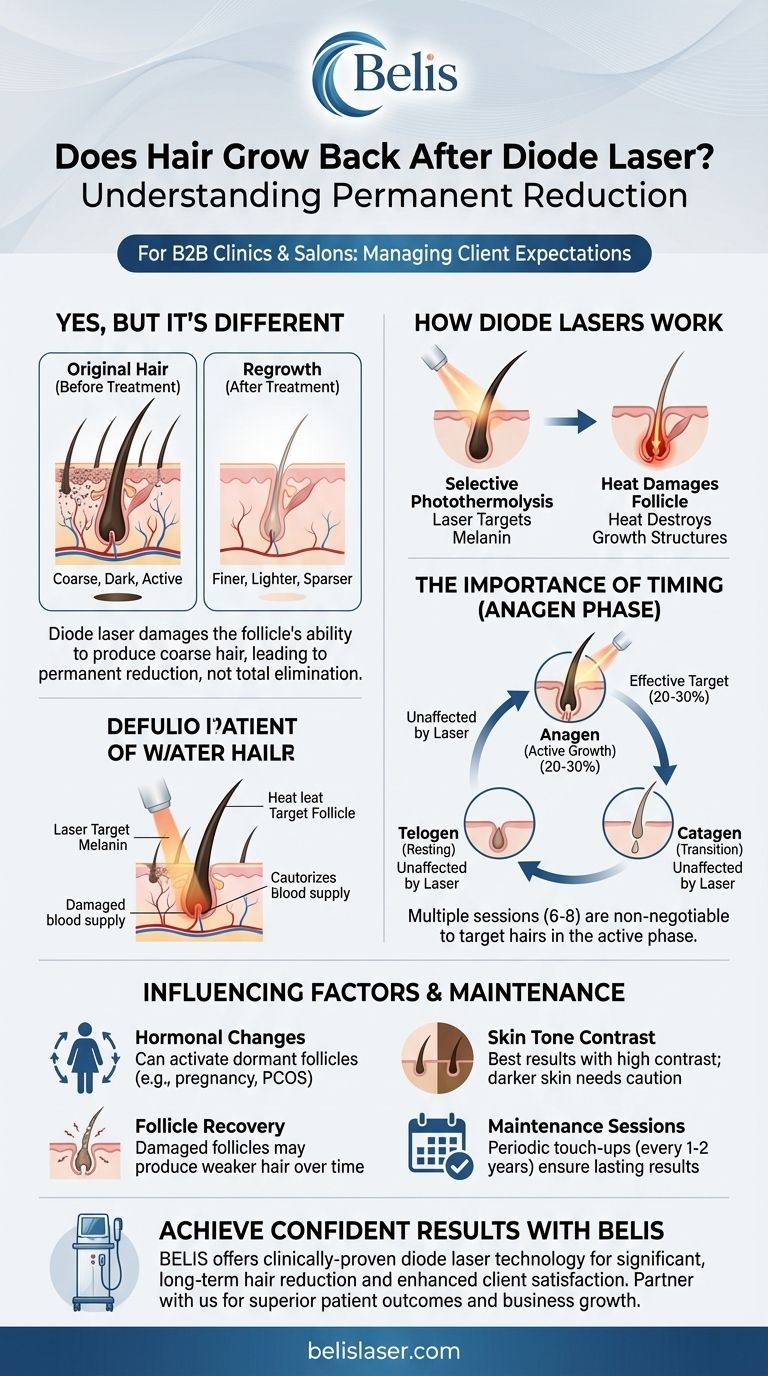
Yes, some hair can grow back after diode laser treatment, but it is not a simple regrowth. The treatment is designed for permanent hair reduction, not total elimination. Hair that does return is typically finer, lighter, and sparser because the laser fundamentally damages the follicle's ability to produce a coarse, dark hair.
Diode laser hair removal provides permanent hair reduction by damaging hair follicles. While many follicles are destroyed for good, some may eventually recover or were simply dormant during treatment. This leads to new, but significantly weaker, growth that may require periodic maintenance.

How Diode Lasers Target Hair Growth
To understand why some hair returns, you must first understand how the technology works. The process is precise and depends entirely on the hair's growth cycle.
The Principle of Selective Photothermolysis
Diode lasers operate on a principle called selective photothermolysis. This means the laser emits a highly concentrated beam of light at a specific wavelength.
This light is selectively absorbed by the melanin (the pigment that gives hair its color) within the hair shaft.
Upon absorption, the light energy converts into intense heat. This heat travels down the hair shaft to the surrounding follicle, damaging the key structures responsible for hair production.
Targeting the Anagen (Growth) Phase
A laser can only destroy a hair follicle when the hair is in its anagen, or active growth, phase. During this stage, the hair is physically connected to the follicle's base, providing a direct pathway for the heat to do its damage.
At any given time, only a fraction of the hairs on your body (around 20-30%) are in this anagen phase. Hairs in the resting or transitional phases do not have this connection and are unaffected by the treatment.
This is precisely why multiple sessions, spaced weeks apart, are non-negotiable. Each session targets a new crop of follicles that have entered the anagen phase.
The Damage to the Follicle
When successful, the heat from the laser cauterizes the blood supply to the follicle and damages its regenerative structures.
A completely destroyed follicle cannot grow a new hair. A follicle that is only damaged may eventually heal and produce a new hair, but it will almost always be finer and weaker than the original.
Understanding "Permanent Reduction" vs. "Removal"
The language used to describe the results of laser hair removal is specific and important. Regulatory bodies and clinicians distinguish between two different outcomes.
What "Permanent Reduction" Means
The FDA clears these devices for "permanent hair reduction." This is officially defined as a significant, stable reduction in the number of hairs regrowing after a treatment course.
It does not imply the complete eradication of every single hair forever. The goal is to achieve a state where the vast majority of coarse, dark hairs are gone, leaving behind only sparse, fine hairs, if any.
Why Some Hair Appears to "Regrow"
Several factors explain why you may see hair in a treated area after completing your sessions:
- Dormant Follicles: Hairs that were in the resting phase during your treatments were unaffected. They will eventually grow as part of their natural cycle, appearing as "new" hair months later.
- Follicle Recovery: As mentioned, some follicles are only damaged, not fully destroyed. Over a long period (months or even years), they may repair themselves enough to produce a new, weaker hair.
- Hormonal Changes: Fluctuations in hormones due to pregnancy, menopause, or conditions like PCOS can activate entirely new hair follicles that were previously dormant. This is not regrowth from treated follicles but rather new growth.
Common Pitfalls and Influencing Factors
Achieving the best possible outcome requires understanding the limitations and variables that affect the treatment's efficacy.
The Importance of Multiple Sessions
A single treatment is not effective for long-term reduction. A full course of 6 to 8 sessions is typically required to capture as many hairs as possible in their active growth phase. Skipping appointments or stopping the course early will compromise your results.
The Contrast Between Hair and Skin
Diode lasers work best when there is a clear contrast between dark hair and light skin. The laser's target is melanin. If the surrounding skin has a high concentration of melanin (as in darker skin tones), it can also absorb the laser's energy, increasing the risk of side effects and making the treatment less efficient.
The Need for Maintenance
For most people, laser hair removal is not a "one-and-done" solution. To maintain a smooth, hair-free appearance, you should expect to need a maintenance or "touch-up" session every one to two years to address any recovered or newly activated follicles.
Making the Right Choice for Your Goal
Setting realistic expectations is the key to being satisfied with your diode laser hair removal results.
- If your primary focus is a significant, long-term reduction in coarse hair: Diode laser is a highly effective solution, but you must commit to a full series of treatments and plan for occasional maintenance.
- If your primary focus is 100% permanent removal of every hair: No laser system can guarantee this outcome, and you should adjust your expectations toward management and dramatic reduction rather than total elimination.
- If you have light hair (blonde, grey, red) or dark skin: You must consult an experienced technician, as results can be less effective and require specialized equipment or different laser types to ensure safety and efficacy.
Understanding this process allows you to see diode laser not as a magic wand, but as a powerful, scientific tool for long-term hair management.
Summary Table:
| Factor | Impact on Hair Regrowth |
|---|---|
| Hair Growth Cycle | Laser only destroys follicles in the active (anagen) phase. Hairs in resting phases are unaffected. |
| Follicle Damage | Successfully destroyed follicles are gone forever. Damaged follicles may produce finer, weaker hair. |
| Number of Sessions | A full course (6-8 sessions) is crucial to target all hairs as they enter the growth phase. |
| Hormonal Changes | New hormonal fluctuations can activate previously dormant follicles, causing new growth. |
| Maintenance | Periodic touch-up sessions (every 1-2 years) help maintain optimal, long-term results. |
Achieve Confident, Long-Term Hair Reduction with BELIS
Tired of the endless cycle of temporary hair removal? BELIS specializes in professional medical aesthetic equipment, delivering clinically-proven diode laser technology to medical aesthetics clinics and premium beauty salons. Our devices are engineered for safety, efficacy, and superior patient outcomes, helping your business provide lasting results.
We help you deliver:
- Significant, Permanent Hair Reduction: Effectively target and diminish hair growth for your clients.
- Safe Treatments for Various Skin Tones: Advanced technology designed to treat a broader range of clients safely.
- Enhanced Client Satisfaction: Build a loyal clientele with a popular, high-demand service that delivers real value.
Ready to enhance your service offerings and drive business growth? Let our experts show you how BELIS equipment can become a cornerstone of your success.
Contact our specialists today for a personalized consultation and discover the BELIS difference.
Visual Guide
Related Products
- Diode Laser SHR Trilaser Hair Removal Machine for Clinic Use
- Clinic Diode Laser Hair Removal Machine with SHR and Trilaser Technology
- Trilaser Diode Hair Removal Machine for Beauty Clinic Use
- Diode Tri Laser Hair Removal Machine for Clinic Use
- Fractional CO2 Laser Machine for Skin Treatment
People Also Ask
- What is the working mechanism of professional-grade Diode laser equipment? Master the Physics of Selective Photothermolysis
- What are the characteristics of the Diode laser for hair removal? The Gold Standard for Deep Efficacy and Skin Safety
- What are the technical advantages of using industrial-grade Diode lasers? Superior Precision for Professional Clinics
- What advancements have occurred in laser hair removal machine technology? Trends Shaping Modern Aesthetic Clinics
- How long does a single laser hair removal session take? Fast & Effective Treatments for Your Busy Schedule








