
The most effective hair removal laser is the one precisely matched to your specific combination of skin tone and hair color. There is no single "best" laser for everyone; rather, the technology's effectiveness hinges on targeting the pigment in the hair follicle without affecting the surrounding skin.
The central principle of laser hair removal is matching the laser's wavelength to your unique profile. The goal is to select a laser that is highly absorbed by the melanin in your hair but poorly absorbed by the melanin in your skin, ensuring a safe and effective treatment.
The Core Principle: How Lasers Target Hair
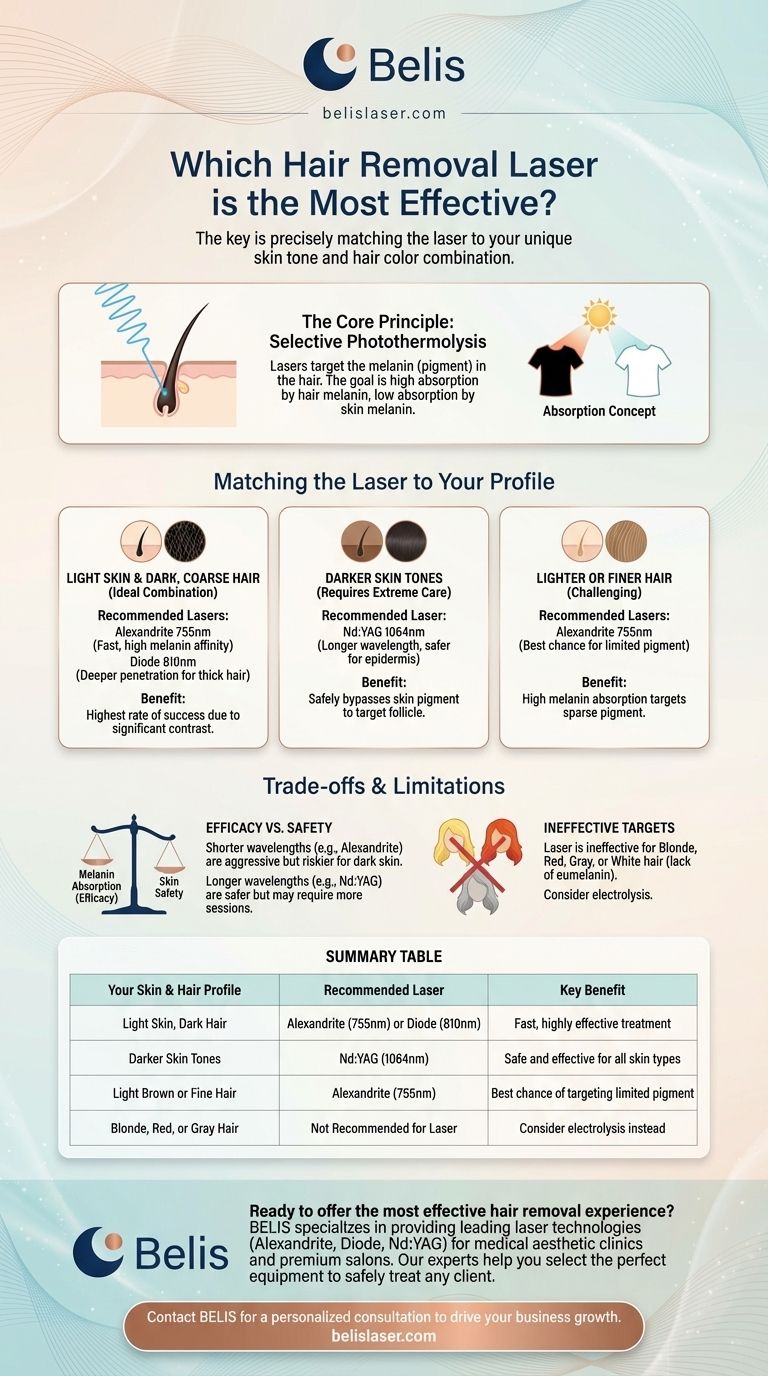
Laser hair removal operates on a principle called selective photothermolysis. In simple terms, this means using a specific wavelength of light that is strongly attracted to and absorbed by a target—in this case, the melanin (pigment) in the hair follicle.
When the melanin absorbs this intense light energy, it converts to heat. This heat then travels down the hair shaft to the base of the follicle, damaging the key structures responsible for hair growth without harming the surrounding tissue.
Think of it like the sun on a hot day. A black shirt (high in pigment) absorbs far more light and gets much hotter than a white shirt (low in pigment). Lasers use this same concept in a highly controlled way.
Matching the Laser to Your Hair and Skin
The effectiveness of a treatment is determined by the contrast between your skin and hair color. The greater the contrast (e.g., light skin and dark hair), the easier it is for the laser to "see" and target the hair follicle.
For Light Skin and Dark, Coarse Hair
This is the ideal combination for laser hair removal, offering the highest rate of success. The significant contrast allows the laser to easily lock onto the hair follicle.
The Alexandrite 755nm laser is a powerful option, known for its high repetition rate and large spot size, making treatments fast. It has a very high affinity for melanin.
The Diode 810nm laser is another excellent choice. It penetrates slightly deeper than the Alexandrite, making it particularly effective for thicker, more deeply rooted hairs.
For Darker Skin Tones
Treating darker skin requires extreme care. Using a laser with a high attraction to melanin (like the Alexandrite) is dangerous because the laser cannot easily distinguish between the pigment in the hair and the pigment in the skin, leading to a high risk of burns, blistering, or discoloration.
The gold standard for darker skin tones (Fitzpatrick types IV-VI) is the Nd:YAG 1064nm laser. Its longer wavelength is not as readily absorbed by melanin, allowing it to bypass the pigment in the epidermis and target the follicle more safely at a deeper level.
For Lighter or Finer Hair
Effectively treating light brown or very fine hair is challenging because it contains less melanin for the laser to target.
The Alexandrite 755nm laser is often the best choice in this scenario. Its high melanin absorption coefficient gives it the best chance of being absorbed by the limited amount of pigment present in lighter, finer hair strands.
Understanding the Trade-offs and Ineffective Targets
Choosing a laser involves balancing effectiveness with safety. It's also critical to understand the technology's limitations.
Efficacy vs. Safety
The fundamental trade-off is between melanin absorption and skin safety. Lasers with shorter wavelengths (like Alexandrite) are very aggressive in targeting melanin, making them highly effective but only safe for lighter skin tones.
Lasers with longer wavelengths (like Nd:YAG) are less aggressive toward melanin, making them much safer for dark skin but sometimes requiring more sessions to achieve the desired reduction, especially on finer hair.
The Challenge of Light Hair Colors
Laser hair removal is largely ineffective for red, blonde, gray, or white hair. This is because these hair colors lack the specific type of melanin (eumelanin) that the lasers are designed to target. Without a pigment target, the laser energy has nothing to absorb and cannot damage the follicle.
The Practitioner Is as Important as the Laser
The most advanced laser system is only as good as the person operating it. An experienced, certified technician knows how to accurately assess your skin and hair type, select the correct laser, and apply the appropriate settings to maximize results while ensuring your safety.
Making the Right Choice for Your Goal
Your decision should be guided by a professional assessment of your personal characteristics. During a consultation, a practitioner will identify your skin type (using the Fitzpatrick scale) and hair quality to recommend the safest and most effective technology.
- If your primary focus is treating dark hair on light skin: The Alexandrite 755nm or Diode 810nm laser will likely provide the most efficient results.
- If your primary focus is safety and efficacy on darker skin: The Nd:YAG 1064nm laser is the undisputed standard of care.
- If your primary focus is treating lighter brown or fine hair: The Alexandrite 755nm laser offers the best probability of success, though results may vary.
- If your primary focus is removing blonde, red, or gray hair: Laser hair removal is not a viable option, and you should consider a pigment-independent method like electrolysis.
Ultimately, the most effective path is to seek a consultation with a reputable clinic that offers multiple laser technologies to ensure a truly customized treatment plan.
Summary Table:
| Your Skin & Hair Profile | Recommended Laser | Key Benefit |
|---|---|---|
| Light Skin, Dark Hair | Alexandrite (755nm) or Diode (810nm) | Fast, highly effective treatment |
| Darker Skin Tones | Nd:YAG (1064nm) | Safe and effective for all skin types |
| Light Brown or Fine Hair | Alexandrite (755nm) | Best chance of targeting limited pigment |
| Blonde, Red, or Gray Hair | Not Recommended for Laser | Consider electrolysis instead |
Ready to offer your clients the most effective hair removal experience?
BELIS specializes in providing professional medical aesthetic clinics and premium beauty salons with the industry's leading laser technologies, including Alexandrite, Diode, and Nd:YAG systems. Our expert team will help you select the perfect equipment to safely and effectively treat any skin and hair type, enhancing your service offerings and client satisfaction.
Contact BELIS today for a personalized consultation and discover how our professional-grade equipment can drive your business growth.
Visual Guide
Related Products
- Clinic Diode Laser Hair Removal Machine with SHR and Trilaser Technology
- Trilaser Diode Hair Removal Machine for Beauty Clinic Use
- Diode Tri Laser Hair Removal Machine for Clinic Use
- Clinic Use IPL and SHR Hair Removal Machine with Nd Yag Laser Tattoo Removal
- Diode Laser SHR Trilaser Hair Removal Machine for Clinic Use
People Also Ask
- How can aesthetic practitioners prevent side effects like paradoxical hair regrowth and thermal burns when performing diode laser hair removal on dark skin? Master safe protocols for Fitzpatrick IV–VI skin.
- How do broad-spectrum noncoherent light sources compare to single-wavelength diode lasers in aesthetic hair removal applications? Find the best fit for your clinic.
- What are the advantages of the Constant Motion Technique? Elevate Your Clinic's Laser Hair Removal Results
- Why can traditional high-energy pulse (HR) modes lead to adverse skin reactions? Understanding Thermal Injury Risks
- Why is a 40-ms pulse width critical for Fitzpatrick skin types III-V? The Key to Safe & Effective Laser Hair Removal










