
Yes, you can use many at-home hair removal devices on some parts of the intimate area, but it is critically important to understand which areas are safe and which are not. While devices like IPL (Intense Pulsed Light) can be effective on the wider bikini line and mons pubis, they must never be used on the genitals themselves, such as the inner labia, vagina, or scrotum, due to a high risk of burns.
The core principle is safety through precision. At-home devices are designed for the less sensitive, lighter-pigmented skin of the bikini line, not the delicate, often darker-pigmented tissue of the genitals.
Understanding "Private Parts": A Zone-Based Approach
The term "private parts" covers different anatomical areas with vastly different skin characteristics. For safe at-home hair removal, you must distinguish between them.
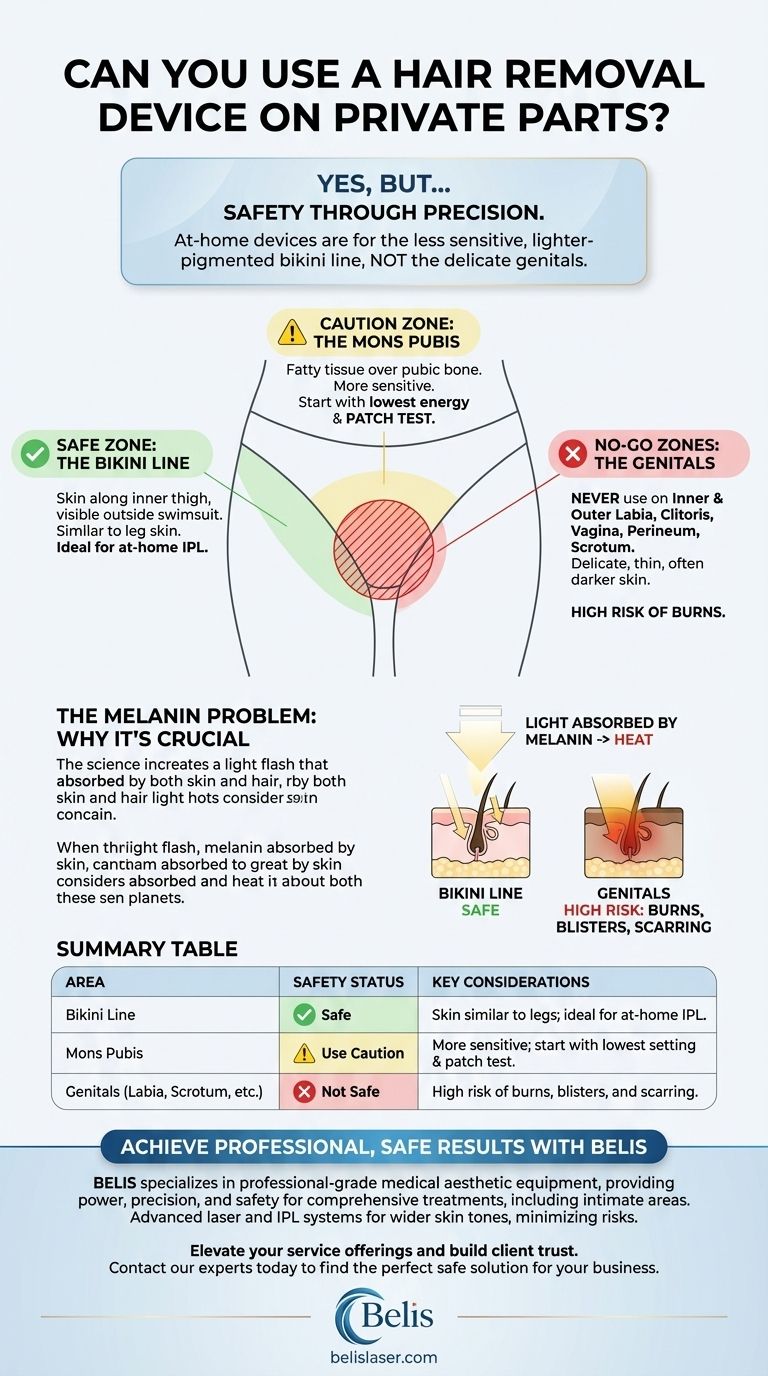
Safe Zone: The Bikini Line
The bikini line refers to the skin along the inner thigh where pubic hair may be visible outside of underwear or a swimsuit bottom.
This area is generally considered safe for at-home IPL or laser devices. The skin is typically similar in tone to the rest of your legs and is less sensitive than the genitals.
Caution Zone: The Mons Pubis
The mons pubis is the fatty tissue over the pubic bone. Extending treatment from the bikini line to cover this area is common.
While generally safe, this skin can be more sensitive than your legs. It is crucial to start with the lowest energy setting on your device and perform a patch test first.
No-Go Zones: The Genitals
This is the most critical area to understand. You must never use an at-home IPL or laser device on the genitals themselves.
This includes the inner and outer labia, the clitoris, the vagina, the perineum, and the scrotum. The skin here is extremely delicate, thin, and often has a higher concentration of pigment (melanin).
Why This Distinction Is Crucial
At-home hair removal devices, particularly IPL, are not "smart." They work on a simple principle that creates significant risk in these sensitive zones.
The Science of Light-Based Hair Removal
These devices emit a flash of light that is absorbed by melanin, the pigment that gives hair its color. This light energy converts to heat, which damages the hair follicle and inhibits future growth.
The Melanin Problem
The device cannot distinguish between the melanin in your hair and the melanin in your skin. The skin on the genitals is often darker and contains more pigment than surrounding areas.
Using an IPL device here would cause the skin to absorb a dangerous amount of energy, resulting in painful burns, blisters, and potential scarring or hyperpigmentation (darkening of the skin).
Understanding the Trade-offs and Risks
Even when used correctly on the bikini area, you must be aware of the potential downsides.
Risk of Burns and Skin Damage
The primary risk is burns. This can happen if the energy setting is too high for your skin tone or if you accidentally treat a "no-go zone." Always start with the lowest setting and perform a patch test 24 hours before full treatment.
Pain and Discomfort
The bikini area is more sensitive than an arm or leg. Most users describe the sensation as a quick "snap" of a rubber band. Using a lower setting, as recommended in the references, helps manage discomfort.
Incomplete or Patchy Results
Results vary based on your hair color and skin tone contrast. The ideal candidate has light skin and dark hair. The device may be less effective on lighter hair (blonde, red, grey) or unsafe for darker skin tones.
Making the Right Choice for Your Goal
Your approach should be dictated by your specific hair removal goal and your commitment to safety.
- If your primary focus is a tidy bikini line: At-home IPL devices are a safe and effective option for this specific zone.
- If your primary focus is a full "Brazilian" style removal: Do not attempt this at home. The safety risks are too high. This level of hair removal should only be performed by a trained professional in a clinical setting.
- If you have a medium to dark skin tone: You must exercise extreme caution. Only use devices explicitly rated for your skin tone and always start with a patch test on the lowest possible setting.
Ultimately, understanding the technology's limitations is the key to using these devices safely and effectively.
Summary Table:
| Area | Safety Status | Key Considerations |
|---|---|---|
| Bikini Line | ✅ Safe | Skin similar to legs; ideal for at-home IPL. |
| Mons Pubis | ⚠️ Use Caution | More sensitive; start with lowest setting & patch test. |
| Genitals (Labia, Scrotum, etc.) | ❌ Not Safe | High risk of burns, blisters, and scarring. |
Achieve Professional, Safe Results with BELIS
For salon owners and clinic professionals, ensuring client safety while delivering effective hair removal is paramount. At-home devices have clear limitations, especially for sensitive areas.
BELIS specializes in professional-grade medical aesthetic equipment, providing the power, precision, and safety features necessary for comprehensive treatments, including intimate areas. Our advanced laser and IPL systems are designed for efficacy across a wider range of skin tones, minimizing risks and maximizing client satisfaction.
Elevate your service offerings and build client trust with technology you can rely on.
Contact our experts today to find the perfect, safe hair removal solution for your business.
Visual Guide
Related Products
- IPL SHR Hair Removal Machine for Permanent Hair Removal
- Clinic Use IPL and SHR Hair Removal Machine with Nd Yag Laser Tattoo Removal
- Clinic Use IPL SHR ND YAG Laser Hair Removal RF Skin Tightening Machine
- Diode Laser SHR Trilaser Hair Removal Machine for Clinic Use
- Trilaser Diode Hair Removal Machine for Beauty Clinic Use
People Also Ask
- How does an IPL SHR machine achieve long-term hair reduction compared to traditional methods? Professional Tech Guide
- How does the frequency of IPL SHR sessions compare to traditional laser hair removal? Maximize Comfort and Efficiency
- How does IPL SHR technology accommodate a wide range of skin types and hair colors? Safe Solutions for All Skin Tones
- How does the safety mechanism of IPL SHR technology protect the surrounding skin tissue? Advanced Protection Guide
- Why is the IPL SHR hair removal process described as painless and comfortable for the patient? Discover the Tech.

















