
Yes, laser treatments can successfully tighten mild to moderate loose skin. They work by delivering focused energy into the deeper layers of your skin, which stimulates your body's natural production of collagen and elastin. This process gradually restores firmness and improves the skin's underlying support structure, making it a powerful non-surgical option for improving skin laxity.
The core principle of laser skin tightening is not the removal of skin, but rather prompting your body to rebuild its own support system. By using controlled thermal energy to kickstart collagen production, these treatments improve skin firmness over time, but they are not a substitute for surgical procedures required for significant amounts of excess skin.
How Energy-Based Devices Achieve Skin Tightening
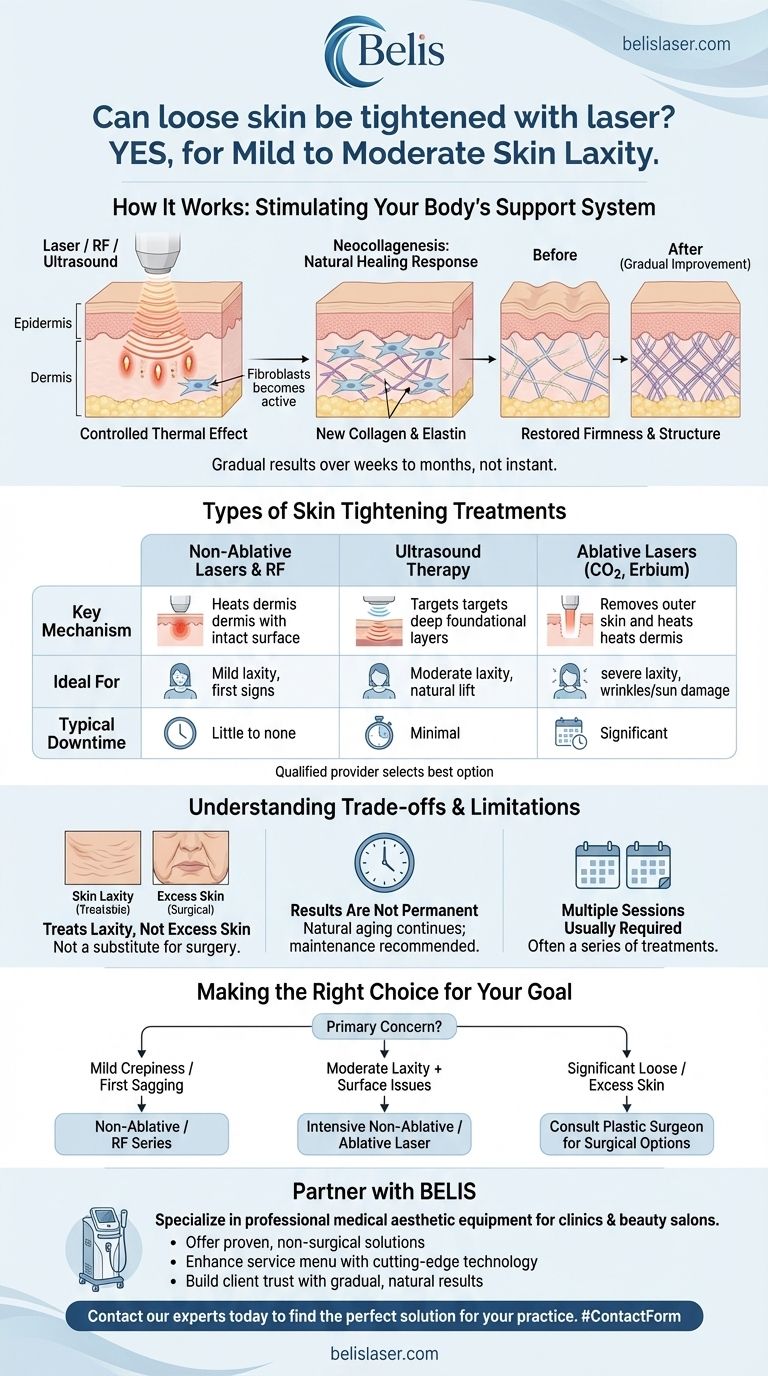
Laser and other energy-based treatments don't magically shrink skin. They leverage a biological process known as neocollagenesis—the creation of new collagen.
The Principle of Controlled Heating
At its heart, skin tightening is about delivering a precise amount of heat to the dermis, the layer of skin beneath the surface. This energy creates a controlled "thermal effect" without harming the outer skin layer.
Your body perceives this controlled heating as a type of injury and initiates its natural healing response.
Stimulating Collagen and Elastin
The key players in this healing response are collagen and elastin. These proteins form the fibrous network that gives youthful skin its structure, firmness, and elasticity.
The heat from the treatment signals your fibroblast cells to ramp up production of new, healthy collagen, effectively rebuilding and reinforcing this support network from the inside out.
The Gradual Improvement Process
This is not an instant fix. The results of laser skin tightening appear gradually over several weeks to months.
It takes time for your body to produce the new collagen and for that collagen to mature and remodel, leading to a visible tightening and lifting of the skin's surface.
Types of Skin Tightening Treatments
While "laser" is often used as a catch-all term, several different technologies can achieve this goal. A qualified provider will select the best one for your specific skin condition and goals.
Non-Ablative Lasers and Radiofrequency (RF)
These are the most common treatments for skin tightening. They work by heating the deep layers of the skin while leaving the surface completely intact.
This approach means there is typically little to no downtime. However, a series of multiple treatments is almost always required to achieve the desired result.
Ultrasound Therapy
Focused ultrasound technology (such as Ultherapy) can deliver energy even deeper than many lasers and radiofrequency devices.
It allows providers to target specific foundational layers of tissue, resulting in a noticeable but natural-looking lift over two to three months.
Ablative Lasers (CO2, Erbium)
Ablative lasers are more aggressive. They remove the outermost layers of skin while also heating the underlying dermis.
While highly effective for treating severe sun damage and wrinkles alongside laxity, they involve significant downtime and a more intensive recovery period.
Understanding the Trade-offs and Limitations
Objectivity is critical when considering any cosmetic procedure. Laser tightening is highly effective in the right circumstances, but it has clear limitations.
It Treats Laxity, Not Excess Skin
This is the most important distinction. Laser treatments are ideal for improving skin laxity—when skin has lost its firmness and has a crepey or slightly saggy appearance.
They cannot remove excess skin, such as the significant folds that can remain after major weight loss or pregnancy. In those cases, surgery (like a tummy tuck or facelift) is the only effective solution.
Results Are Not Permanent
The treatment turns back the clock, but it doesn't stop it from ticking. The natural aging process will continue, and you will continue to lose collagen over time.
Maintenance treatments every one to two years are often recommended to preserve the results.
Multiple Sessions Are Usually Required
With the exception of some aggressive ablative procedures, expect to undergo a series of treatments. Most non-invasive tightening protocols involve three to six sessions spaced several weeks apart.
Making the Right Choice for Your Goal
To determine if laser tightening is right for you, honestly assess your primary concern.
- If your primary focus is mild crepiness or the first signs of sagging: A series of non-ablative laser or radiofrequency treatments is an excellent and low-downtime option.
- If your primary focus is moderate laxity combined with surface issues like sun spots or fine lines: You may be a candidate for either a more intensive series of non-ablative treatments or a single ablative laser procedure.
- If your primary focus is significant folds of loose, excess skin: Your most effective and realistic path will be a consultation with a board-certified plastic surgeon to discuss surgical options.
Understanding the technology's capabilities and limitations empowers you to set realistic expectations and work with a qualified provider to achieve the best possible outcome for your skin.
Summary Table:
| Treatment Type | Key Mechanism | Ideal For | Typical Downtime |
|---|---|---|---|
| Non-Ablative Lasers & RF | Heats deep dermis to stimulate collagen | Mild laxity, first signs of aging | Little to none |
| Ultrasound Therapy (e.g., Ultherapy) | Targets deep foundational tissue layers | Moderate laxity, natural-looking lift | Minimal |
| Ablative Lasers (CO2, Erbium) | Removes outer skin layers & heats dermis | Severe laxity with wrinkles/sun damage | Significant |
Ready to restore your skin's natural firmness?
At BELIS, we specialize in professional medical aesthetic equipment for clinics and premium beauty salons. Our advanced laser and energy-based systems are designed to deliver safe, effective, and predictable skin tightening results for your clients.
Partner with BELIS to:
- Offer proven, non-surgical solutions for skin laxity.
- Enhance your service menu with cutting-edge technology.
- Provide treatments that build client trust and loyalty through gradual, natural-looking improvements.
Contact our experts today to find the perfect skin tightening solution for your practice.
Visual Guide
Related Products
- Clinic Use IPL SHR ND YAG Laser Hair Removal RF Skin Tightening Machine
- 4D 12D HIFU Machine Device for Skin Tightening and Lifting
- 4D 12D HIFU Machine Device for Skin Tightening
- Fractional CO2 Laser Machine for Skin Treatment
- 22D HIFU Machine Device Facial Machine
People Also Ask
- Why is the millisecond pulse width critical for laser hair removal on dark skin? Safety Guide for Dark Skin Treatments
- How does the combined application of laser devices and Eflornithine cream create a synergistic effect? Maximize Results
- What are the core hardware limitations of home hair removal devices? Why Professional Systems Deliver Superior Results
- Why is a 0–10 satisfaction scale used for hair management equipment? Elevate Your Clinic's Clinical Efficacy Metrics
- How many times a week should I use my laser hair removal machine? The Truth About Timing for Optimal Results

















