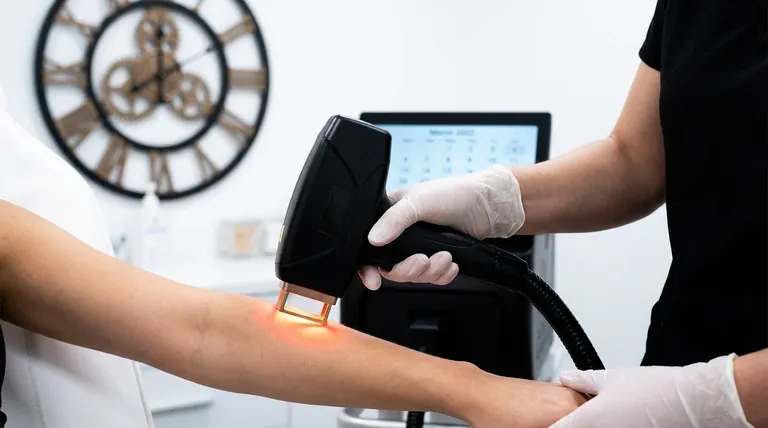
The Allure of a Permanent Solution
We are drawn to the idea of permanence. In a world of constant change, a one-time solution that lasts forever feels like the ultimate victory over maintenance and routine. This is the promise that makes "permanent hair removal" so compelling.
But biology rarely deals in absolutes.
The path to a lasting result isn't a single, decisive event. It's a strategic campaign, a war of attrition waged against thousands of individual hair follicles, each operating on its own invisible clock. True success comes not from a more powerful beam of light, but from a deeper understanding of the system you're trying to influence.
A Precision Strike, Not a Blanket Bomb
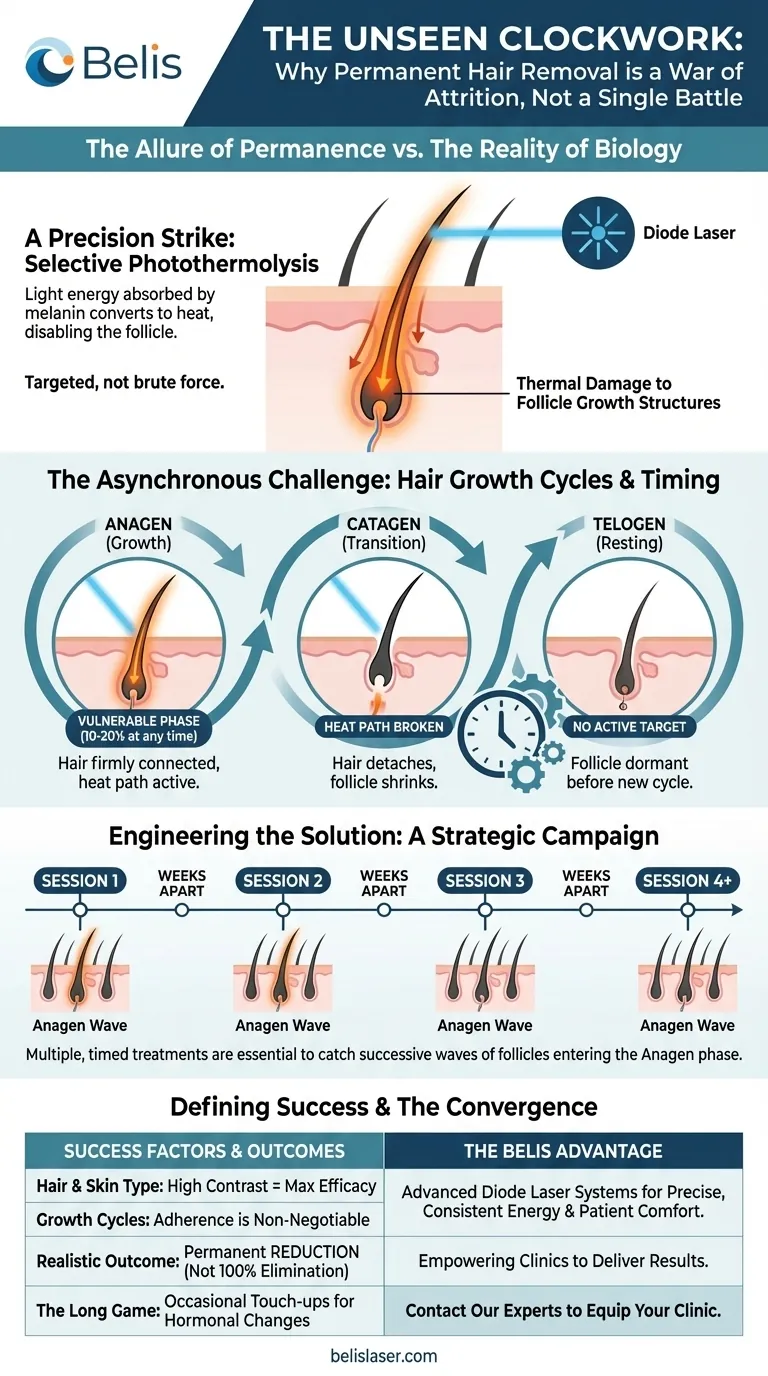
The underlying technology, selective photothermolysis, is an elegant piece of physics. A diode laser emits a single, pure wavelength of light engineered for one purpose: to be absorbed by melanin, the pigment that gives hair its color.
When the melanin in a hair shaft absorbs this light, the energy instantly converts to intense heat. This heat travels down the hair, like a fuse, to the follicle—the tiny organ responsible for producing it. The goal is to thermally damage the follicle's growth structures, disabling its ability to produce hair in the future.
It's not brute force. It's a targeted strike, using the hair itself as a conduit to deliver energy precisely where it's needed, leaving the surrounding skin unharmed.
The Asynchronous Challenge of Biology
Here we encounter the critical variable: time. The entire process hinges on the hair being physically connected to the follicle's base. If it isn't, the heat has no path to its target.
The problem is that hair follicles are not synchronized. They operate independently through three phases:
- Anagen (Growth): The hair is actively growing and firmly connected to the follicle's root. This is the only phase where the laser is effective.
- Catagen (Transition): The hair detaches from the follicle and stops growing.
- Telogen (Resting): The old hair rests and eventually sheds, while the follicle lies dormant before starting a new cycle.
At any given moment, only a fraction of your hair (typically 10-20%) is in the vulnerable Anagen phase. Treating an area once is like trying to catch all the fish in a lake with a single net; you only catch the ones that are in the right place at the right time.
Engineering the Solution: Timing is Everything
This is why a single laser session can never achieve a permanent result. The real solution is a matter of engineering a schedule.
Multiple treatments, spaced several weeks apart, are not an upsell; they are a fundamental requirement of the process. The schedule is carefully calculated to target the next wave of follicles as they rotate into the Anagen phase.
Skipping a session or waiting too long is like missing a critical train connection. You lose the opportunity to target that specific group of follicles, compromising the final outcome. The entire treatment course is a carefully choreographed dance between technology and biology.
Defining Success: The Nuance of "Permanent Reduction"
The FDA wisely uses the term "permanent hair reduction." This isn't a semantic trick; it's a commitment to scientific accuracy. It means a significant, stable, and long-term reduction in the number of hairs that regrow.
It does not mean the absolute elimination of every single hair, forever. Some follicles may be stunned rather than destroyed, eventually recovering. Hormonal shifts—like pregnancy or menopause—can also awaken previously dormant follicles.
Success depends on aligning several key factors:
| Factor | Impact on Outcome |
|---|---|
| Hair & Skin Type | High contrast (dark, coarse hair on fair skin) provides the ideal target for the laser, maximizing efficacy. |
| Growth Cycles | Adherence to a multi-session schedule is non-negotiable for targeting all follicles in their Anagen phase. |
| Realistic Outcome | Expect a dramatic reduction, not 100% elimination. Fine, light hairs may remain. |
| The Long Game | Occasional touch-up sessions may be needed every few years to address new growth from hormonal changes. |
The Convergence of Technology and Biology
For medical aesthetic clinics and premium salons, delivering on the promise of permanent hair reduction is about mastering this convergence. It requires a deep understanding of the biological process and, just as importantly, professional equipment capable of delivering precise, consistent, and safe energy, session after session.
This is where the quality of the technology becomes paramount. The ability to customize parameters for different skin and hair types, ensure reliable energy output, and maintain patient comfort defines the difference between a good result and a great one. BELIS provides advanced diode laser systems designed to meet these exacting professional standards, empowering clinics to deliver the results their clients seek.
Understanding the elegant science behind the process allows you to set the right expectations and build the trust that is the foundation of a successful practice. If you are ready to equip your clinic with technology that honors this principle, Contact Our Experts.
Visual Guide
Related Products
- Clinic Diode Laser Hair Removal Machine with SHR and Trilaser Technology
- Diode Tri Laser Hair Removal Machine for Clinic Use
- Trilaser Diode Hair Removal Machine for Beauty Clinic Use
- Diode Laser SHR Trilaser Hair Removal Machine for Clinic Use
- IPL SHR Hair Removal Machine for Permanent Hair Removal
Related Articles
- Beyond 'Permanent': The Biological Rhythm of Diode Laser Hair Removal
- Diode Laser Hair Removal: A Personalized Guide for Your Skin & Hair Type
- Diode Laser vs. TRILASER-LED: Which Hair Removal Technology Fits Your Skin Type?
- Diode Laser vs. TRILASER-LED Hair Removal: Which Technology Delivers Better Results?
- The Specialist's Blade: The Unseen Advantage of Diode Lasers in Hair Removal







