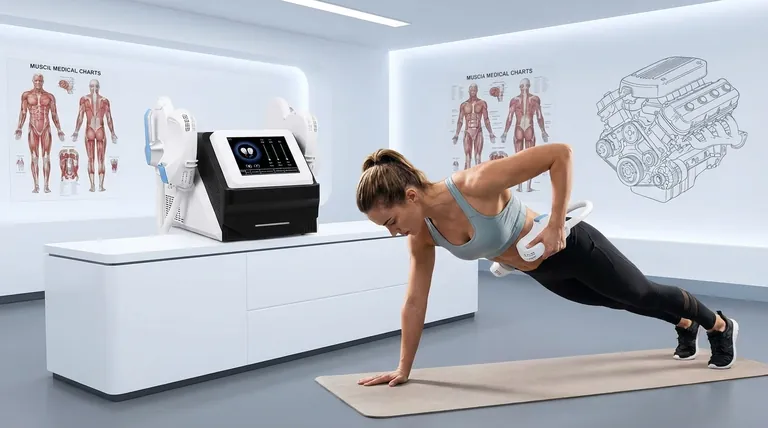
The Allure of the Effortless Answer
Every client who walks into a clinic is looking for a solution. Often, they frame the problem as "weight loss," but the real desire runs deeper. They want to look and feel better, stronger, more toned. It’s a search for control over their own biology.
This search often leads them to technologies that promise maximum results for minimum effort. Electrical Muscle Stimulation (EMS) is frequently caught in this narrative, marketed as a shortcut to shedding pounds.
But this framing misses the point entirely. To understand the power of EMS is to stop looking at the number on the scale and start looking at the body as an engine. The technology isn't designed to simply burn fuel; it's designed to help you build a better engine.
Hijacking a Biological Signal
At its core, every movement you make begins with a tiny electrical signal from your brain. It travels through your nervous system and tells a muscle to contract. It’s an elegant and efficient biological process.
EMS technology doesn't try to reinvent this process. It "hijacks" it.
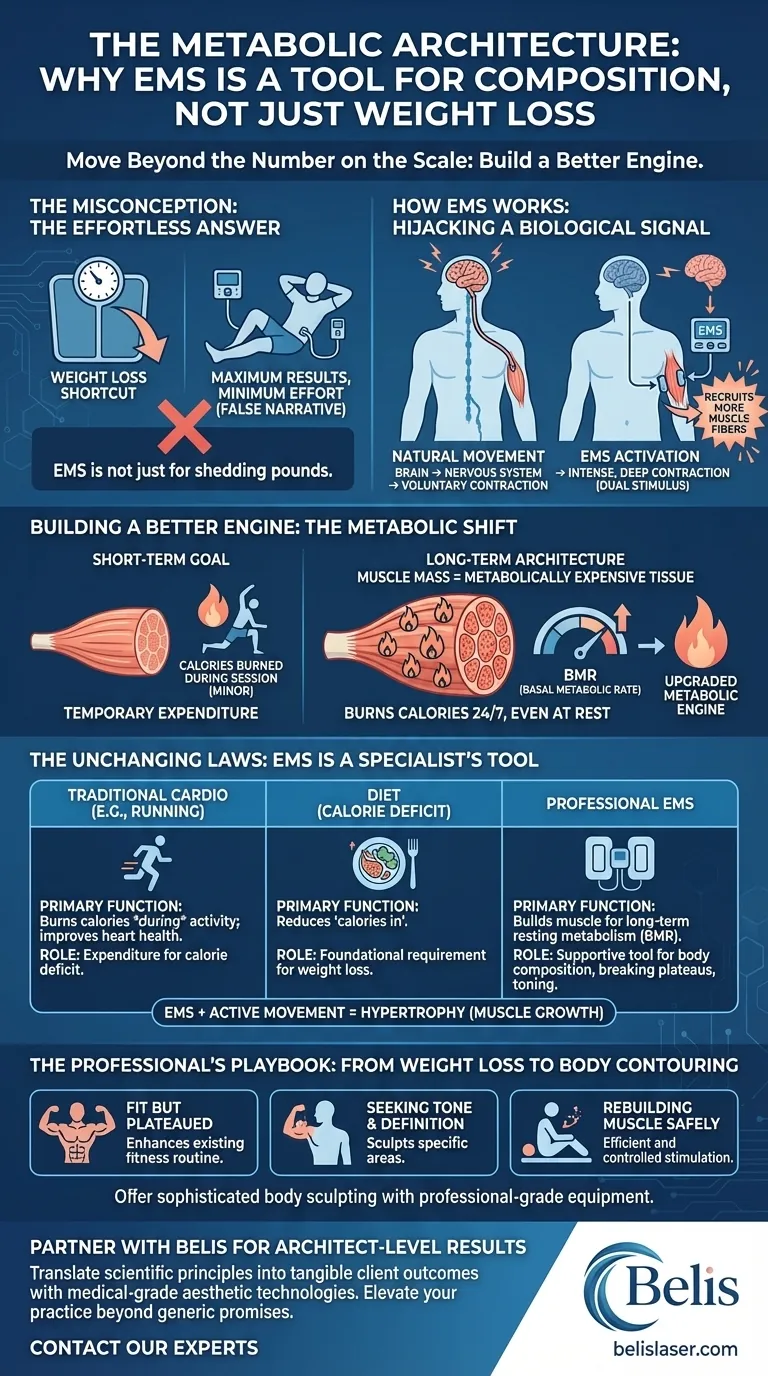
By placing electrodes on the skin over targeted muscles, an EMS device sends controlled electrical impulses that mimic the brain's own signal. The result is deep, involuntary, and intense muscle contractions—often recruiting more muscle fibers than one could engage through voluntary effort alone.
This isn't a passive therapy. When combined with active movements like squats or lunges, the effect is compounded. The muscle is being told to work by two sources at once: your brain and the device. This dual stimulus is the key to its true purpose: hypertrophy, or the growth of muscle fibers.
Building a Better Engine, Not Just Burning Fuel
Here we arrive at the central misunderstanding about EMS and weight loss. The value is not in the calories burned during a 20-minute session. That number is relatively minor.
The real benefit is what happens after.
Muscle tissue is metabolically expensive. It burns calories just to exist, even while you're sleeping. The more muscle mass you have, the higher your Basal Metabolic Rate (BMR)—the rate at which your body uses energy at rest.
By helping you build more muscle, EMS is effectively upgrading your body's metabolic engine. Each new gram of muscle tissue is another small furnace, burning calories 24/7. This makes the entire "calories in, calories out" equation far easier to manage in the long run.
It’s a strategic shift from a short-term goal (burning 300 calories in a session) to a long-term architectural change (building a body that naturally burns more calories every single day).
The Unchanging Laws of Physics and Fitness
No technology can defy the laws of thermodynamics. For fat loss to occur, a calorie deficit is non-negotiable. EMS does not change this fundamental truth. It is a powerful tool, but its role must be clearly understood within a complete wellness strategy.
| Aspect | Traditional Cardio (e.g., Running) | Diet (Calorie Deficit) | Professional EMS |
|---|---|---|---|
| Primary Function | Burns significant calories during the activity; improves heart health. | Reduces the "calories in" side of the equation. | Builds muscle to increase long-term resting metabolism (BMR). |
| Role in Weight Loss | A primary tool for creating a calorie deficit through expenditure. | The foundational requirement for any weight loss. | A supportive tool to improve body composition and make deficits easier to maintain. |
| Best Application | Endurance, heart health, immediate calorie burn. | Fat reduction, overall health management. | Breaking strength plateaus, muscle toning, enhancing an existing fitness routine. |
As the table shows, EMS isn't a replacement for diet or cardio. It's a specialist's tool that addresses a different part of the system: the body's underlying metabolic architecture.
The Professional's Playbook: From Weight Loss to Body Contouring
For a clinic or aesthetic salon, reframing the conversation from "weight loss" to "body composition" is crucial. You aren't selling a quick fix; you are offering a sophisticated method to sculpt and strengthen the body.
The ideal client for EMS isn't necessarily someone looking to lose 50 pounds. It's often:
- The client who is already fit but has hit a plateau.
- The individual seeking to improve muscle tone and definition in specific areas.
- The person who needs to rebuild muscle safely and efficiently.
By understanding the true mechanism of EMS, you can deliver honest, powerful results. It requires professional-grade equipment capable of delivering precise, effective, and safe stimulation.
At BELIS, we provide the medical-grade aesthetic and body contouring technologies that professionals need to translate scientific principles into tangible client outcomes. If you're ready to elevate your practice beyond generic promises and deliver architect-level results in body composition, we can help you choose the right tools for the job.
To explore how our professional systems can enhance your service offerings, Contact Our Experts.
Visual Guide
Related Products
- EMS Body Sculpting Slimming Machine EMSlim Body Slimming Machine
- EMSlim Body Sculpting Machine EMS Body Slimming Machine
- EMS Body Sculpting Machine for Body Slimming and Sculpting
- EMSlim RG Laser Body Sculpting and Slimming Machine
- Cryolipolysis Fat Freezing Machine Cavitation Lipo Laser Machine
Related Articles
- Beyond Fat Reduction: The Precise Engineering of Muscle Sculpting
- The Two Clocks of Transformation: Deconstructing the EMSlim Results Timeline
- The Architecture of Muscle: Why the Rhythm of Rest is Key to EMSlim Results
- How RF Machines Deliver Multifunctional Aesthetic Solutions: Efficacy, ROI, and Treatment Optimization
- The Operator, Not the Ultrasound: Deconstructing the True Risks of HIFU Body Sculpting

















