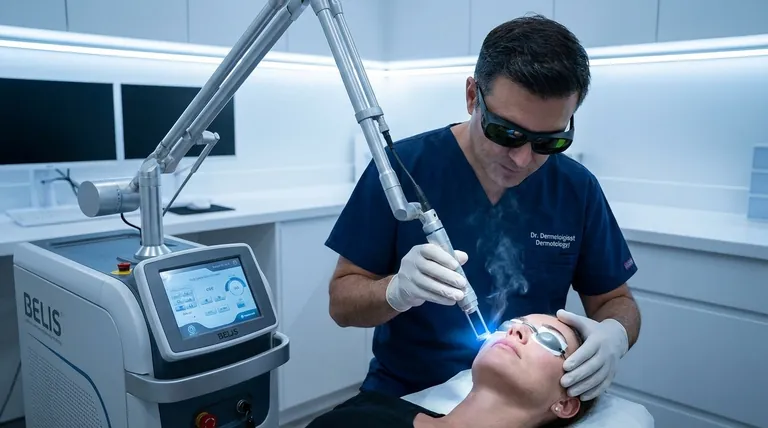
The Allure of a Simple Number
We are psychologically drawn to simple, powerful numbers. "Lose 10 pounds." "Double your investment." "Look 10 years younger."
This last promise, often associated with CO2 laser treatments, is particularly compelling. The idea of erasing a decade of wrinkles, sun damage, and gravity's pull is a powerful motivator. A 55-year-old patient emerging from recovery looking closer to 45 is not a fantasy; it's a documented outcome of advanced aesthetic medicine.
But a single number, however appealing, hides the elegant complexity of the process. The "10-year" result isn't a button you press; it's the peak outcome on a spectrum of possibilities, governed by a clear and predictable equation of physics, biology, and personal choice.
The Clinical Equation: Intensity is the Master Variable
The degree of rejuvenation is not a matter of chance. It is a calculated result based on several key inputs, with one variable holding more weight than all others combined.
Intensity: The Ablative vs. Fractional Dial
The single most critical factor is the laser's intensity. This is the primary dial the practitioner turns to control the outcome.
-
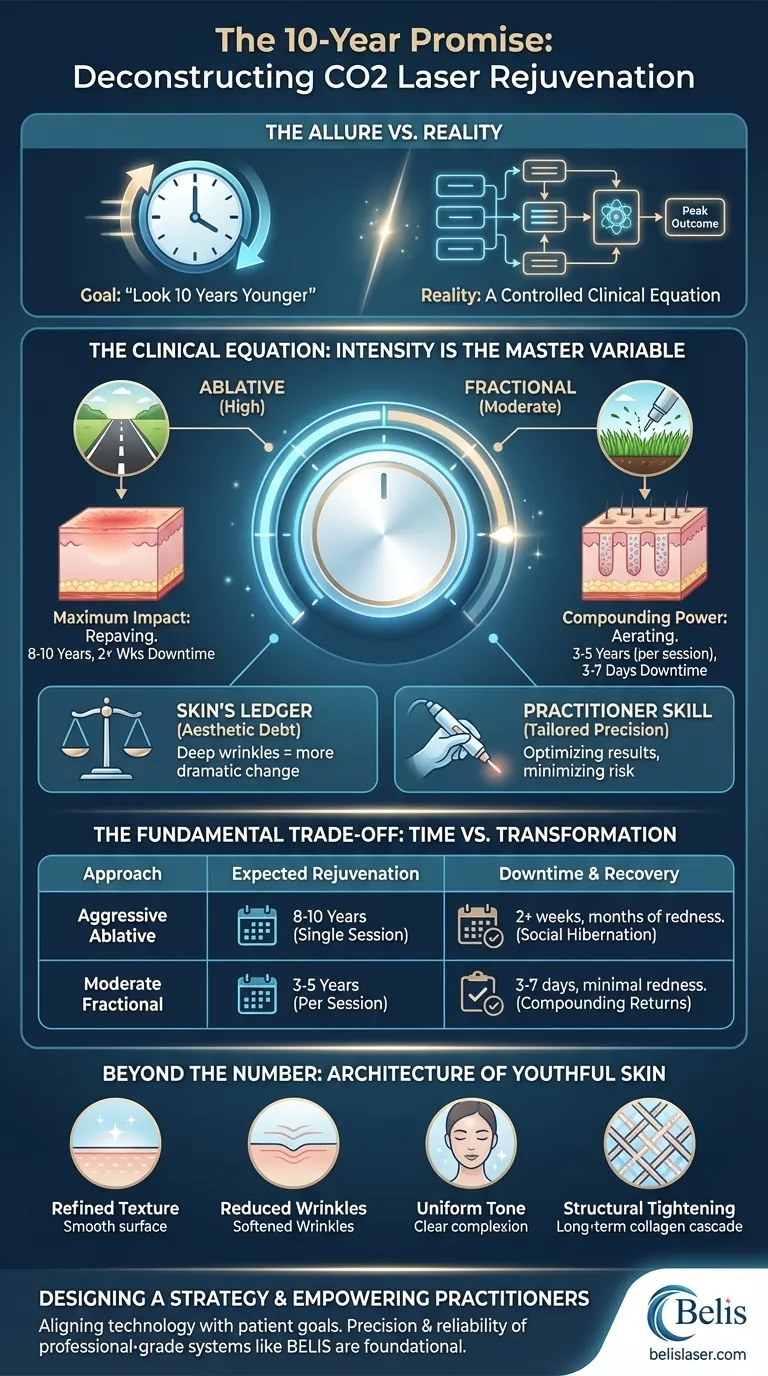
Fully Ablative Treatment: This is the high-intensity path to the "10-year" result. The laser vaporizes the entire outer layer of skin (epidermis), creating a controlled, uniform wound that forces a profound healing and collagen-rebuilding response. It's like repaving an entire road surface.
-
Fractional Treatment: This is a more moderate, nuanced approach. The laser creates microscopic columns of ablation in the skin, leaving the surrounding tissue untouched. This creates thousands of tiny healing centers, stimulating collagen with far less risk and downtime. It's more like aerating a lawn to stimulate new, healthy growth from within.
The Starting Point: Your Skin's Ledger
The potential for dramatic change is relative. A person with deep-set wrinkles and significant photodamage has a larger "aesthetic debt" to pay down. For them, the visual improvement will be far more pronounced than for someone with only fine lines and mild texture issues.
The Practitioner: The Operator's Skill
A CO2 laser is a powerful instrument. In the hands of a skilled dermatologist or surgeon, its energy can be precisely tailored to depth and density, optimizing results for a specific skin type and minimizing risks. In the wrong hands, it is simply a tool for creating damage.
The Fundamental Trade-Off: Time vs. Transformation
Every patient considering a CO2 laser treatment faces a fundamental economic choice—not of money, but of lifestyle. The decision is a direct trade-off between the result you want and the recovery you are willing to endure.
| Treatment Approach | Expected Rejuvenation | Downtime & Recovery | Ideal Candidate |
|---|---|---|---|
| Aggressive Ablative | 8-10 Years (Single Session) | 2+ weeks of social downtime, months of residual redness. | Seeks maximum transformation and can commit to recovery. |
| Moderate Fractional | 3-5 Years (Per Session) | 3-7 days of social downtime, minimal lasting redness. | Seeks significant, compounding results with less disruption. |
Path 1: Maximum Impact, Maximum Commitment
Choosing a fully ablative treatment is a decision to prioritize a singular, dramatic transformation. It requires a commitment to a period of "social hibernation" as the skin heals. The reward is the most profound rejuvenation possible from a single procedure.
Path 2: The Compounding Power of Gradualism
Choosing a series of fractional treatments is a different strategy. It's an investment in compounding returns. Each session builds upon the last, achieving a powerful cumulative effect over time, but with recovery periods measured in days, not weeks. It's the path for those who want exceptional results without pressing pause on their life.
Beyond the Number: The Architecture of Youthful Skin
Focusing solely on the "years" metric overlooks the true goal: rebuilding the qualitative signs of youth. The laser doesn't just make you look younger; it triggers biological processes to make your skin behave like younger skin.
- Refined Texture: The resurfacing process replaces a rough, weathered canvas with a smooth, light-reflective surface.
- Reduced Wrinkles: The ablation erases fine lines and dramatically softens the deep creases etched by years of expression.
- Uniform Tone: Layers of sun-damaged cells are removed, clearing away age spots and hyperpigmentation for a clean, even complexion.
- Structural Tightening: Most importantly, the thermal energy stimulates a massive, long-term collagen production cascade. This new collagen matrix is what firms, lifts, and tightens the skin from within for months after the procedure.
Ultimately, achieving a successful outcome is about designing a strategy. It requires aligning the right technology with a patient's specific goals, skin condition, and tolerance for recovery. For clinics and salons dedicated to providing this level of strategic, personalized care, choosing the right equipment is the foundational first step. The precision and reliability of professional-grade systems like those from BELIS empower practitioners to confidently control the variables and deliver the exact outcome their patients desire.
Visual Guide
Related Products
- Fractional CO2 Laser Machine for Skin Treatment
- Fractional CO2 Laser Machine for Skin Treatment
- Cryolipolysis Fat Freezing Cavitation Lipo Laser Machine
- Cryolipolysis Fat Freezing Machine Cavitation Lipo Laser Machine
Related Articles
- Beyond the Beam: A Clinician's Guide to the CO2 Laser Recovery Arc
- The Anatomy of Downtime: Engineering Predictable Recovery in CO2 Laser Treatments
- The Paradox of Healing: Why CO2 Laser Downtime Is the Feature, Not the Bug
- Controlled Chaos: How CO2 Lasers Harness Biology for Skin Renewal
- How Alexandrite Lasers Revolutionize Trilaser Hair Removal for Fine Hair & Large Areas



