The Second Half of the Procedure
A CO2 laser procedure doesn't end when the beam switches off. In reality, that's only the halfway point. The true artistry and clinical success are determined in the days and weeks that follow—a period we can call the recovery arc.
This arc is a predictable, multi-stage journey of physiological healing. But more importantly, it's a delicate psychological experience for the patient. Mastering this post-ablative landscape is what separates a good result from a great one, and a satisfied patient from a clinic advocate.
The Engineered Response: The First 48 Hours
The moment the treatment is complete, the body initiates a cascade of events. The intense redness, swelling, and sunburn-like sensation aren't side effects; they are the intended and immediate signs of a successful procedure.
From Inflammation to Regeneration
The laser creates a precise, controlled thermal injury. The subsequent erythema and edema are evidence of the body's inflammatory response rushing growth factors and restorative cells to the site. This is the engineered foundation for new collagen.
For the patient, this phase is the most uncomfortable. Psychologically, it can be alarming. The clinician's role here is to frame this intense response not as a complication, but as Phase One of the rejuvenation blueprint. Clear communication, setting expectations, and providing robust cooling and soothing protocols are paramount.
Deconstruction and Renewal: The Peeling Phase (Days 3-7)
After the initial inflammatory peak, the skin enters a state of profound transition. It becomes dry, tight, and bronzed as the ablated epidermal layers prepare to shed.
The Psychology of Impatience
This is the most critical juncture for patient compliance. As the skin begins to flake and peel, a powerful psychological impulse arises: the desire to "help" the process along. Picking, rubbing, or scrubbing at the skin is a direct response to this impatience.
However, this is precisely the action that can lead to scarring, infection, and post-inflammatory hyperpigmentation (PIH). The clinician's duty is to tirelessly reinforce the "hands-off" protocol. The peeling isn't a flaw to be removed; it's a protective, biological bandage that must be allowed to fall away on its own schedule.
The Remodeling Blueprint: The Pink Phase (Weeks 2-12)
As the old skin sheds, a new, smooth, but distinctly pink epidermis is revealed. This "Pink Phase" is often the longest part of the recovery arc and a common source of patient anxiety.
Visible Healing, Invisible Work
The persistent pinkness is not a sign of damage. It is the visible signature of neovascularization—a rich new blood supply feeding the dermal-epidermal junction as fibroblasts work deep below the surface, synthesizing Type I and Type III collagen. This is the remodeling engine at work.
The Non-Negotiable Protocol
During this phase, the new skin is exquisitely vulnerable. It lacks its mature protective barrier and has no melanocytic defense. Sun exposure isn't just a risk; it's a direct threat to the entire investment.
Strict, unwavering adherence to a broad-spectrum SPF 30+ sunscreen is not optional—it is an inseparable part of the treatment protocol itself. Failure here can quickly lead to PIH, erasing the benefits of the procedure.
The Equipment-Outcome Chain
A predictable recovery arc is born from a predictable procedure. The patient's trust in the process is a direct reflection of the clinician's confidence in their tools. This is the link between technology and trust.
A superior clinical outcome depends on:
- Precise Energy Delivery: Creating a uniform, controlled injury without unexpected hotspots or energy drop-offs.
- Consistent Performance: Ensuring the 1000th pulse is identical to the first, across every patient.
- Clinical Reliability: Minimizing technical variables so the practitioner can focus entirely on technique and patient care.
Professional-grade equipment is the bedrock of this predictability. BELIS provides advanced CO2 laser systems engineered for this very purpose—to deliver consistent, reliable energy that creates a predictable physiological response. When you can trust the beam, you can better manage the entire recovery arc, ensuring the patient's journey from inflammation to rejuvenation is smooth and successful.
Summary of the Recovery Arc
| Stage | Timeframe | Key Physiological Characteristics | Key Psychological Management |
|---|---|---|---|
| Immediate Aftermath | First 48 Hours | Intense erythema, edema, heat sensation, serous fluid oozing. | Reassurance. Frame discomfort as a sign of efficacy. |
| Peeling Phase | Days 3-7 | Desiccation, crusting, significant peeling, new pink skin revealed. | Strict reinforcement of "no picking" rule. Manage impatience. |
| Pink Phase | Week 2 to Month 3 | Persistent pinkness/redness, extreme photosensitivity. | Education on remodeling. Mandate non-negotiable sun protection. |
Ensuring every stage of this recovery arc is managed perfectly begins with the right foundation—the equipment itself. To build that foundation of trust and efficacy in your practice, Contact Our Experts.
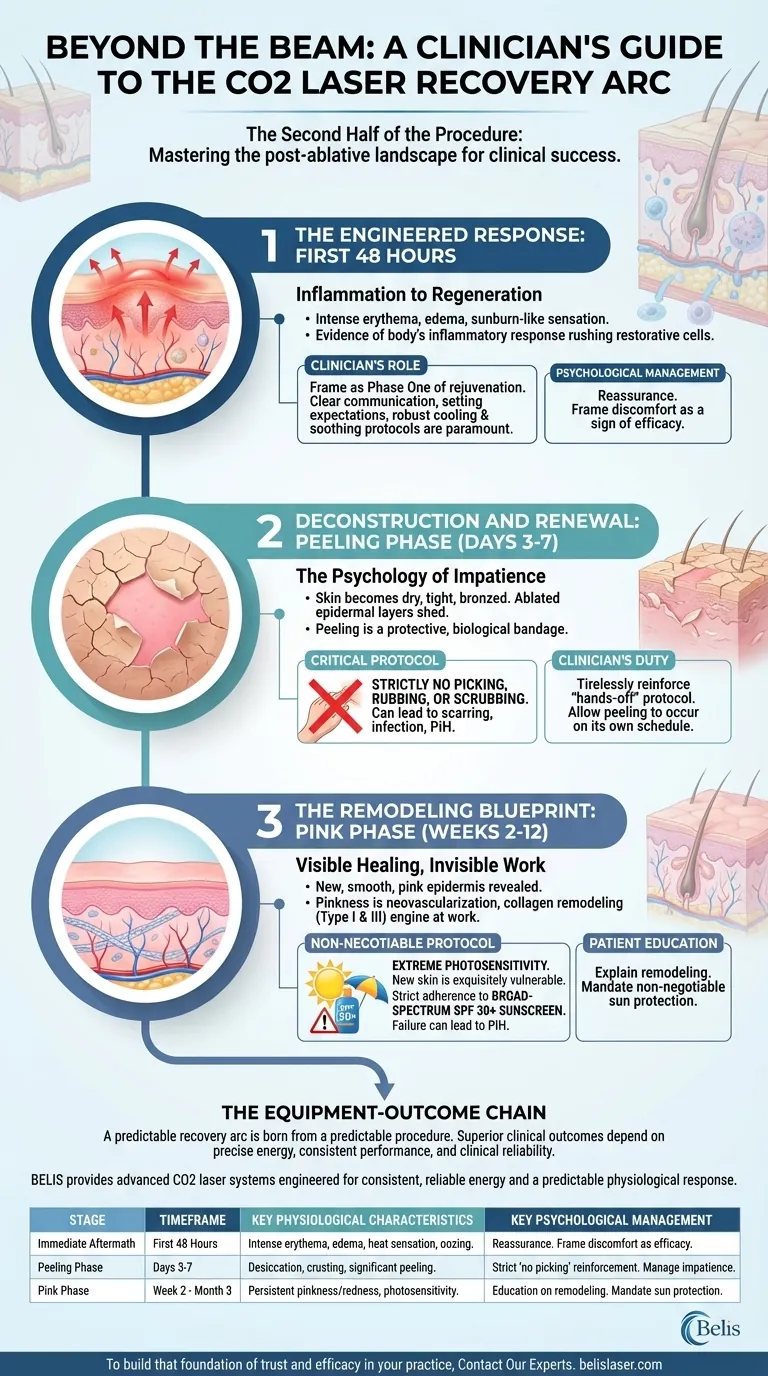
Visual Guide
Related Products
- Fractional CO2 Laser Machine for Skin Treatment
- Fractional CO2 Laser Machine for Skin Treatment
- Cryolipolysis Fat Freezing Cavitation Lipo Laser Machine
- Cryolipolysis Fat Freezing Machine Cavitation Lipo Laser Machine
Related Articles
- The Anatomy of Downtime: Engineering Predictable Recovery in CO2 Laser Treatments
- The 10-Year Promise: Deconstructing the Physics and Psychology of CO2 Laser Rejuvenation
- The Paradox of Healing: Why CO2 Laser Downtime Is the Feature, Not the Bug
- Controlled Chaos: How CO2 Lasers Harness Biology for Skin Renewal
- How Alexandrite Lasers Revolutionize Trilaser Hair Removal for Fine Hair & Large Areas



