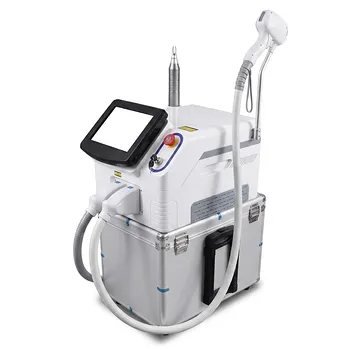
The combination is more effective because it treats different problems at different depths. A 532 nm laser primarily addresses superficial pigmentation, redness, and small vessels, while a 1064 nm Nd:YAG laser reaches deeper dermal tissue to stimulate collagen and elastin remodeling. Used in a coordinated protocol, the two wavelengths can improve skin tone and vascular irregularities while also treating laxity, texture, and wrinkles—benefits that a single wavelength cannot provide as comprehensively.
Core takeaway: 532 nm treatment improves the skin’s visible surface concerns, while 1064 nm treatment addresses deeper structural aging. Their complementary depth and chromophore targeting create broader rejuvenation than monotherapy, although outcomes still depend on appropriate laser parameters and patient selection.
Why One Wavelength Cannot Address Every Aging Concern
Photoaging occurs at multiple levels
Skin aging is not a single-layer problem. Pigmentation and superficial redness may be visible near the epidermis and dermal papillae, while collagen loss, elastin disruption, and laxity occur deeper in the dermis.
A monotherapy can be effective for its preferred targets, but it may leave other contributors to photoaging untreated.
Different wavelengths interact with different targets
Laser effectiveness depends on how deeply the wavelength penetrates and which chromophores absorb its energy. The two wavelengths therefore provide complementary rather than redundant treatment.
This is the central advantage of combining them: the protocol expands the range of treatable structures without relying on one wavelength to solve every problem.
What the 532 nm Laser Contributes
It targets superficial pigmentation
The 532 nm wavelength is strongly absorbed by melanin, making it useful for superficial epidermal pigmentation and dyschromia. Treating these targets can produce a more even and brighter-looking complexion.
Its superficial action is particularly relevant when uneven tone is a prominent part of the patient’s photoaging pattern.
It addresses superficial vascularity
The wavelength is also absorbed by oxyhemoglobin, allowing it to target superficial microvessels, redness, and small telangiectatic vessels. This can reduce visible vascular irregularity and diffuse erythema.
The result is primarily an improvement in surface color and visible tone, rather than deep tightening.
It can contribute to superficial remodeling
Beyond pigment and vascular targets, 532 nm treatment can contribute to dermal remodeling. However, its principal clinical value in this combination is its ability to address superficial color-related concerns that are not the primary focus of a deeply penetrating 1064 nm treatment.
What the 1064 nm Nd:YAG Laser Contributes
It reaches deeper dermal structures
The 1064 nm wavelength generally penetrates more deeply into the dermis than 532 nm. This makes it better suited to addressing deeper vascular structures and the reticular dermis.
It therefore complements the superficial action of 532 nm rather than duplicating it.
It stimulates structural remodeling
Energy delivered in the deeper dermis can promote fibroblast activity and remodeling of extracellular matrix components, including collagen and elastin. Over time, this process can improve skin firmness, texture, and fine lines.
The deeper treatment is consequently associated with the structural side of rejuvenation, including laxity and rhytids.
It broadens vascular treatment
Because 1064 nm can reach deeper vascular structures, it may address vascular components that are beyond the effective depth of a superficial 532 nm treatment. This creates a more complete approach to redness when superficial and deeper vessels coexist.
Why the Combination Produces Broader Results
It treats color and structure together
The 532 nm wavelength focuses on superficial dyschromia and vascular redness, while 1064 nm focuses on deeper dermal remodeling. Combining them addresses both the visible “finish” of the skin and the underlying structural changes.
This is why combined treatment can improve tone, texture, tightness, pores, fine lines, and dyschromia more comprehensively than either wavelength alone.
It creates multi-depth treatment
The wavelengths reach different anatomical levels: 532 nm primarily treats superficial structures, and 1064 nm extends treatment into deeper dermal tissue. The clinician can therefore build a treatment strategy around the patient’s full pattern of photoaging.
The approach is better understood as complementary targeting at multiple depths, not simply as applying more laser energy.
It may enhance dermal remodeling
Clinical evaluations and tissue analyses described in the references report greater collagen and elastin accumulation with combined treatment than with single-wavelength treatment. In some evaluations, the increase was reported as more than double that observed with monotherapy.
That finding supports the concept of a synergistic remodeling response, although it should not be interpreted as a guaranteed result for every patient or protocol.
Why Sequential Treatment Can Be More Practical Than Monotherapy
It allows each wavelength to perform its intended role
A protocol may use 532 nm for superficial pigment and vascular targets, followed by 1064 nm for deeper dermal remodeling. This sequencing allows clinicians to match each wavelength to the structure it is best equipped to treat.
The exact order, settings, and whether both wavelengths are used in one session must be determined clinically.
It addresses mixed presentations
Many patients have several concerns at once: uneven pigmentation, diffuse redness, enlarged pores, fine lines, and early laxity. A single wavelength may improve one or two of these features but produce limited change in the others.
Dual-wavelength treatment is therefore especially useful when the treatment goal is overall photorejuvenation rather than correction of one isolated lesion.
Understanding the Trade-offs
More comprehensive treatment requires more careful planning
Using two wavelengths increases the need for appropriate assessment of skin type, pigmentation, vascularity, treatment depth, pulse parameters, and cumulative thermal exposure. The combination is not automatically superior if the settings are poorly selected.
A technically appropriate single-wavelength treatment may be preferable when the patient has one clearly defined target.
Pigment risk must be considered
Because 532 nm is strongly absorbed by melanin, treatment must be selected and configured carefully in patients with greater epidermal melanin or a tendency toward post-inflammatory pigmentary change. Treating the wrong target or using excessive energy can compromise the epidermal barrier or worsen dyschromia.
Patient selection and conservative parameter adjustment are therefore essential.
Clinical improvement is not identical to permanent correction
Combined laser treatment can improve the appearance and structure of photoaged skin, but it does not eliminate the biological processes that cause aging. Maintenance, photoprotection, and management of the patient’s broader skin condition remain important.
Results depend on more than wavelength
Spot size, fluence, pulse duration, cooling, treatment density, repetition, and operator technique all influence outcomes. The phrase “532 nm plus 1064 nm” describes a treatment strategy, not a universally fixed protocol.
How to Apply This to the Treatment Goal
The appropriate choice depends on whether the primary problem is superficial, deep, or mixed.
- If your primary focus is pigmentation and superficial redness: Emphasize the 532 nm component because it is better matched to melanin, oxyhemoglobin, superficial dyschromia, and small superficial vessels.
- If your primary focus is laxity, texture, and fine lines: Emphasize the deeper remodeling role of the 1064 nm Nd:YAG wavelength, which reaches the reticular dermis and supports collagen and elastin remodeling.
- If your primary focus is comprehensive photorejuvenation: Consider a coordinated dual-wavelength protocol to address superficial color irregularities and deeper structural aging in the same treatment plan.
- If your primary focus is safety and predictability: Prioritize individualized assessment and parameter selection rather than assuming that combining wavelengths is appropriate for every patient.
The strongest rationale for combining 532 nm and 1064 nm Nd:YAG lasers is that they treat the skin’s visible surface and deeper architecture as two connected but distinct rejuvenation targets.
Summary Table:
| Aspect | 532 nm Laser | 1064 nm Nd:YAG Laser | Combined Effect |
|---|---|---|---|
| Primary Target | Superficial pigmentation, redness, small vessels | Deep dermal structures, collagen & elastin | Comprehensive treatment of surface and deep concerns |
| Depth | Superficial (epidermis to papillary dermis) | Deep (reticular dermis) | Multi-depth treatment of photoaging |
| Clinical Benefits | Improves tone, reduces dyschromia and superficial vascularity | Stimulates collagen/elastin remodeling, improves texture and laxity | Enhanced overall skin rejuvenation, tone, texture, and tightness |
| Chromophore Absorption | Melanin and oxyhemoglobin | Water and deeper vascular structures | Complementary absorption profiles |
| Role in Combination | Addresses visible surface color irregularities | Addresses underlying structural aging | Synergistic remodeling, potentially more than double collagen increase |
Elevate your clinic's skin rejuvenation offerings with BELIS's advanced dual-wavelength laser systems. Our professional-grade Nd:YAG lasers combine 532nm and 1064nm wavelengths to deliver comprehensive, multi-depth treatments for your patients, enhancing results and patient satisfaction. Partner with BELIS for cutting-edge technology, comprehensive training, and reliable support. Contact us today to learn how our solutions can expand your practice and boost your revenue. Get in touch with our experts!
Related Products
- Tri Laser Diode Hair Removal Machine Professional Beauty Equipment
- 808nm Diode Laser Hair Removal Machine 755+808+1064nm Mixed Wavelength Professional Equipment
- Clinic Use IPL SHR ND YAG Laser Hair Removal RF Skin Tightening Machine
- Q Switch Nd Yag Laser Machine Tattoo Removal Nd Yag Machine
- Clinic Use IPL and SHR Hair Removal Machine with Nd Yag Laser Tattoo Removal
People Also Ask
- How can aesthetic practitioners prevent side effects like paradoxical hair regrowth and thermal burns when performing diode laser hair removal on dark skin? Master safe protocols for Fitzpatrick IV–VI skin.
- How do demographic trends in non-surgical procedures like laser hair removal compare to surgical aesthetics, and how should clinics leverage professional diode laser hair removal equipment to meet this demand?
- Why is monitoring the revenue rate per hour per physician essential when deciding to invest in high-throughput aesthetic technology like diode hair removal lasers or multi-applicator body sculpting machines? Optimize your practice's profitability
- What are the primary differences in mechanism and pigment dependency between standard laser hair removal devices (Alexandrite, Diode, Nd:YAG) and photosensitizer-assisted light therapies? Discover expert insights and tailored solutions
- Why is the Anagen phase the primary target for laser hair removal machines? Unlock the science for optimal results