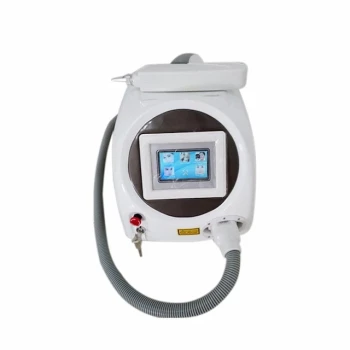
Q-switched laser treatments cause tissue splattering because nanosecond pulses deliver extremely high peak power to pigment faster than the surrounding tissue can dissipate the energy. The pigment and nearby water-containing tissue undergo rapid photothermal expansion, creating photoacoustic shockwaves. These shockwaves can eject microscopic epidermal fragments, blood droplets, and aerosolized cellular material from the treatment site.
Tissue splattering is a predictable photomechanical effect, not evidence that the procedure is necessarily being performed incorrectly. Safety depends on controlling fluence, containing debris, protecting the eyes and airway, and positioning the handpiece according to the device manufacturer’s instructions.
Why Q-Switched Lasers Produce Splatter
Nanosecond pulses create high peak power
Q-switched systems release energy in pulses lasting only nanoseconds. Because the energy is delivered so quickly, pigment particles heat and expand before the surrounding tissue can accommodate the pressure.
This produces a photoacoustic or photomechanical effect that fractures tattoo ink into smaller particles. The same pressure wave can disrupt superficial vessels and eject epidermal debris.
Pigment location affects the reaction
Tattoo ink is distributed through the dermis, while the epidermis forms the surface barrier. When the shockwave reaches the surface, it may create visible frosting, pinpoint bleeding, or small amounts of blood and tissue splatter.
The degree of splatter varies with pigment color, ink depth, fluence, spot size, pulse duration, skin characteristics, and the number of passes.
Splatter is different from smoke
Laser-generated airborne material may include vapor, smoke, microscopic tissue fragments, viable blood components, and pigment-containing debris. A smoke evacuator is useful for airborne plume control, but it does not replace a physical barrier for larger droplets or surface splatter.
These hazards should therefore be managed as both an aerosol-control problem and a blood-and-tissue contamination problem.
Protocols That Control Tissue Splatter
Use a manufacturer-approved containment device
A dedicated transparent cone, nozzle, or splatter shield attached to the handpiece can help contain debris and protect the handpiece lens. The device must be compatible with the specific laser and approved for the intended wavelength and treatment mode.
A generic cover should not be substituted if it changes the beam path, focal distance, or optical transmission.
Consider a transparent dressing or gel interface
A transparent water-based gel dressing or hydrogel pad may reduce splatter and provide a physical barrier between the treatment site and the operator. It can also provide limited surface cooling or act as a heat sink.
However, transmission, energy loss, sterility, and optical distortion vary by product. Use only a material validated for the laser system, and account for any documented reduction in delivered energy.
Apply universal precautions
Operators and staff should use appropriate fluid-resistant gloves, masks, and eye or face protection when blood or tissue aerosolization is possible. The treatment area and contaminated surfaces should be managed under the clinic’s infection-control protocol.
A high-efficiency smoke evacuator positioned close to the treatment zone can reduce airborne plume exposure. It should be used with suitable filtration and maintained according to the manufacturer’s instructions.
Remove potentially flammable residues
Makeup, sunscreen, topical products, alcohol residue, and other contaminants should be completely removed before firing the laser. Some products contain materials that can heat, ignite, or produce irritating fumes when exposed to high peak power.
The skin should be dry, clean, and free of loose materials in the beam path.
Use the minimum effective fluence
Fluence should be selected according to the device’s clinical protocol and adjusted to the intended endpoint, such as appropriate pigment frosting, rather than increased simply to produce a more dramatic reaction.
Excessive fluence can increase bleeding, epidermal injury, pigmentary change, scarring risk, and splatter without improving the clinical result.
Correct Handpiece Positioning
Keep the beam perpendicular to the skin
The handpiece should generally be held perpendicular to the treatment surface so the beam strikes the target evenly and the intended spot size and fluence are maintained.
Tilting the handpiece can create an oblique beam, alter the effective spot geometry, reduce treatment consistency, and increase the risk of unintended reflection.
Use the supplied distance guide
When the handpiece includes a physical distance guide or focusing cone, the guide should be used as specified by the manufacturer. It establishes the intended focal distance and helps maintain a stable treatment plane.
The cone should be clean, intact, and positioned correctly. Direct contact with the skin is appropriate only when the device’s instructions specifically require or permit it.
Do not rely on sound alone to establish focus
Some systems produce a characteristic popping sound near the intended treatment endpoint or focal plane. That sound may be useful as an operator cue, but it is not a universal or sufficient focusing standard.
For handpieces without a physical spacer, focusing should follow the manufacturer’s documented method, which may involve a calibrated working distance, aiming beam, focusing indicator, or validated clinical endpoint. Operators should not deliberately vary probe height solely to chase an acoustic sound.
Maintain consistent working distance
The operator should keep the same handpiece height and perpendicular orientation throughout each treatment area. Changes in distance can alter beam divergence, spot size, fluence, and the amount of energy reaching the pigment.
Any adjustment should be made using the system’s calibrated controls or written operating instructions.
Eye and Room Safety
Provide wavelength-specific eye protection
The patient, operator, and every person in the controlled treatment room must use protective eyewear rated for the laser’s wavelength and operating parameters.
Ordinary safety glasses or eyewear intended for a different wavelength are not adequate. The eyewear must have the optical density specified by the laser manufacturer and applicable safety standards.
Control reflections and access
Reflective instruments, jewelry, mirrors, and unnecessary equipment should be removed from the beam area. The treatment room should have controlled access and appropriate laser warning signage.
The patient should be positioned so that unintended beam reflections cannot reach the eyes, and staff should avoid placing themselves in the direct or reflected beam path.
Manage fire and electrical hazards
Flammable gauze, hair products, alcohol-based disinfectant residue, oxygen delivery lines, and other combustible materials must be kept away from the beam path.
Q-switched lasers also use high-voltage electrical systems. Equipment, cables, and surrounding surfaces should be kept dry, inspected, and serviced according to the manufacturer’s maintenance requirements.
Understanding the Trade-offs
Barriers can affect delivered energy
A hydrogel, hydrocolloid, or transparent dressing may reduce splatter, but it can also alter reflection, transmission, focusing, or delivered fluence. The approximate energy loss cannot be assumed to be the same across products or laser wavelengths.
The material must therefore be validated for the specific device rather than adopted as a universal accessory.
More energy is not automatically better
Increasing fluence may intensify frosting or splatter, but it can also increase tissue injury and delayed pigmentary complications. Treatment should be guided by an appropriate clinical endpoint and the patient’s skin and tattoo characteristics.
Transient hypopigmentation can occur after treatment, particularly when normal epidermal melanin is affected. Patients should receive realistic counseling about expected recovery and possible complications.
Anesthetic products require their own controls
Topical anesthetics may reduce discomfort, but they must be used according to their labeling and clinical protocol. Residual creams, occlusive products, or flammable solvents should be removed before laser exposure.
Analgesia should never obscure the need to monitor treatment endpoints or recognize excessive tissue injury.
Accessory use must be device-specific
A cone, dressing, gel, or nozzle that is suitable for one laser may be unsuitable for another. Optical components can change the focal plane or beam profile, while nonsterile materials can introduce contamination.
The laser’s instructions for use and the clinic’s validated standard operating procedure take precedence over generic technique descriptions.
How to Apply This Safely
A safe protocol combines optical control, debris containment, infection prevention, and conservative treatment parameters.
- If your primary focus is splatter control: Use a manufacturer-approved cone, nozzle, or validated transparent dressing together with smoke evacuation and fluid-resistant protective equipment.
- If your primary focus is handpiece accuracy: Keep the handpiece perpendicular, maintain the specified working distance, and use the supplied spacer or focusing system whenever available.
- If your primary focus is patient eye safety: Provide wavelength-specific protective eyewear for the patient and everyone in the controlled treatment area.
- If your primary focus is tissue protection: Use the minimum effective fluence and follow the device-specific endpoint rather than increasing energy to produce more visible frosting or popping.
- If your primary focus is infection prevention: Treat splatter as potentially contaminated biological material and follow the clinic’s bloodborne-pathogen, surface-decontamination, and waste-disposal procedures.
The safest Q-switched laser treatment is one that treats the pigment precisely while controlling the predictable mechanical debris generated by the pulse.
Summary Table:
| Risk | Cause | Mitigation |
|---|---|---|
| Tissue splattering | Nanosecond pulses create high peak power leading to photoacoustic shockwaves | Use manufacturer-approved containment devices, transparent dressings, smoke evacuators, and universal precautions |
| Handpiece mispositioning | Oblique beam or incorrect distance alters spot size and fluence | Keep handpiece perpendicular, maintain consistent working distance, use supplied distance guides |
| Ocular injury | Direct or reflected beam exposure | Use wavelength-specific protective eyewear for all in the treatment room; control reflections |
| Fire hazard | Flammable residues and materials near beam path | Remove makeup, alcohol, and flammable items; keep beam area clear |
| Excessive tissue damage | Overly high fluence | Use minimum effective fluence and follow device-specific endpoints |
Ensure patient safety and optimal results with BELIS professional aesthetic laser systems, trusted by clinics and premium salons worldwide. Our advanced Q-switched lasers feature precise calibration and comprehensive safety protocols. Contact us today to elevate your practice – Get in touch with our experts and discuss OEM/ODM solutions tailored to your needs.
Related Products
- Q Switch Nd Yag Laser Machine Tattoo Removal Nd Yag Machine
- Ultrasonic Cavitation Machine Lipo Laser Device
- Cryolipolysis Fat Freezing Cavitation Lipo Laser Machine
People Also Ask
- How does laser fluence influence pigment clearance vs. safety? Balancing Speed and Skin Integrity in Tattoo Removal
- What is the documented effectiveness of Q-switched Nd:YAG lasers for tattoo removal? Gold Standard Results
- How do wavelength selection and parameter guidelines differ when using Q-switched Nd:YAG laser equipment for removing different tattoo colors? Master Tattoo Removal for Every Color
- What pigment compositions and particle properties should practitioners evaluate before operating Q-switched Nd:YAG lasers for tattoo removal? Evaluate pigment composition and particle size for safe, effective tattoo removal.
- How should wavelength and fluence settings be adjusted on Nd:YAG and Q-switched lasers when treating darker skin tones? Optimize Safety & Efficacy